Power supply chains face a new test
Updated 1 hour ago

Gap matters as only 18% of approved subsidised financing reaches borrowers
Ask Pakistan's business community about the economy and relief often outweighs confidence. Memories of punishing inflation and currency instability remain fresh, while global wars, energy shocks and domestic political uncertainty cloud investment decisions. Against this backdrop, the push for affordable housing offers a welcome bright spot: an opportunity to generate employment, revive industry and help families acquire their first meaningful asset.
Housing combines economic opportunity with a basic human need. The State Bank cites an estimated shortage of 10 million homes, concentrated among lower- and middle-income households. At an October planning review, annual demand was estimated at 700,000 units against supply of approximately 250,000. These estimates are imperfect, but the direction is unmistakable: Pakistan continues to add to an already substantial housing deficit. For a working family, home ownership can offer protection from rising rents, greater financial security and an asset to pass to the next generation. Its social value extends to children's stability, privacy and dignity. Affordable housing policy therefore deserves to be judged by how widely it distributes these benefits.
The federal government's Apna Ghar programme provides financing of up to Rs10 million at a fixed customer rate of 5% for the first 10 years with Rs66,000 monthly installment only. The advertised repayment period extends to 30 years, with market-linked pricing after 10 years. Eligible properties include houses up to 10 marla (2,700 square feet) and flats up to 1,500 square feet. This represents meaningful support for households otherwise priced out of mortgage finance.
Demand is encouraging. The programme's dashboard reported approximately 191,900 applications and 75,200 approvals as of October 9. An earlier October review reported Rs426 billion in approvals and Rs76 billion in disbursements, alongside a Rs700 billion financing target covering 125,000 homes. The gap matters: only about 18% of the approved amount had reached borrowers. Converting approvals into completed transactions is now the critical delivery challenge.
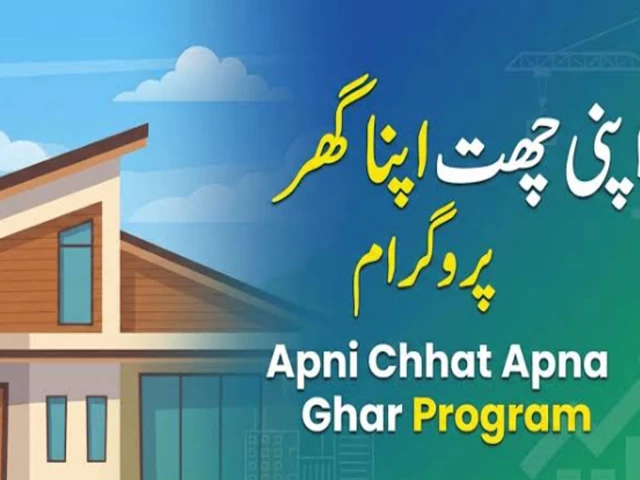
Punjab offers a complementary approach through Apni Chhat Apna Ghar. Its construction loan component provides up to Rs1.5 million interest-free, with the provincial government requiring repayment over nine years at approximately Rs14,000 monthly. It serves eligible owners of small plots – up to five marla in urban areas and 10 marla in rural areas – who need financing to build. This can reach households requiring a modest construction loan, although families without land still need a separate solution.
The economic benefits extend well beyond property transactions. The Pakistan Economic Survey 2025-26 estimated construction's direct contribution at 2.35% of GDP, with growth of 5.73%. Large-scale manufacturing, separately accounting for 8.17% of GDP, grew 6.11%. Construction creates demand across several manufacturing industries; their contribution should not be confused with, or mechanically added to, construction's direct share. Some cite 19% YoY growth in construction sector in Q1 of FY27.
Demand travels through the economy in stages: cement, steel and aggregates first; cables, pipes, glass and tiles next; paints, furniture and appliances as homes approach completion. Alongside factories, masons, electricians, plumbers, transporters and small retailers benefit. The finance ministry reported that domestic cement dispatches increased 7-8% during 1QFY27. This indicates improving construction demand, although the increase cannot be attributed entirely to subsidised mortgages.
The fiscal connection is also substantial. FBR recorded approximately Rs108.7 billion in domestic sales tax collection from cement alone in FY2025, excluding its other tax contributions. Higher formal production can expand sales, excise and income tax receipts across the supply chain. However, additional revenues must be weighed against subsidy costs; housing finance should not be assumed to pay for itself automatically. International experience provides useful lessons. India's PMAY-U 2.0 combines construction assistance, affordable rental housing and interest subsidies; eligible borrowers receive a 4% subsidy on the first INR800,000 of their loan, subject to programme limits. Indonesia's FLPP offers subsidised mortgages at 5%, with down payments starting at 1%, and explicitly includes informal-income workers. The lesson is to combine affordable credit with housing supply and inclusive eligibility.
Pakistan's central challenge is access. A salaried employee can produce payslips; a tailor, driver or electrician with comparable earnings may struggle to prove repayment capacity. SBP's August regulations already require banks to use applicable informal-income assessment models and recognise evidence such as rent payments and utility bills. They also permit general mortgage tenors of up to 30 years and a debt burden ceiling of 65%. These broader limits should not be mistaken for automatic scheme eligibility, or comfortable household affordability.
The next phase should therefore prioritise implementation and fairness. Banks should assess verified cash flows, rent payment histories and digital receipts, allow suitable co-borrowers and offer repayment schedules matching irregular earnings. Carefully capped guarantees can support deserving borrowers, while grants, incremental construction and affordable rentals are needed for families unable to sustain a mortgage.
Supply must expand alongside credit. Faster approvals, reliable land titles, serviced plots and affordable apartments near employment centres would help prevent subsidies from being absorbed into higher selling prices. Financing an existing home changes ownership; financing additional construction creates new housing supply and a stronger industrial stimulus.
Borrowers also need transparent legal, valuation and insurance charges, enforceable processing deadlines and effective complaint channels. Affordability assessments should preserve money for food, education and healthcare and explain potential instalment increases after the subsidy expires. Recovery must follow lawful procedures, with restructuring options for genuine hardship. Finally, publish outcomes by income, gender, district and employment type, alongside disbursements, completed homes, defaults and subsidy costs. Any increase in loan limits should follow evidence that lower-income applicants are being served adequately. Perhaps it is time for assisting with the down payments also at a slightly higher mark-up as "Help to Buy" scheme in the UK.
Amid global conflict and economic uncertainty, housing finance is a promising policy success taking shape. Its lasting achievement should be measured in secure homes, productive jobs and broader ownership of wealth. The strongest endorsement will come when workers building Pakistan's homes can afford homes of their own.
The writer is an independent economic analyst







This material may not be published, broadcast, rewritten, redistributed or derived from. Unless otherwise stated, all content is copyrighted © 2026 The Express Tribune.








COMMENTS
Comments are moderated and generally will be posted if they are on-topic and not abusive.
For more information, please see our Comments FAQ