Power supply chains face a new test
Updated 2 hours ago

Informal recyclers already turning waste into economic value yet remain excluded from formal waste-management planning
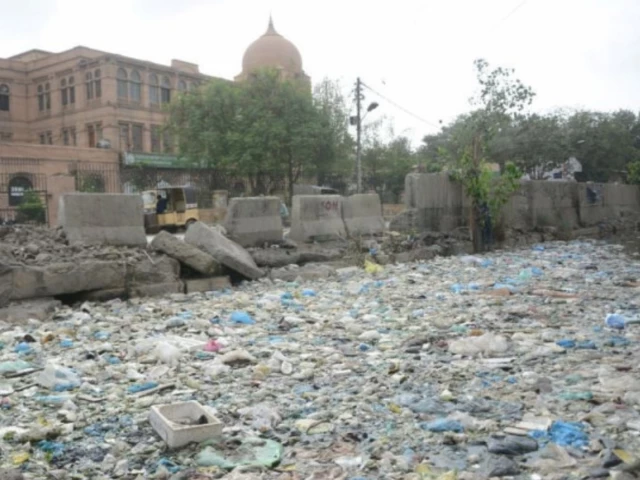
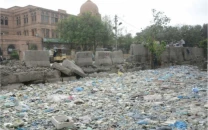
Karachi floods during the monsoon and chokes under summer pollution. Both crises have multiple causes, but waste management connects them in ways the city can no longer afford to ignore.
Cleaner air could add an estimated 2.7 years to the average Karachi resident's life. Industry and transport are the largest contributors, but waste is part of the same crisis. Uncollected garbage accumulates in drains, on vacant plots and at open dumpsites, and when burned adds black carbon and other pollutants to air that met the World Health Organisation's (WHO) daily guideline on only three days in 2024, according to PAQI's 2025 national report.
An official of the Sindh Solid Waste Management Board (SSWMB) said Karachi generates more than 14,800 tonnes of waste daily, including over 3,000 tonnes in District Central alone. Around 42% is organic. Karachi is also reported to account for 25% of Pakistan's recyclable plastic waste. PAQI's 2025 source inventory attributes 7% of Karachi's PM2.5 emissions to open waste burning.
Waste as economic value
A 2014 World Economic Forum report estimated the circular economy at over $1 trillion per year in material savings globally, with recycling in Europe alone already supporting 500,000 jobs. Pakistan imported virgin plastic resin worth $3 billion in 2022, compared with $707 million in tea imports. Better collection and sorting could reduce dependence on some virgin resin imports.
Pakistani businesses are already showing what recovery can look like. Concept Loop converts difficult-to-recycle multilayer plastic packaging into construction products such as pavers, blocks and tiles, turning material that would otherwise clog a drain or burn on a roadside into a product with a market price. The company has received support through Karandaaz's GreenFin Innovations programme and reports that its pavers were used in a Mari Petroleum project at Daharki in Sindh, diverting over 7,000 kg of low-value plastic waste.
The Sindh Enterprise Incubation Centre reports that Concept Loop has recycled over 1,300 tonnes of plastic and produced more than 100,000 square feet of building materials. However, Karachi needs a system to recover recycled waste.
Regulation can shift behaviour when it is enforced consistently. Rwanda banned plastic bags in 2008, one of the first countries in the world to do so, and later expanded the ban to cover single-use plastics. According to the Global Green Growth Institute, enforcement included border inspections to prevent smuggling, strict penalties for violations and government support to help businesses transition to alternatives. Karachi does not need to replicate the ban. It needs what made it work: enforcement, alternatives and businesses brought in from the start.
Organic waste should become a product
Lahore's Mehmood Booti composting project shows that waste recovery and carbon finance are not theoretical possibilities in Pakistan. Lahore Compost Limited began operating there in 2006 under an arrangement with the City District Government, processing municipal waste into compost while pursuing carbon revenue from methane reductions. The proposed carbon finance project also received $5.524 million in World Bank funding. The original operation ran until 2016. It is a historical example, but the lesson applies: composting requires clean organic inputs, a reliable market and sustained management.
The potential of carbon finance is demonstrated by the World Bank's account of the Monterrey Waste Management and Carbon Offset Project in Mexico, which generated and sold more than one million metric tonnes of certified emissions reductions between 2005 and 2017. Carbon revenue should supplement, not replace, reliable funding for basic waste collection and disposal services. Karachi's Bagh Ibne Qasim biogas plant shows what this looks like in practice. The facility converts organic and livestock waste into biogas, with reported processing of around two tonnes of organic waste daily and production capacity of 150 cubic metres of gas. The project was designed to supply subsidised cooking fuel to 70 to 80 households in Clifton at Rs2,000 per month.
Fixing the system: accountability, financing
It was reported in July 2026 that the World Bank had downgraded Karachi's $100 million Solid Waste Emergency and Efficiency Project to "Moderately Unsatisfactory". Delays to four transfer stations, contract management problems and no measurable waste disposed through a sanitary landfill were among the concerns. Investment without functioning management and public accountability does not deliver.
Karachi's informal recyclers are already turning waste into economic value, yet remain excluded from formal waste-management planning. A 2023 study estimated that they recover 4,100 tonnes of waste daily, valuing Karachi's informal recycling economy at Rs1.2 billion annually. Yet workers remain vulnerable, with the Fair Circularity Initiative estimating monthly earnings at around Rs42,500 to Rs43,300, below the Rs60,434 monthly living-wage benchmark calculated using the Anker methodology.
Pune in India offers a practical model through its SWaCH cooperative, which integrates over 3,900 waste pickers, diverts approximately 80,000 tonnes annually and has been associated with estimated municipal transport savings of Rs16 million a year. Karachi can build on its existing recycling economy by giving registered kabariwalas access to sorting facilities, protective equipment, working capital and fair municipal contracts.
Financing waste services through user charges has a record. Worcester in Massachusetts introduced a Pay As You Throw programme in which households pay per bag of waste they discard, reducing volumes and increasing recycling rates. Closer to home, Punjab under the Suthra Punjab programme introduced a sanitation fee ranging from Rs300 per month for smaller urban households to Rs5,000 for the largest properties, collected alongside property tax. A fee without reliable service is a tax with no corresponding benefit. Any comparable charge in Karachi must be tied to published service standards and transparent expenditure.
From waste crisis to circular economy
Karachi's waste is an economic opportunity sitting in plain sight. The city already has businesses converting plastic into products, informal workers recovering materials at scale, and local projects demonstrating the potential of biogas and composting. What is missing is enforcement, accountability and money tied to results. Progress should be measured not by projects inaugurated but by waste recovered, pollution reduced and a formal, transparent system that works.
THE WRITER IS AN ASSISTANT PROFESSOR AT THE SCHOOL OF ECONOMICS AND SOCIAL SCIENCES, IBA. SHE HOLDS A PHD IN ECONOMICS FROM CLARK UNIVERSITY





This material may not be published, broadcast, rewritten, redistributed or derived from. Unless otherwise stated, all content is copyrighted © 2026 The Express Tribune.







COMMENTS
Comments are moderated and generally will be posted if they are on-topic and not abusive.
For more information, please see our Comments FAQ