MQM-P calls for new administrative units to address urban Sindh’s woes
Updated 1 hour ago

Siddiqui says failure to devolve powers has fuelled public discontent in Karachi, Hyderabad and other urban districts
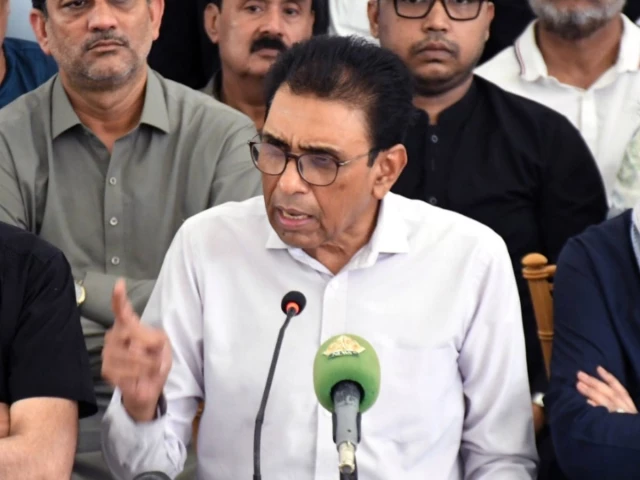
The Muttahida Qaumi Movement-Pakistan (MQM-P) has renewed its call for new administrative units in Sindh, arguing that the devolution of powers and authority is essential to address longstanding civic problems in Karachi, Hyderabad and other urban areas.
“Establishing new and empowered administrative units is the biggest challenge and the solution to ensuring that people receive their rights at their doorstep,” MQM-P Chairman Dr Khalid Maqbool Siddiqui said during a meeting with legal experts at the party’s Bahadurabad headquarters.
The meeting brought together members of the Muttahida Lawyers Forum, the party’s Legal Aid Committee and prominent legal experts to discuss urban Sindh’s civic challenges, constitutional and legal reforms, judicial performance and strategies for securing the release of party activists in detention.
Read: 'The country's system is about to be reset': Naqvi says move will bring improvement in affairs
Senior MQM-P leader Wasim Akhtar and other party leaders attended the meeting, while former judge Qazi Khalid was also present.
Addressing the gathering, Siddiqui said the lack of basic facilities and the failure to devolve powers had fuelled public discontent in Karachi, Hyderabad and other urban districts. He called for a new administrative arrangement to restore balance in governance and ensure that citizens could access their rights and essential services more effectively.
Legal experts briefed the party leadership on what they described as shortcomings in existing laws and regulations that could be exploited to deprive citizens of their rights. They presented legal proposals and draft amendments aimed at addressing procedural and constitutional gaps.
The participants also discussed the need for far-reaching judicial reforms to ensure timely, affordable and transparent justice, particularly for disadvantaged and marginalised communities.
Members of the Legal Aid Committee pledged to expand and strengthen legal assistance for citizens facing difficulties in accessing justice. The meeting also considered legal strategies concerning detained party workers and efforts to secure their release.
At the conclusion of the meeting, MQM-P leaders and legal experts reiterated their commitment to pursuing the party’s demands through political, constitutional and legal means, including advocating new administrative units and reforms to existing laws.
The current debate over new provinces began on July 30, when Interior Minister Mohsin Naqvi called for additional administrative units or provinces as part of a broader overhaul of the country’s governance system. Naqvi argued that meaningful structural reforms were needed to improve governance, deliver justice and create opportunities for young people.
Also Read: Governance system has collapsed: Naqvi
A day later, his proposal appeared to receive support from Inter-Services Public Relations (ISPR) Director General Lt Gen Ahmed Sharif Chaudhry, who said an administrative reset, if required, should be undertaken to ensure good governance
The proposal quickly became politically sensitive in Sindh, where the PPP strongly opposed any move to divide the province. Sindh Chief Minister Murad Ali Shah rejected Naqvi’s assessment that the governance system had collapsed and called the proposal outdated, warning that no bloodshed would be allowed over the creation of new provinces.
The debate widened in August when Muttahida Qaumi Movement–Pakistan (MQM-P) backed the creation of new provinces and called for a national dialogue with political parties. The party argued that Pakistan’s growing population, poor governance and concentration of political power made greater administrative devolution necessary. The move put the party, which is part of the federal coalition but sits in opposition in Sindh, at odds with the PPP’s position on the province.
The PPP, meanwhile, maintained that administrative reform and the division of Sindh were separate questions. Sindh minister Nasir Hussain Shah said the provincial government was willing to discuss measures to improve governance and devolve power, but rejected linking those reforms to the creation of a new province.
The dispute reached the Sindh Assembly at the beginning of September. On September 3, the house unanimously passed a resolution rejecting any proposal to divide Sindh or alter its territorial limits. The resolution described Sindh as a “historic, civilisational and constitutional entity” and declared that “Sindh is one and shall remain one”.
Read More: PTI's Barrister Gohar warns against dividing provinces without broad public consensus
Naqvi, however, showed no sign of backing away. On September 5, he said he would continue to support new provinces regardless of whether he remained in office, arguing that the ultimate decision should belong to the people rather than politicians or governments. He said the public should first be told the “pros and cons” of creating new administrative units before being allowed to decide.
That position has since raised another question over how public opinion could be formally established. A constitutional debate emerged over whether a referendum could be used to gauge support for new provinces. Article 48(6) allows a matter of national importance to be put to a referendum following approval by a joint sitting of Parliament, although a referendum itself would not create a new province; any change to provincial boundaries would still have to follow the constitutional process.
Pakistan Tehreek-e-Insaf Chairman Barrister Gohar Ali Khan warned on September 7 that dividing Sindh or any other province without the consent of its people and representatives would weaken the federation. He called for a commission and extensive deliberations before the issue was taken to parliament.
Defence Minister Khawaja Asif, while accepting that Sindh had the right to take its own position, also said a final decision would have to emerge through consensus. Asif separately suggested that Islamabad could be used as a starting point for any future administrative restructuring, while Prime Minister’s Adviser Rana Sanaullah said the question of new provinces should be taken up at the relevant forums and resolved through consensus among political parties.








This material may not be published, broadcast, rewritten, redistributed or derived from. Unless otherwise stated, all content is copyrighted © 2026 The Express Tribune.

1727268465-0/Untitled-design-(42)1727268465-0-208x130.webp "sisyphus in the land of saviours")



COMMENTS
Comments are moderated and generally will be posted if they are on-topic and not abusive.
For more information, please see our Comments FAQ