PM Shehbaz stresses equal opportunities in education to realize Quaid's vision
Updated 2 hours ago

Dar, Egyptian counterpart discuss upcoming R-4 meeting involving during phone call
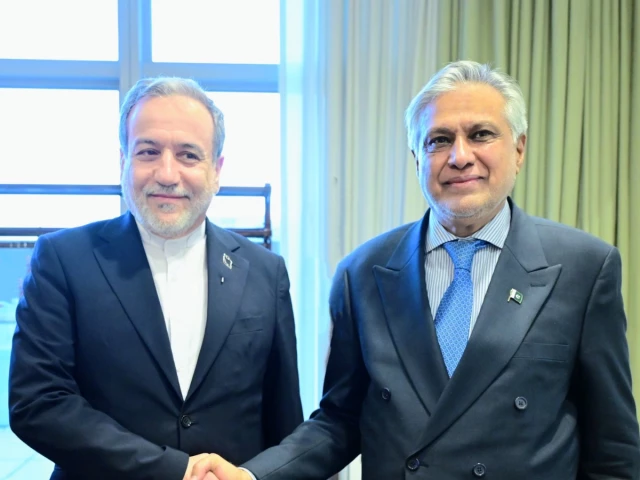
Deputy Prime Minister and Foreign Minister Ishaq Dar on Sunday held a telephone conversation with his Iranian counterpart, Seyyed Abbas Araghchi, to discuss the evolving regional situation and an ongoing meeting of the Organisation of Islamic Cooperation’s (OIC) Council of Foreign Ministers in Baghdad, the FO said.
In a post on X, the FO said the two leaders had discussed “the evolving regional situation” and “the ongoing OIC Council of Foreign Ministers meeting in Baghdad”.
FM Dar “underscored the importance of continued dialogue and diplomacy in addressing regional challenges”, the statement said. The two foreign ministers also “agreed to maintain close contact."
Pakistan and Iran were expected to hold further consultations on regional peace efforts on the sidelines of the Organisation of Islamic Cooperation’s (OIC) Council of Foreign Ministers meeting in Baghdad on October 17–18.
Iranian state news agency IRNA reported that the meeting would provide an opportunity for consultations between key regional players, including Islamabad and Tehran.
Pakistan has continued to advocate a negotiated settlement to the conflict involving Iran and the United States. On October 9, the military’s media wing chief, Lieutenant General Ahmed Sharif Chaudhry, said Pakistan remained committed to a “negotiated and peaceful outcome” and warned against the conflict spreading further across the region.
He said Pakistan had condemned attacks on Iran by the United States and Israel, as well as Iranian attacks on Arab and Gulf countries.
Dar, Egyptian counterpart discuss upcoming R-4 meeting
Earlier today, FM Dar also held a telephone conversation with his Egyptian counterpart, Badr Abdelatty, and strongly condemned the Houthi attacks against Saudi Arabia, reaffirming their full solidarity with the Kingdom and support for its sovereignty, territorial integrity and security.
In a post on X, the FO said the two leaders also discussed the next meeting of the R-4 grouping, comprising Pakistan, Egypt, Turkiye and Saudi Arabia, during a telephone conversation.
“The two leaders exchanged views on recent regional developments," the ministry added. Both looked forward to holding the next R-4 meeting soon to “further strengthen mutual ties and to coordinate on the regional issues."
According to the FO, the R-4 framework brings together Pakistan, Egypt, Türkiye and Saudi Arabia to strengthen ties and coordinate on regional issues.
Pakistan, Saudi Arabia, Türkiye and Egypt held the latest round of high-level consultations in Istanbul late last month, as Islamabad stepped up diplomatic coordination with key regional powers following the signing of a landmark defence agreement between Pakistan, Saudi Arabia and Türkiye.
The four countries have been coordinating under the R-4 framework, which was launched earlier this year to intensify consultations on regional crises, particularly the conflict involving the United States and Iran and broader efforts to promote regional stability. The grouping has held several meetings since March, with its fourth ministerial meeting taking place in Cairo in June.
The attacks by Yemen’s Houthi group on Saudi Arabia escalated in October, with missile and drone strikes targeting King Khalid International Airport in Riyadh and Abha International Airport, killing and injuring civilians and disrupting air traffic.
Saudi authorities reported that at least 12 people were killed and more than 300 injured in a strike on Riyadh’s airport on October 10. Pakistan, Egypt, Saudi Arabia and Türkiye, under the R-4 framework, condemned the attacks and backed the kingdom’s right to take legitimate measures to counter the threat.
Read more: Gaza: Muslim states seek coordination
The foreign ministers of Pakistan, Egypt, Saudi Arabia and Türkiye last met on the sidelines of the 81st session of the United Nations General Assembly in New York on September 22 to discuss regional developments and efforts to promote peace and stability.
During the meeting, the four countries condemned attacks against Saudi Arabia, including recent Houthi attacks, and reaffirmed their support for the kingdom’s sovereignty, territorial integrity and security. They also stressed the importance of dialogue and diplomacy, called for the Islamabad Memorandum of Understanding to be upheld to help secure lasting regional peace and stability, and reiterated support for the Palestinian people’s right to self-determination.
The Istanbul meeting, however, assumes added significance because it will be the first major R-4 engagement since Pakistan, Saudi Arabia and Türkiye signed the Makkah Joint Defence Agreement on August 7.
The agreement commits the three countries to collective defence, with an armed attack against one member to be treated as an attack against all. Pakistan and Türkiye have stressed that the pact is defensive in nature and is not directed against any particular country. The agreement also envisages deeper military coordination, joint exercises and cooperation in defence technology.
Egypt's potential participation had emerged as an important question in the run-up to the Makkah agreement. Turkish officials had indicated that Cairo could eventually join the new defence arrangement, given its military weight and strategic importance in the region. However, Egypt did not become a signatory when Pakistan, Saudi Arabia and Türkiye concluded the pact in Makkah.









This material may not be published, broadcast, rewritten, redistributed or derived from. Unless otherwise stated, all content is copyrighted © 2026 The Express Tribune.

1727268465-0/Untitled-design-(42)1727268465-0-208x130.webp "sisyphus in the land of saviours")


COMMENTS
Comments are moderated and generally will be posted if they are on-topic and not abusive.
For more information, please see our Comments FAQ