Pakistan committed to 'negotiated and peaceful outcome' between US, Iran: DG ISPR
Updated 1 hour ago

Says Pakistan has been 'a very honest broker' and has been clear about its position with all its partners, friends
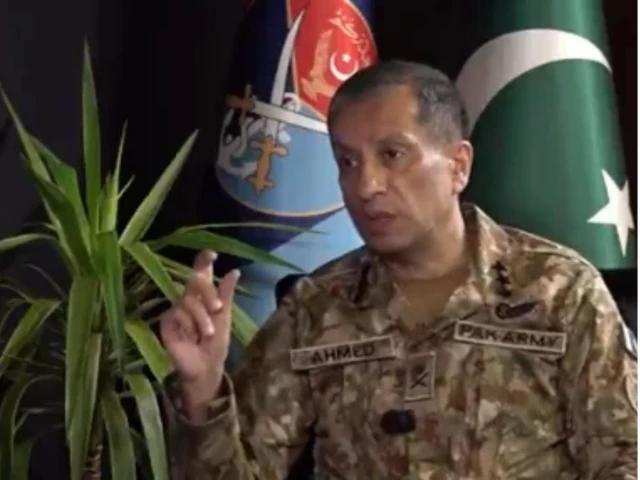
Inter-Services Public Relations (ISPR) Director General Lieutenant General Ahmed Sharif Chaudhry has said that Pakistan would continue to work towards a “negotiated and peaceful outcome” to the conflict between the United States and Iran, stressing that the war should not “expand horizontally or vertically”.
“We want that this conflict should not expand horizontally or vertically,” Chaudhry said in an interview with CNN correspondent Ivan Watson on Wednesday, a clip of which was shared by Pakistan Television on X on Friday.
On August 7, Pakistan, Saudi Arabia and Turkiye formalised their longstanding strategic relationship through the Makkah Joint Defence Agreement (MJDA), a trilateral security framework that its proponents describe as a defensive arrangement aimed at strengthening collective deterrence, enhancing military cooperation and promoting regional stability.
Asked whether Pakistan could continue to act as a neutral broker despite its defence commitments to Saudi Arabia under the Makkah Defence Alliance, Chaudhry said Islamabad had demonstrated its impartiality through its responses to attacks on both Iran and Gulf countries.
“I think what Pakistan has been doing is exhibiting that we have been a very honest broker,” he said, adding that Pakistan had been clear about its position with all its partners and friends.
In an interview with CNN, DG ISPR Lieutenant General Ahmed Sharif Chaudhry says Pakistani troops have been deployed in Saudi Arabia for decades, adding that Pakistan, Saudi Arabia and Türkiye have longstanding diplomatic, political and military relations.@OfficialDGISPR… pic.twitter.com/dVcNT74nbX
— Pakistan TV (@PakTVGlobal) October 9, 2026
He said Pakistan had openly condemned attacks on Iran by Israel and the United States, as well as Iranian attacks on Arab and Gulf countries. “We don't mince our words. Why? Because we have a stake in regional peace and stability,” he said. “We tell all that nobody benefits from expanding this war.”
The military spokesperson's remarks came amid continued regional tensions and questions over how Pakistan would balance its mediation efforts with its defence commitments to Saudi Arabia.
On Pakistan's military presence in Saudi Arabia, Chaudhry confirmed that Pakistani forces were already in the Kingdom, “The Pakistani troops have been there for decades, in multiple capacities have been there for decades in Saudi Arabia,” he said, pointing to the longstanding diplomatic, political and military ties between the three countries.
He said the alliance had not emerged in isolation and was built on sustained relations between the countries. “The Makkah Accord, its actualisation and whatever effects it achieves, that will be purely defensive,” Chaudhry said.
He declined to provide details about how or when forces would be deployed under the agreement, “How that will be done, which component will go there, how it will be employed, that's for the operational commanders to decide,” he said, adding that participating countries did not disclose operational details during a military conflict.
Read: Makkah pact: DG ISPR says Pakistani troops present in Saudi Arabia in 'multiple capabilities'
“The objective of this is not to start labelling enemies and friends,” he said. “The objective is the defence of the Kingdom of Saudi Arabia and their military.” He added that the three countries had significant military, diplomatic and other capabilities, which could discourage potential attacks against any member of the alliance.
In a major development that may have far-reaching implications for the region, Pakistan, Saudi Arabia and Turkiye activated the practical implementation of their collective defence commitments on Monday.
According to a joint statement issued on Monday night, the activation entailed immediate deployment of "the agreed military forces and capabilities to the kingdom in response to security threats".
The decision was taken at an emergency meeting of the Strategic-Political and Defence Committee of the alliance, held in Riyadh to discuss the security developments and threats facing Saudi Arabia.
Saudi Arabia is currently engaged in an active conflict with Houthis, who have been targeting the various strategic and economic assets in the kingdom.
However, the Ministry of Information and Broadcasting on Tuesday had rejected what it described as “speculative” reporting by Reuters on the pact, saying operational details concerning the implementation of the collective deterrence mechanism were confidential.
The ministry’s statement followed a Reuters report published on October 2, which said Pakistan had deployed between 30,000 and 40,000 troops to Saudi Arabia to help defend the kingdom’s land borders and assist with drone and missile interceptions, citing a Pakistani official. Reuters reported that Islamabad had not decided to send troops into Yemen in a fighting capacity.






This material may not be published, broadcast, rewritten, redistributed or derived from. Unless otherwise stated, all content is copyrighted © 2026 The Express Tribune.




COMMENTS
Comments are moderated and generally will be posted if they are on-topic and not abusive.
For more information, please see our Comments FAQ