Aurangzeb says Pakistan’s fiscal deficit falls to 22-year low
Updated 6 hours ago

Finance minister highlights three consecutive primary surpluses, targets growth of 4% or higher this fiscal year
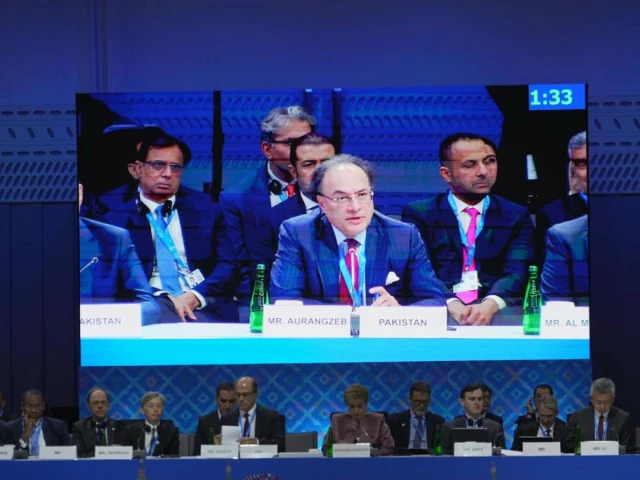
Finance Minister Muhammad Aurangzeb on Wednesday told an International Monetary Fund (IMF) meeting that Pakistan’s fiscal deficit had fallen to a 22-year low, with three consecutive years of primary surpluses and economic growth of 3.7 per cent, according to a statement issued by the Ministry of Finance.
Aurangzeb held a series of meetings with international financial institutions, credit rating agencies, investors and US officials on the sidelines of the World Bank Group-IMF Annual Meetings 2026 in Bangkok, with discussions focused on Pakistan’s economic outlook, financing, trade, energy cooperation and reforms.
Addressing the Middle East, North Africa, Afghanistan and Pakistan (MENAP) meeting on the sidelines of the World Bank Group-IMF Annual Meetings 2026 in Bangkok, Thailand, Aurangzeb also highlighted Pakistan’s foreign exchange reserves, sovereign rating upgrades and progress under the IMF programme.
“He noted historic-high foreign exchange reserves covering three months of imports, and stronger buffers against climate and regional shocks. He cited sovereign rating upgrades, the September Eurobond issuance and the October 7 IMF staff-level agreement as evidence of progress,” the statement read.
The minister reaffirmed commitment "to reforms and targeted, budget-neutral and time-bound subsidies to protect low-income groups and preserve social cohesion." He also called for diversified energy sources and trade routes, deeper regional integration, and investment in logistics and food systems.
“The Finance Minister emphasised renewed commitment to multilateralism and Pakistan's readiness to contribute actively to regional cooperation,” the ministry added.
Finance Minister Highlights Pakistan’s Economic Progress and Reaffirms Commitment to Reforms, Regional Cooperation and Multilateralism at MENAP Meeting
— Ministry of Finance, Government of Pakistan (@Financegovpk) October 14, 2026
Federal Minister for Finance and Revenue, Senator Muhammad Aurangzeb, addressed the Middle East, North Africa, Afghanistan and… pic.twitter.com/d9ILN0kRqj
Discusses energy imports and Reko Diq with US officials
In a separate meeting with Ambassador Yon of the US State Department, Aurangzeb discussed bilateral economic cooperation, including progress towards a trade framework agreement and energy diversification through increased imports from the United States.
“He reviewed progress towards a trade framework agreement and energy diversification through increased imports from the United States. The Finance Minister also outlined measures to maintain fuel supplies and support vulnerable consumers,” the ministry said.
Finance Minister Discusses Trade, Energy Cooperation, Strategic Minerals and Investment with U.S. State Department
— Ministry of Finance, Government of Pakistan (@Financegovpk) October 14, 2026
Federal Minister for Finance and Revenue, Senator Muhammad Aurangzeb, met with Ambassador Yon of the U.S. State Department on the sidelines of the World Bank… pic.twitter.com/ZBCizqKDb0
“Discussions covered AML/CFT arrangements, FATF follow-up and investment financing through the US Development Finance Corporation (DFC) and EXIM Bank. The Finance Minister highlighted Reko Diq, cooperation on critical minerals, project security and opportunities to mobilize private investment,” the statement read.
According to the statement, the meeting also discussed Boeing aircraft acquisition and financing, aviation clearances, digital asset regulation and potential remittances and Eurobond tokenisation applications.
Ambitious to secure double-B sovereign rating
At a separate meeting with S&P Global Ratings, the finance minister discussed Pakistan’s economic progress and sovereign credit outlook, highlighting the "September bond issuance, investor participation and progress under the IMF programme."
"He briefed the agency on improved tax collections, reserve accumulation and reduced swap and forward liabilities,” the statement added.
Finance Minister Highlights Pakistan’s Market Access, Economic Reforms and Sovereign Rating Ambitions in Meeting with S&P Global Ratings
— Ministry of Finance, Government of Pakistan (@Financegovpk) October 14, 2026
Federal Minister for Finance and Revenue, Senator Muhammad Aurangzeb, met with S&P Global Ratings on the sidelines of the World Bank Group–IMF… pic.twitter.com/CxpT6Or5Ro
Aurangzeb reaffirmed commitment to "structural reforms, fiscal discipline and sustainable export-led growth." He also outlined Pakistan’s ambition to enter the double-B rating category through sustained economic improvements.
“Discussions covered agricultural income taxation, energy and food security, targeted relief and climate resilience. The Finance Minister noted S&P’s emphasis on policy continuity, reform implementation, a lower interest burden and stronger external buffers as key rating considerations,” the ministry added.
Discusses post-IMF growth
At Standard Chartered Bank’s Sovereign Investor Roundtable, Aurangzeb briefed investors on Pakistan’s economic progress and financing strategy.
He highlighted three consecutive years of primary surpluses, a fiscal deficit at a 22-year low and sovereign rating upgrades.
"He outlined financing diversification through Sukuk, Panda bonds and a proposed rupee-denominated, dollar-settled international bond, emphasizing lower borrowing costs, longer debt maturities and reduced rollover risks,” the handout read.
Finance Minister Highlights Economic Progress and Financing Strategy at Standard Chartered Sovereign Investor Roundtable
— Ministry of Finance, Government of Pakistan (@Financegovpk) October 14, 2026
Federal Minister for Finance and Revenue, Senator Muhammad Aurangzeb, briefed investors on Pakistan’s economic progress at Standard Chartered Bank’s Sovereign… pic.twitter.com/suJZiLLj1b
The minister stressed, "sustained structural reforms, fiscal discipline, stronger tax enforcement and investment- and export-led growth beyond the IMF programme."
Discussions covered stronger reserves, inflation and the external outlook, energy security, targeted relief and climate financing.
“The Finance Minister reaffirmed the government’s commitment to sustaining reforms and further strengthening Pakistan’s sovereign credit standing,” the ministry added.
Minister sees growth exceeding 4% this fiscal year
In a separate meeting at the Citi Macro Forum held earlier, Aurangzeb briefed international investors on Pakistan’s economic outlook and reform priorities, expressing optimism about growth in the current fiscal year.
According to the ministry's post on X, “The Finance Minister highlighted continued macroeconomic stabilization, three consecutive years of primary surpluses, a fiscal deficit at a 22-year low and strengthened foreign exchange buffers, while expressing optimism about growth reaching or exceeding 4% during the current fiscal year."
Finance Minister Highlights Macroeconomic Stabilization, Capital Market Strategy and Reform Priorities at Citi Macro Forum
— Ministry of Finance, Government of Pakistan (@Financegovpk) October 14, 2026
Federal Minister for Finance and Revenue, Senator Muhammad Aurangzeb, participated in the Citi Macro Forum Session and briefed international investors on… pic.twitter.com/Y0pNkn1y8l
He outlined Pakistan’s capital market strategy, including further Panda bond issuances, Sukuk and a rupee-denominated, dollar-settled international bond, emphasising "diversification of funding sources, lower borrowing costs and longer debt maturities."
"He also discussed progress under the IMF programme, tax-base expansion, stronger enforcement and provincial coordination to sustain fiscal discipline,” the statement read.
The minister, addressing the impact of the Middle East conflict, outlined measures to maintain energy supplies and provide targeted relief to vulnerable groups within existing budgetary allocations. Discussions also covered climate resilience, disaster preparedness, and effective utilization of development financing.
“He reaffirmed Pakistan’s commitment to sustained reforms and a transition from aid towards trade and investment in its partnerships with other countries,” the statement added.









This material may not be published, broadcast, rewritten, redistributed or derived from. Unless otherwise stated, all content is copyrighted © 2026 The Express Tribune.

COMMENTS
Comments are moderated and generally will be posted if they are on-topic and not abusive.
For more information, please see our Comments FAQ