Thousands march in Argentina to demand implementation of public university funding law
Updated 23 minutes ago

Urges Beijing, Washington to act as responsible powers, keep competition within bounds, build strategic stability
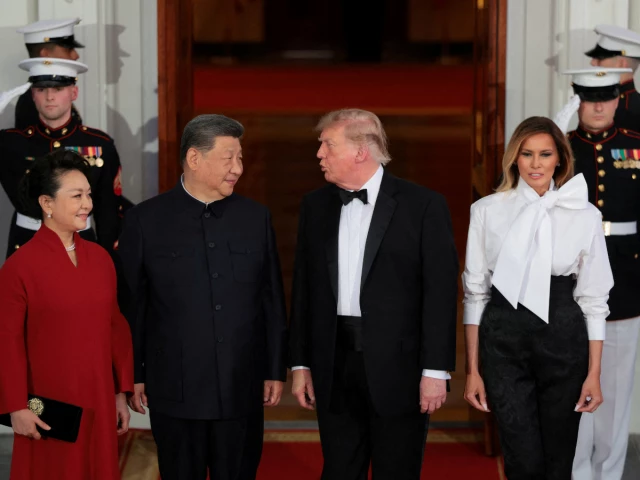
Chinese President Xi Jinping has called for a new chapter in China-US relations, urging Beijing and Washington to act as “responsible major countries,” manage their differences and build a constructive relationship of strategic stability.
Speaking at a state dinner hosted by US President Donald Trump at the White House on Thursday, Xi said his talks with Trump had produced “sincere and in-depth exchanges” and a common understanding on a number of issues, providing fresh strategic guidance for the relationship between the world’s two largest economies.
The Chinese leader said the two countries should strengthen communication, cooperate with sincerity and coexist peacefully rather than allow competition to spiral into confrontation.
“China and the United States must act as responsible major countries, meet the expectations of our peoples, keep pace with the trend of our times, and explore a new approach for major countries to get along with each other,” Xi said according to a text of the Chinese president’s speech released by Xinhua news agency.
The White House state visit, which began with an unusually high-profile welcome by Trump, marked a significant moment in engagement between Beijing and Washington. The US president personally received Xi and his wife, Peng Liyuan, at Joint Base Andrews before hosting a formal arrival ceremony at the White House. The visit is Xi’s first to the White House in more than a decade.
President Donald J. Trump and First Lady Melania Trump greet President Xi Jinping of China and Madame Peng Liyuan upon their arrival in Washington, D.C., ahead of the state visit at the White House. pic.twitter.com/nm2vGonChM
— The White House (@WhiteHouse) September 24, 2026
Xi recalled that he and Trump had agreed during Trump’s May visit to China to work towards a “constructive China-US relationship of strategic stability”.
He described the reciprocal visits by the two presidents within less than six months as unprecedented in the history of bilateral ties and said the two leaders had maintained communication through multiple channels while working to steer the relationship towards a more stable course.
At the White House arrival ceremony earlier on Thursday, Xi said he was ready to work with Trump to “steer the giant ship” of China-US relations towards the future.
.@POTUS salutes as the Star-Spangled Banner is played during the official state welcome ceremony 🇺🇸 pic.twitter.com/NBbio4sbX3
— Rapid Response 47 (@RapidResponse47) September 24, 2026
He said cooperation between Beijing and Washington could not resolve every problem facing the world, but without cooperation between the two countries, many global problems would be difficult to solve.
Xi also called for closer coordination among government departments dealing with foreign affairs, economic affairs, financial cooperation, law enforcement and people-to-people exchanges.
Competition without confrontation
One of the central themes of Xi’s remarks was the need to manage strategic competition without allowing it to turn into conflict.
China and the United States, he said, did not need to avoid discussing competition, but competition should be “healthy” and remain within bounds. “It should be a race of catching up with one another, not a wrestle in which one either wins or loses,” Xi said.
He urged both countries to maintain a firm commitment to avoiding conflict and confrontation and said the two militaries should maintain regular dialogue and improve mechanisms for crisis communication and prevention.
.@POTUS and @FLOTUS welcome Chinese President Xi Jinping and Madame Peng to the United States pic.twitter.com/RPCM1ofEql
— Rapid Response 47 (@RapidResponse47) September 23, 2026
Xi also argued that the so-called Thucydides Trap — the historical tendency for rivalry between an established power and a rising power to lead to conflict — could be overcome. “We can certainly find the right path for our two great countries to get along on this planet we both call home,” he said.
The emphasis on military communication comes as Beijing and Washington continue to navigate disagreements over security, technology, trade and other strategic issues. Xi’s remarks placed crisis management alongside economic and diplomatic engagement as key components of the relationship.
Trade and business ties
Xi also highlighted the economic interdependence between the two countries and called for expanding the areas in which they can cooperate.
China, he said, would keep its doors open to American businesses and welcomed US companies seeking to invest and operate in the Chinese market.
At the same time, he called for Chinese companies to receive fair treatment in the United States. “Working together, we can lengthen the list of cooperation and shorten the list of issues,” Xi said.
Trade and investment have remained among the most sensitive aspects of the relationship as Beijing and Washington seek to manage years of tariff disputes and disagreements over technology, supply chains and strategic industries.
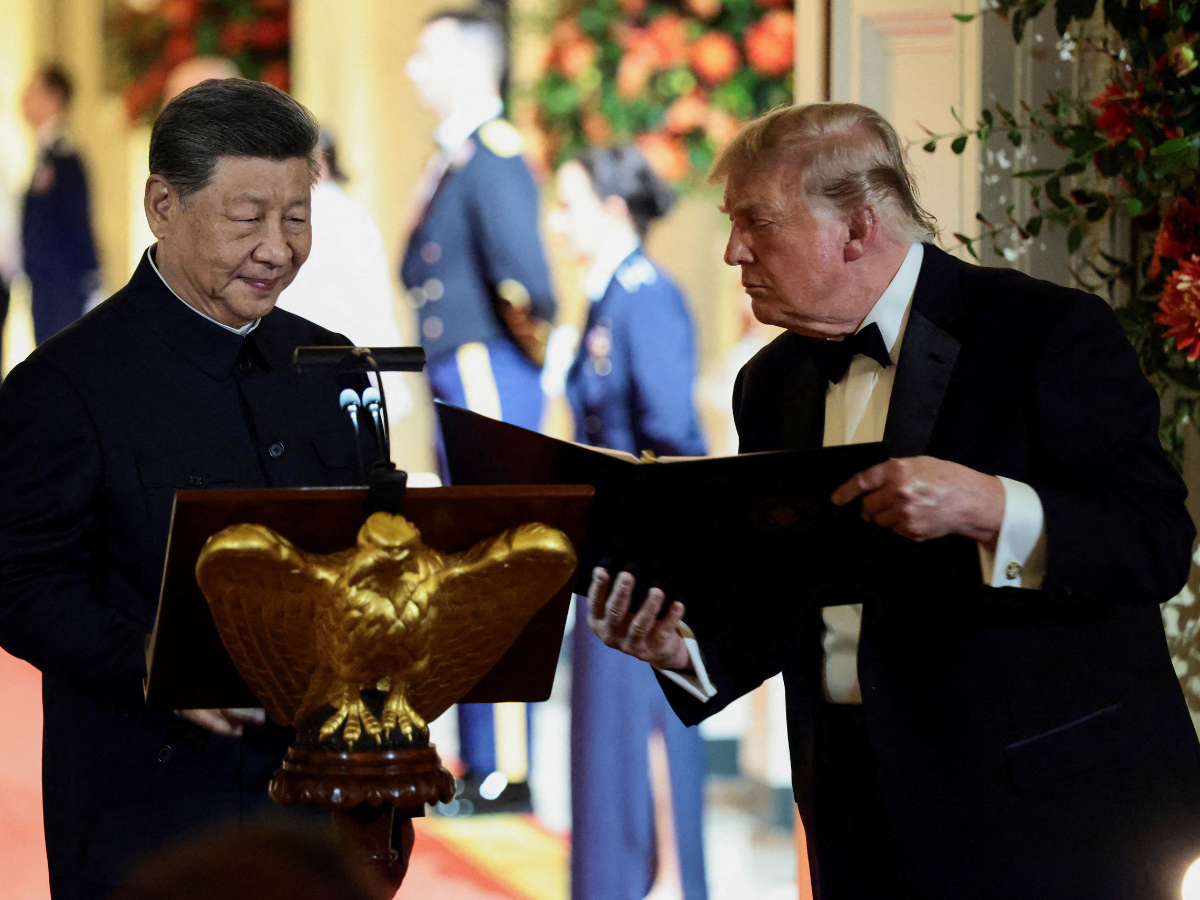
US President Donald Trump holds a binder as he stands next to Chinese President Xi Jinping before Xi delivers a speech during a state dinner at the White House in Washington, DC, US. Photo: Reuters
The summit was therefore closely watched for indications of whether the recent improvement in bilateral engagement could translate into concrete economic cooperation. Analysts have described the meeting as an effort to consolidate a fragile thaw while acknowledging that deep disagreements remain.
AI emerges as new area of cooperation
Artificial intelligence also featured prominently in Xi’s remarks, reflecting the growing importance of the technology to the economic and strategic competition between the two countries.
Xi said China and the United States were both leading nations in AI and had both the capability and responsibility to develop and manage the technology for the benefit of humanity. He called for ensuring that AI development remained under human control and served the well-being of people.
.@FLOTUS hosts Madame Peng for a cultural visit at the Smithsonian Museum of Asian Art pic.twitter.com/anHkakwSIk
— Rapid Response 47 (@RapidResponse47) September 24, 2026
The comments come as Washington and Beijing compete for technological leadership while simultaneously confronting questions over AI safety, regulation, computing power, data and access to advanced technology.
Xi’s call for cooperation suggests Beijing wants AI to become an area where competition can be managed through dialogue rather than another front in the broader strategic rivalry.
Law enforcement and people-to-people links
Xi also proposed expanding cooperation in counternarcotics and law enforcement and called for greater people-to-people exchanges.
He suggested that the two countries could increase direct flights to facilitate travel and trade, linking stronger human contact with the broader effort to stabilise bilateral relations.
The Chinese president placed particular emphasis on the role of ordinary citizens in sustaining ties between the two countries.
Recalling the long history of interaction between Chinese and American peoples, he referred to trade links dating back more than two centuries, cooperation during World War II and the “Ping-Pong diplomacy” that helped reopen bilateral exchanges more than five decades ago.
.@FLOTUS and Madame Peng listen to a children's choir during the cultural visit https://t.co/xZpS69faxu pic.twitter.com/XcIjCHDmfG
— Rapid Response 47 (@RapidResponse47) September 24, 2026
He also recalled cooperation during the war against Japanese militarism, including the Hump air route over the Himalayas and instances in which Chinese civilians and soldiers rescued American pilots.
Xi said the friendship forged during that period should continue “through the generations”.
He cited environmental cooperation and other people-to-people exchanges as examples of how practical cooperation could create lasting bonds beyond government-to-government relations.
100,000 young Americans invited to China
Xi said the future of China-US relations ultimately depended on younger generations and announced an invitation for 100,000 young Americans to visit China over the next five years for exchanges and study.
“The hope of the China-US relationship lies in our people, and its future lies with the young,” Xi said.
An epic White House flyover! pic.twitter.com/qyHQ26Ss9h
— Rapid Response 47 (@RapidResponse47) September 24, 2026
The initiative is intended to increase direct contact between younger Americans and Chinese society at a time when relations between the two countries have increasingly been defined by strategic rivalry.
Xi argued that greater exchanges could strengthen public support for cooperation and provide a foundation for more stable relations in the future.
Pandas return to Atlanta
In a symbolic gesture accompanying the broader diplomatic message, Xi announced that two giant pandas would soon arrive at Zoo Atlanta. The pandas, Ping Ping and Fu Shuang, are expected to become new “envoys of friendship” between the Chinese and American peoples.
Panda exchanges have long been associated with Chinese diplomacy and have periodically featured in US-China relations. The new arrivals will return pandas to Zoo Atlanta after the previous pair was sent back to China in 2024.
.@POTUS and @FLOTUS join President Xi and Madame Peng in observing a silent drill platoon review from the Blue Room balcony pic.twitter.com/O6hfCtIgRI
— Rapid Response 47 (@RapidResponse47) September 24, 2026
Xi’s announcement offered a softer dimension to a summit otherwise dominated by questions of trade, technology, security and strategic competition.
A historic juncture
At the state dinner, Xi sought to frame the current moment as another historic juncture in the relationship.
He said Trump had pledged to “make America great again”, while China was pursuing national rejuvenation through modernisation. “These two goals are both ambitious and can surely be mutually reinforcing,” Xi said.
He urged the two sides to “join hands and move forward side by side”, arguing that the interests of the Chinese and American peoples could provide a basis for cooperation despite differences between their governments.
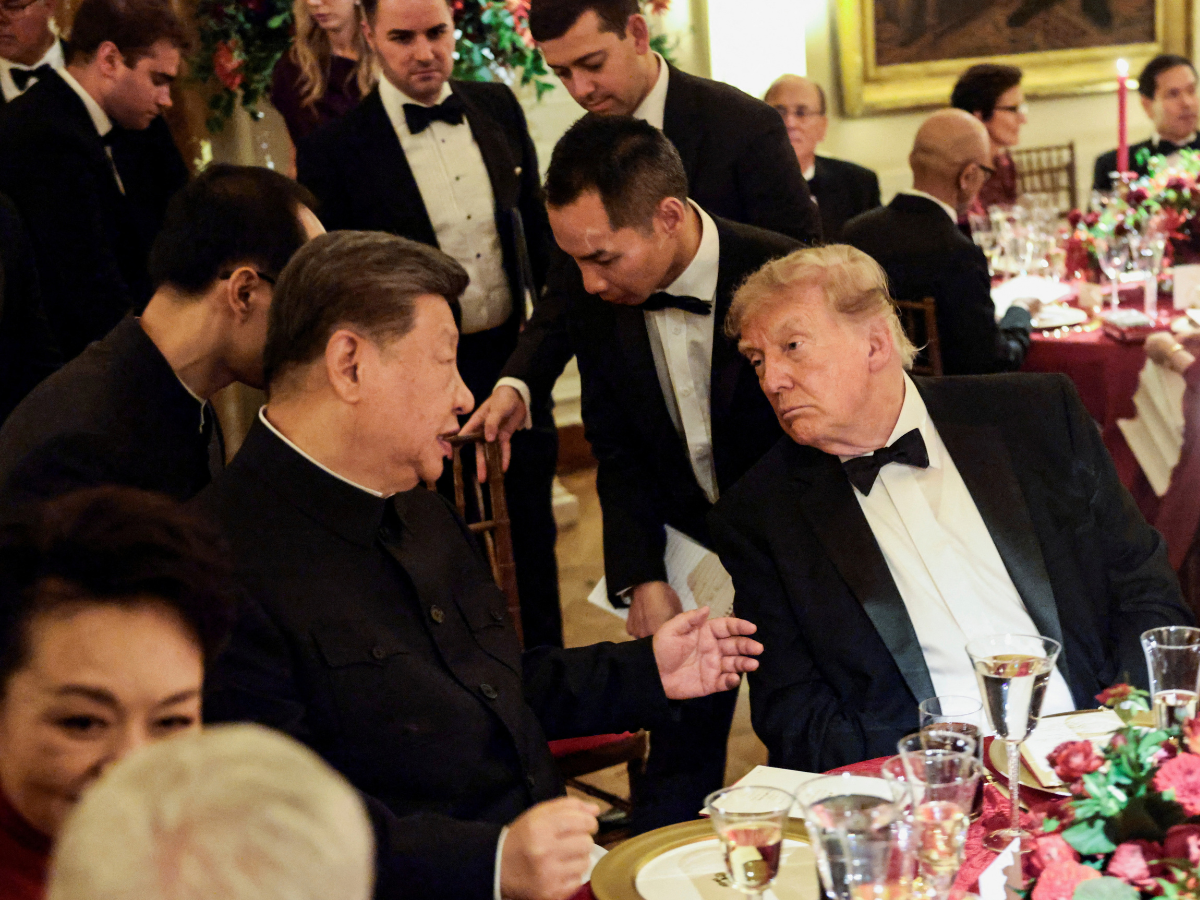
Chinese President Xi Jinping and US President Donald Trump speak during a state dinner at the White House in Washington, DC, US. Photo: Reuters
The Chinese president ended his toast by raising his glass to the health of Trump and First Lady Melania Trump, the prosperity of China and the United States, and the friendship between the two peoples.
The carefully choreographed state visit underscored the importance both governments attach to managing their relationship even as major differences persist. Trump’s decision to give Xi an elaborate welcome and host him for a state dinner reflected the high political and diplomatic significance attached to the summit.
For Beijing, Xi’s message was that strategic competition with Washington need not become a zero-sum struggle. For Washington, the challenge remains balancing competition with a relationship that has significant consequences for global trade, technology, security and economic stability.
Xi’s appeal for a “constructive China-US relationship of strategic stability” therefore represents not an end to competition but an effort to establish mechanisms through which the two powers can compete while avoiding conflict.
Whether that vision can be translated into sustained cooperation will depend on how Beijing and Washington handle the disagreements that have repeatedly strained their relationship.
For now, Xi has presented dialogue, economic engagement, military communication and people-to-people exchanges as the principal tools for keeping the “giant ship” of China-US relations on a steady course.









This material may not be published, broadcast, rewritten, redistributed or derived from. Unless otherwise stated, all content is copyrighted © 2026 The Express Tribune.






COMMENTS
Comments are moderated and generally will be posted if they are on-topic and not abusive.
For more information, please see our Comments FAQ