Sanaullah links reversal of K-P governor's rule if PTI supports counterterrorism efforts
Updated 1 hour ago

Reviews security threats, reaffirms collective defence, and vow to strengthen military cooperation
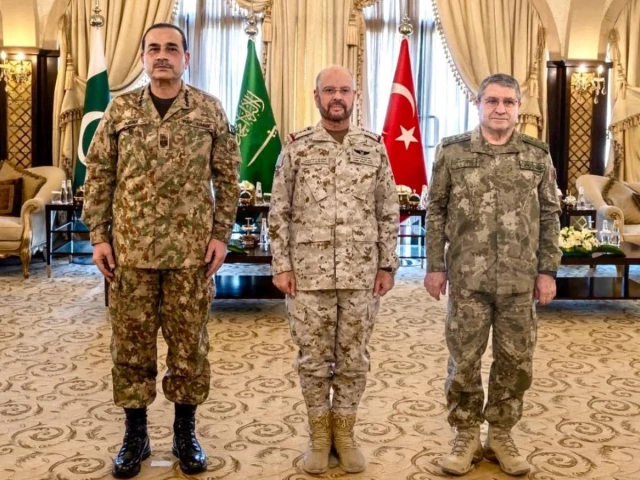
Pakistan, Saudi Arabia and Türkiye on Friday strongly condemned attacks targeting the holy city of Makkah as senior military leadership from the three countries reaffirmed their commitment to the collective defence of the Kingdom under the Makkah Joint Defence Agreement, the military media wing said.
According to a statement issued by the Inter Services Public Relations (ISPR), the meeting of the Chiefs of Defence Forces and Chiefs of General Staff of the three countries was held in Riyadh on Sept 25, with the participation of Saudi Arabia, Pakistan and Türkiye.
It added that the participants reviewed the security situation and threats facing Saudi Arabia and “strongly resented” the attacks targeting the holy city of Makkah as well as civilian and economic infrastructure.
Türkiye's Chief of General Staff, General Selcuk Bayraktaroglu, attends meeting within scope of Mecca Joint Defence Agreement alongside Chief of Army Staff of Pakistan, General Asim Munir, and Chief of General Staff of Saudi Arabia, General Fayyadh bin Hamed Al-Ruwaili, in Riyadh pic.twitter.com/LlQHjpGcIN
— TRT World (@trtworld) September 25, 2026
They also appreciated the “vigilance and professionalism” of the Saudi Armed Forces in ensuring the safety of the people and security of the Kingdom.
The participants also discussed ways to further advance cooperation among the armed forces of the three countries and enhance intelligence sharing, military coordination and capability integration to strengthen deterrence and collective defence.
Commending the longstanding relations and mutual trust between the people and armed forces of the three countries, the statement noted that the Riyadh meeting reflected the strength of defence partnership between the three countries and their shared determination to immediately translate the commitments of the Makkah Joint Defence Agreement into effective military cooperation.
Reaffirming their commitment to collective defence, the participants demonstrated the resolve of the three countries to defend the security, sovereignty and territorial integrity of Saudi Arabia.
Earlier in the day, the foreign ministers of Pakistan, Saudi Arabia and Turkiye strongly condemned attacks targeting the holy city of Makkah and civilian and economic facilities in Saudi Arabia, according to a joint statement released on Friday.
On August 7, Pakistan, Saudi Arabia and Turkiye formalised their longstanding strategic relationship through the newly signed Makkah Joint Defence Agreement (MJDA), a trilateral security framework that its proponents describe as a defensive arrangement aimed at strengthening collective deterrence, enhancing military cooperation and promoting regional stability.
Deputy Prime Minister and Foreign Minister Ishaq Dar, Saudi Foreign Minister Prince Faisal bin Farhan and Turkish Foreign Minister Hakan Fidan met on the sidelines of the UN General Assembly in New York on Thursday under the framework of the MJDA between the three countries, which was formed last month.
During the meeting, the foreign ministers reviewed progress toward establishing the agreement's general secretariat, committees, and working groups, as well as preparations for them to begin their work, according to a Turkish foreign ministry statement.
🔊PR No.2️⃣6️⃣2️⃣/2️⃣0️⃣2️⃣6️⃣
— Ministry of Foreign Affairs - Pakistan (@ForeignOfficePk) September 25, 2026
Foreign Ministers of the Makkah Joint Defense Agreement Meet on the Margins of the United Nations General Assembly in New York
🔗⬇️ pic.twitter.com/04Oi2Z3gGn
They condemned the attacks in the strongest terms and commended the vigilance of the Saudi Armed Forces and their ability to defend the kingdom's security. They also reaffirmed Saudi Arabia's right to take measures it deems appropriate to defend its security in line with Article 51 of the UN Charter.
The foreign ministers discussed plans to convene an urgent meeting of the three countries' military chiefs to explore ways to assist Saudi Arabia under the agreement, which stipulates that an attack against any one of its parties shall be considered an attack against all.
They also discussed the current situation in the region, emphasising the importance of upholding international law, good neighbourliness, mutual respect for state sovereignty, and non-interference in internal affairs, as well as ensuring the security and freedom of navigation.
The foreign ministers reiterated their determination to work together to achieve sustainable peace and stability in the region, support de-escalation efforts, and encourage the peaceful resolution of crises.
Met with my brothers, Foreign Minister of Saudi Arabia Prince Faisal bin Farhan Al Saud @FaisalbinFarhan and Foreign Minister of Türkiye Hakan Fidan @HakanFidan, along with our respective delegations, on the sidelines of the 81st Session of the United Nations General Assembly in… pic.twitter.com/OOwWdMVZtl
— Ishaq Dar (@MIshaqDar50) September 25, 2026
Earlier in a statement, Dar said he reviewed progress on establishing institutional structures under the MJDA with his Saudi and Turkish counterparts on the sidelines of the 81st Session of the United Nations General Assembly in New York. According to a post on X, FM Dar met Saudi and Turkish foreign ministers along with their respective delegations.
“Under the framework of the Makkah Joint Defence Agreement, we reviewed progress towards establishing the institutional structures under the Agreement,” Dar said. The three foreign ministers also “exchanged views on regional and international security issues”, the minister added.
On Wednesday, the appointment of Lieutenant General Nauman Mahmood marked the first formal step towards operationalising the MJDA, with Pakistan providing the alliance’s inaugural secretary general.
The post will head the general secretariat being established in Riyadh and oversee the implementation of the agreement, coordination of joint activities, and expanded defence cooperation among the participating countries.
Urgent meeting of chiefs of staff
An “urgent” meeting of the chiefs of staff of Pakistan, Saudi Arabia and Turkiye was also being arranged to discuss ways of supporting the kingdom under the MJDA, Saudi Arabia’s foreign ministry said on Friday.
The ministry said the development was discussed during the meeting between the three foreign ministers. The ministers also reviewed progress on establishing the secretariat, committees and working groups under the agreement and preparations for them to begin their work.
#نيويورك | سمو وزير الخارجية الأمير #فيصل_بن_فرحان @FaisalbinFarhan يعقد اجتماعاً مع معالي نائب رئيس الوزراء وزير خارجية جمهورية باكستان الإسلامية السيد محمد إسحاق دار، ومعالي وزير خارجية الجمهورية التركية السيد هاكان فيدان، وذلك في إطار اتفاقية مكة للدفاع المشترك.… pic.twitter.com/FqSWVfY17z
— وزارة الخارجية 🇸🇦 (@KSAMOFA) September 25, 2026
The meeting came as the ministers “strongly condemned” attacks targeting Makkah and civilian and economic facilities in Saudi Arabia, while affirming the kingdom’s right to take measures it deemed appropriate to defend its security under Article 51 of the UN Charter.
The ministers also discussed the regional situation, stressing the importance of international law, good neighbourliness, mutual respect for states’ sovereignty and non-interference in their internal affairs, as well as the security and freedom of maritime navigation.
They renewed their commitment to working towards “sustainable peace and stability” in the region and supporting efforts to reduce tensions and find peaceful solutions to ongoing crises, the ministry said.
Significance of the Makkah Joint Defence Agreement
The MJDA was the latest step in longstanding military and strategic cooperation between Pakistan, Saudi Arabia and Turkiye. Signed in Makkah, the pact established a framework for collective deterrence and stipulated that an armed attack on any one of the three countries would be considered an attack on all three, while providing for wider cooperation across defence.
The agreement followed nearly a year of negotiations and came amid heightened instability across the Middle East. Turkiye and Pakistan had sought closer regional security cooperation, while Saudi Arabia had faced growing security concerns as conflicts spread across the region, threatening its territory, energy infrastructure and ambitious economic development plans.
For Pakistan and Saudi Arabia, the trilateral pact is built on their Strategic Mutual Defence Agreement signed in September 2025. That agreement stated that “any aggression against either country shall be considered an aggression against both” and committed the two sides to strengthening defence cooperation and joint deterrence.
Read More: Pakistan, Saudi Arabia, Turkiye sign joint defence pact in Makkah
The three countries already had extensive military links. Pakistan had provided training and technical assistance to Saudi forces for decades, while Islamabad and Ankara had maintained close defence ties through military training, naval cooperation and defence equipment. In 2023, Saudi Arabia agreed to purchase Turkish drones in what Ankara described as its largest defence export contract.
Pakistan had also expanded its military and security cooperation with the kingdom, deploying about 8,000 troops, fighter jets, drones and an air-defence system to Saudi Arabia, according to Reuters. Pakistan deploys troops to Saudi air base under defence pact. Islamabad had also been pursuing wider security and economic ties in the Gulf, including negotiations with Kuwait on an expanded cooperation pact linked to energy and investment. Pakistan-Kuwait agree to boost cooperation across key sectors
The signing in Makkah, Islam’s holiest city, added symbolic weight to an agreement that brought together three countries with significant military and strategic capabilities. It also came as Pakistan sought to avoid becoming directly involved in the Iran conflict, instead pursuing diplomatic efforts to mediate, while strengthening its broader regional security partnerships.




This material may not be published, broadcast, rewritten, redistributed or derived from. Unless otherwise stated, all content is copyrighted © 2026 The Express Tribune.






COMMENTS
Comments are moderated and generally will be posted if they are on-topic and not abusive.
For more information, please see our Comments FAQ