Musk says Zelensky should 'go' as doubts grow over US support for Ukraine
Updated 1 hour ago

Chinese president sets red lines for Trump at White House reception
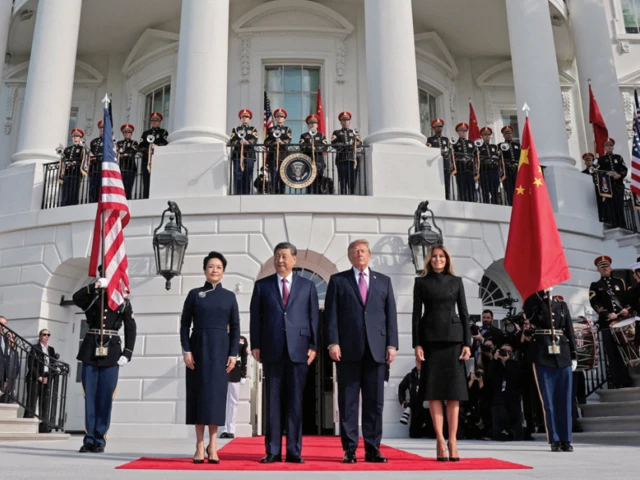
Chinese President Xi Jinping on Thursday called on the United States and Iran on Thursday to return to the negotiating table to end their war, according to a report by state-run news agency Xinhua on Xi's closed-door meeting with US President Donald Trump as the US president gave his Chinese counterpart a lavish welcome to the White House.
Xi told Trump that China "has always maintained that the sovereignty and security of all countries should be respected" and said Beijing had played a constructive role in easing tensions between the two sides and pushing them toward talks.
The Chinese leader said "Beijing supports Washington and Tehran returning to the Islamabad Memorandum of Understanding", expressing hope the two sides would resume negotiations as soon as possible.
Xi said he hoped the countries could reach a comprehensive agreement, including on the nuclear issue, and ultimately achieve peace.
The Chinese president told Donald Trump that Beijing and Washington must peacefully manage their superpower rivalry.
While Trump hailed their "truly great friendship" on a day of sweeping pomp and circumstance, Xi used his state visit to lay down China's red lines on AI, Taiwan and the Iran war. Behind the pageantry and symbolic gestures, like Trump taking Xi inside his Marine One helicopter, the talks were focused on tensions that continue to divide the world's two largest economies.
In his opening remarks with Trump, Xi said the two countries must ensure there is "no conflict and no confrontation between us." Xi also warned that the development of artificial intelligence should be "always under human control," in contrast to Trump, who has repeatedly dismissed warnings that AI could threaten humanity itself.
Trump's remarks struck a warmer tone, underscoring the US president's long-term efforts to woo the Chinese leader. "President Xi and I have made tremendous strides on the issues facing our two countries," Trump said after greeting Xi for his first visit to the White House in over a decade.
Earlier on Thursday at the White House, Trump touted his "truly great friendship" with Xi and said the two powers had made strides on trade since his trip to China in May.
"During this visit, we will also discuss pressing issues concerning security, technology, and 'super intelligence,'" Trump said, using his alternative name for artificial intelligence. "The decisions we make in these areas today can promote peace and prosperity for decades and decades to come."
Speaking after Trump, Xi said the competition between the US and China should be a "healthy one." US companies were welcome in China, he said, adding that he hopes "Chinese companies are treated fairly here in the United States."
Xi also said both militaries should maintain regular dialogue to improve crisis prevention.
"The Thucydides trap can be overcome," he said, referring to the academic theory that sees a risk of rivalry between a rising and an established power spiraling into open conflict.
The summit, Xi's first visit to Washington in more than a decade, is the second meeting this year between the leaders of the world's two biggest economies.
For Trump, who relishes ceremony and prizes his ties with powerful leaders, the visit is as much a matter of national prestige as an opportunity for high-stakes diplomacy. The US president aimed to reciprocate the grand welcome he received in China in May.
But Trump and Xi's remarks were not carried live by any US television networks, which have collectively declined to provide footage in protest of the White House's ban of CNN, MS Now and Politico.
Trump greeted Xi on arrival on Wednesday evening with a red carpet on the tarmac, the first time a US president has welcomed a foreign leader at Joint Base Andrews since President Barack Obama met Pope Francis in 2015, according to C-SPAN, which tracks presidential events.
Following their remarks on Thursday, the two leaders observed a military ceremony including a flyover at the Rose Garden, with Chinese flags waving from the Oval Office roof alongside US flags, before a scheduled bilateral meeting.
Trump's embrace of Xi could complicate his campaign message at home ahead of November's midterm elections, when Republicans' narrow congressional majorities are at stake as voters fret about inflation and the war on Iran.
The president for months has labeled Democrats "communists" in an effort to paint them as too extreme, but he welcomed Xi, the head of the Chinese Communist Party, on Thursday as a dear personal friend.










This material may not be published, broadcast, rewritten, redistributed or derived from. Unless otherwise stated, all content is copyrighted © 2026 The Express Tribune.






COMMENTS
Comments are moderated and generally will be posted if they are on-topic and not abusive.
For more information, please see our Comments FAQ