$1.2b loan accord reached with IMF
Updated 3 hours ago

Waqas Ahmed, had challenged the planned move on the grounds that the protest could disrupt routine life
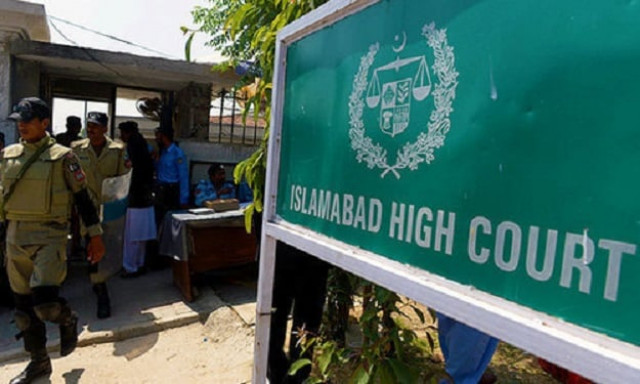
The Islamabad High Court (IHC) has ruled that any act resulting in the infringement of citizens' fundamental rights constitutes a violation of the Constitution, warning that public office holders responsible for such violations would also be deemed to have breached their oath of office.
The ruling came in a detailed 37-page judgment on a petition concerning the proposed nationwide PTI protest towards Islamabad on September 27, 2026. PTI had announced the march to demand release of party founder Imran Khan and mobilise people for the supremacy of the Constitution.
A citizen, Waqas Ahmed, had challenged the planned move on the grounds that the protest could disrupt routine life, traffic and business activities in the federal capital.
A three-member bench headed by Chief Justice Sardar Muhammad Sarfraz Dogar and comprising Justice Muhammad Asif and Justice Muhammad Azam Khan issued the judgment.
The bench had announced its short order on September 14 after hearing Attorney General for Pakistan Mansoor Awan, Additional Attorney General Amir Rehman, the advocate generals of the four provinces and Islamabad, and counsel for the petitioner, Barrister Akhter Cheena.
The court described the case as requiring an "unusual degree of constitutional balance" between the right of political parties and citizens to assemble peacefully and express dissent, and the rights of other citizens to life, liberty, dignity, free movement, trade, business, property, and access to hospitals, educational institutions, courts and workplaces.
"The question is not whether a political party is entitled to protest. It plainly is, subject always to the Constitution and law," the judgment observed.
The court held that the right to peaceful assembly could not be exercised in a manner that infringed the fundamental rights of other citizens.
A key objection raised by the Khyber Pakhtunkhwa advocate general concerned the territorial jurisdiction of the IHC over provincial authorities functioning outside Islamabad.
Rejecting the objection, the court held that Article 199(1)© empowered a high court to issue directions where a governmental power or function was being exercised "in, or in relation to" territory within its jurisdiction.
The court clarified, however, that the provision did not confer general supervisory jurisdiction over another province. A high court could issue directions to an authority outside its territorial seat where the governmental function had a direct and proximate legal relation with territory within its jurisdiction and intervention was necessary to protect fundamental rights there.
The bench also observed that where executive action or inaction was likely to infringe the fundamental rights of citizens within Islamabad, the court was under a "bounden duty" to assume jurisdiction under Article 199(1)©.
The court also rejected the objection that the petition was not maintainable because KP Chief Minister Sohail Afridi had not been impleaded as a respondent. It noted that the Advocate General KP was representing both the provincial government and the chief minister.
The court further rejected the argument that the petitioner had an adequate alternate remedy under the Peaceful Assembly and Public Order Act, 2024.
It noted that no application had, admittedly, been filed under Section 3 of the Act and observed that its provisions had not been adhered to by the KP chief minister and others who had announced their intention to march towards Islamabad.
The judgment extensively referred to the Supreme Court's decision in the Faizabad sit-in case, observing that the constitutional right to assemble and protest was protected but remained subject to restrictions where its exercise infringed the fundamental rights of others.
The IHC also referred to the Supreme Court judgment concerning the PTI march of May 25, 2022, noting that assurances regarding a peaceful rally and non-obstruction of the Srinagar Highway had not been honoured.
The judgment referred to damage to public and private property, fires in the Blue Area greenbelt, injuries to police personnel and the subsequent invocation of Article 245 to call in the armed forces in aid of civil power.
The court also cited its November 21, 2024 order directing that no protest, rally or sit-in be allowed in violation of the Peaceful Assembly and Public Order Act. It observed that the order had also been flouted.
During the proceedings, the court allowed the Islamabad deputy commissioner/district magistrate to place electronic material on record. Video clips of the 2022 and 2024 protests were played before the bench, which described the conduct shown in the footage as "highly disturbing and reflective of violence and aggression".
The court noted that PTI was in power in K-P during both episodes and observed that provincial government resources had been used in pursuit of political objectives.
Regarding the proposed September 27 march, the court held that the petitioner's apprehension was not merely speculative. It noted that the date and destination of the proposed gathering were known and that statements attributed to the K-P chief minister indicated that the date was firm and that he intended to lead the march.
While disposing of the petition, the court directed that no political party, political leader, provincial government or public office holder could lawfully occupy roads, highways, interchanges, toll plazas, buildings or similar public places within, or leading to or from, Islamabad in a manner that obstructed free movement or hindered trade, business, professions or access to medical and educational facilities.
The provincial governments and chief ministers were directed to ensure that no government resources, public funds, officials, vehicles, machinery or equipment were used directly or indirectly to facilitate any march, rally or procession towards Islamabad.
They were also directed to ensure that no public servant was compelled, coerced or induced to participate in such activities.
The chief secretaries, police chiefs, federal interior secretary, chief commissioner and IG Islamabad were ordered to issue instructions prohibiting officials from complying with orders requiring them to facilitate such marches.
Officials facing coercion were directed to report the matter to the relevant authorities, while helplines or other communication mechanisms were ordered to be established for this purpose.
The court further directed the authorities to take departmental action against officials who violated the directions.
In a significant finding, the court held that any person whose activity resulted in a violation of the fundamental rights of citizens in Islamabad would be deemed to have violated the Constitution and would be liable for consequences under the law.
It further declared that any public office holder whose activity resulted in a violation of citizens' fundamental rights would be deemed to have violated both the Constitution and his or her oath of office.











This material may not be published, broadcast, rewritten, redistributed or derived from. Unless otherwise stated, all content is copyrighted © 2026 The Express Tribune.





COMMENTS
Comments are moderated and generally will be posted if they are on-topic and not abusive.
For more information, please see our Comments FAQ