Greta Thunberg joins French teens on new day of school protests
Updated 4 hours ago

UK premier reaffirms belief in union
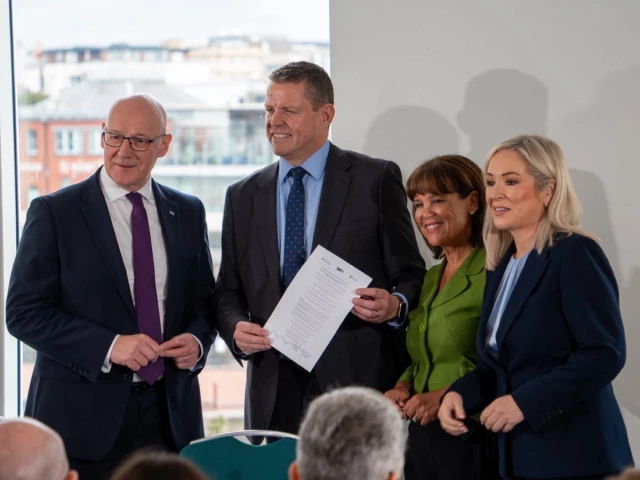
Leaders of the main Scottish, Northern Irish and Welsh nationalist parties on Monday declared their right to choose whether to remain in the United Kingdom (UK) or not at a rare meeting in the Welsh capital Cardiff.
All three parties — the Scottish National Party (SNP), Plaid Cymru in Wales and the pro-Irish unity Sinn Fein — want to break away from the UK.
The meeting came just days after United States President Donald Trump waded in, saying he would back a united Ireland, which Northern Ireland's Michelle O'Neill said showed "the unity debate is very much alive".
"Our nations have the right to self-determination. No Westminster government [the UK government] has the right to block democracy or undermine the principle that our people will decide their own future," a memorandum of understanding (MoU) stated.
Westminster’s time is coming to an end.
— John Swinney (@JohnSwinney) September 14, 2026
We believe there is a better way. Our nations working together as equals, sharing ideas and expertise, building relationships based on mutual respect and common interests.
Today marks a further step in building our cooperation. 🏴🏴🇮🇪 pic.twitter.com/pd8EWzQGED
SNP leader John Swinney, Rhun ap Iorwerth, leader of Plaid Cymru in Wales and Mary Lou McDonald and O'Neill, leader and deputy leader of pro-Irish unity Sinn Fein met in their capacity as party leaders, rather than as officials in their respective governments.
O'Neill is also Northern Ireland's first minister while Iorwerth and Swinney are first ministers of their respective nations.
Announcing the agreement, Swinney said the three parties were "absolutely united by that principle of self-determination", adding that this "lies at the heart of the agreement that we have signed today".
"For the first time ever, people across these islands have first ministers in Scotland, in Wales and in the North of Ireland who are all committed to independence from the UK," the MoU said.
"The future of our nations belongs in the European Union."
Read: Irish unification would be fantastic: Trump
The independence parties are the biggest in both the Scottish and Welsh parliaments for the first time since devolution measures began in 1999. Sinn Fein has been the biggest party in Northern Ireland's assembly since 2022.
The regional parliaments have key powers on health, education, housing, transport and environment matters, along with some tax gathering.
"For people watching across these islands — for people watching around the world — there could be no clearer sign that Westminster's time is coming to an end," the agreement said.
A historic day in Cardiff today.
— John Swinney (@JohnSwinney) September 14, 2026
Scotland, Wales and Ireland coming together to assert that the futures of our nations must be shaped by our people.
If this is still a voluntary union, Westminster has no democratic right to deny our right to choose. pic.twitter.com/QLo3JoyGUW
While the three parties are united in their desire to break away from the UK, they have varying positions on how and when this might take place.
The SNP wants a second independence referendum after an earlier ballot in 2014 saw Scotland narrowly vote to remain part of Britain. Successive UK governments have ruled out an immediate rerun.
Sinn Fein, the former political wing of the paramilitary Irish Republican Army (IRA), wants to see a vote on Ireland being reunified with the UK territory of Northern Ireland.
Plaid Cymru seeks Welsh independence in the longer term, but Iorwerth has ruled out pressing for any referendum immediately.
In Northern Ireland, British Prime Minister Andy Burnham sparked a sharp response from Sinn Fein in August, shortly after taking power the previous month, when he said a referendum on Irish unity was "off the table".
The 1998 Good Friday peace agreement, which largely ended three decades of conflict over British rule, provides for a referendum if the British government's Northern Ireland minister believes a majority is likely to favour joining the Republic of Ireland.
Sinn Fein leader McDonald said the prime minister had no authority to "remove any provision of the Good Friday Agreement", and Burnham backtracked in parliament last week.
Read more: UK curbs on Israeli settlements hailed
On Scotland, Burnham — a former mayor of Manchester and a strong advocate of giving greater power to English local authorities — told lawmakers there could be another vote if there was a "clear consensus" north of the border for it.
He reportedly sent a letter to Swinney later clarifying that a referendum remained "off limits".
UK premier reaffirms belief in union
Burnham "believes strongly in the union", his spokesperson said on Monday in a first reaction.
"The prime minister is committed to delivering change across all four nations of the United Kingdom and believes strongly in the union," Burnham's spokesperson was quoted by Sky News as saying.
The spokesperson told reporters that the UK is "at its best" when people come together around shared values and problem-solving, "rather than division".
"The prime minister will continue to ease pressures on household finances and delivering greater economic security, rather than engaging in constitutional debates or further referendums."










This material may not be published, broadcast, rewritten, redistributed or derived from. Unless otherwise stated, all content is copyrighted © 2026 The Express Tribune.






COMMENTS
Comments are moderated and generally will be posted if they are on-topic and not abusive.
For more information, please see our Comments FAQ