'Indian duty-free access threatens GSP Plus edge'
Updated 21 hours ago

Uniform grid charges okayed for bulk consumers, leading to 400 MW auction
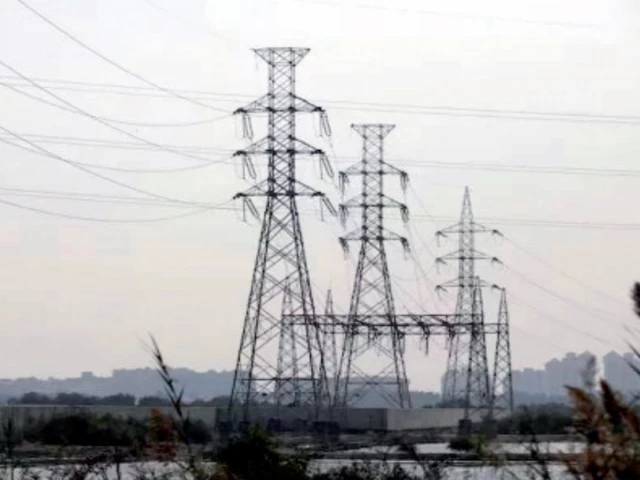
The National Electric Power Regulatory Authority (Nepra) has approved a uniform structure of Use of System Charges (UoSC) for power bulk consumers of distribution companies (Discos) and K-Electric (KE), a key step towards launching a competitive wholesale electricity market.
Under the approved structure, uniform variable grid charges for consumers range from Rs6.23 to Rs19.62 per unit, depending on the consumer category. Consumers will also pay a fixed grid charge of Rs1 per kW per month based on sanctioned load.
The decision is expected to facilitate the government's plan to auction 400 MW of electricity in the first phase through a competitive wheeling framework.
Federal Minister for Energy Sardar Awais Ahmad Khan Leghari welcomed the decision, describing it as a historic milestone in the reform and modernisation of Pakistan's power sector. He said it was the final critical regulatory step required for operationalising open access under the Competitive Trading Bilateral Contract Market (CTBCM) regime, paving the way for the issuance of the RFP for Pakistan's first CTBCM auction.
"Establishing a competitive electricity market is a key component of the broader power sector reform agenda," Leghari said. "The necessary institutional, regulatory, technical and market requirements have been addressed to move Pakistan from the traditional single-buyer electricity market towards a competitive and consumer-oriented market."
With this development, eligible industrial consumers will, for the first time, be able to bilaterally procure electricity from their choice of power suppliers through a competitive market mechanism, rather than being restricted to purchasing electricity solely from their respective distribution companies.
The minister said the benefits of a competitive market will not be limited to industrial consumers but also have the potential to benefit ordinary consumers. Greater competition in power procurement can encourage more efficient generation, improve utilisation of existing power plants and reduce inefficiencies across the electricity value chain.
The competitive market will also support greater participation of renewable energy, battery energy storage and other flexible energy resources, helping reduce dependence on expensive imported fuels.
Nepra finalised the mechanism for determining and settling UoSC after reviewing proposals from the Power Division, ISMO, KE and other stakeholders. The key issue was how to deal with differences in UoSC between Discos while keeping charges fair for open-access and wheeling consumers.
The Power Division initially supported passing inter-Disco differentials on to wheeling consumers, but ISMO and KE opposed this approach, arguing it could result in open-access consumers paying different charges from similar consumers served by suppliers of last resort.
After considering all submissions, Nepra agreed that the key principle should be equal treatment: open-access consumers should pay the same UoSC as similarly placed consumers of suppliers of last resort, rather than bearing inter-Disco differences separately.
The regulator also approved uniform T&D loss factors for open-access consumers. Based on the T&D losses of individual Discos, Nepra determined that the uniform loss factor at the 11kV level worked out to 8.04%, instead of the 8.42% claimed by the Power Division. For consumers connected at 132kV, the regulator approved a uniform loss factor of 1.51%, as proposed by the Power Division.
Nepra has not approved a settlement mechanism for differences arising from uniform T&D losses at this stage, as ISMO's proposal has not yet been fully discussed among all stakeholders.
The power regulator has also noted that the National Electricity Plan 2023-27 specifically requires a mechanism for inter-Disco differences arising from uniform UoSC, but not for energy differences caused by uniform T&D losses.
Nepra has directed the Power Division, Discos, ISMO, KE and other stakeholders to examine the issue during next year's UoSC proceedings. If uniform T&D losses are found to create such differences, the stakeholders will then be required to jointly propose an appropriate settlement mechanism.







This material may not be published, broadcast, rewritten, redistributed or derived from. Unless otherwise stated, all content is copyrighted © 2026 The Express Tribune.


1727268465-0/Untitled-design-(42)1727268465-0-208x130.webp "the reverse renaissance")




COMMENTS
Comments are moderated and generally will be posted if they are on-topic and not abusive.
For more information, please see our Comments FAQ