French police clash with protesters as tens of thousands rally over cost of living
Updated 33 minutes ago

Ghalibaf warns any aggression against Iran will draw a ‘faster, heavier, more painful’ response
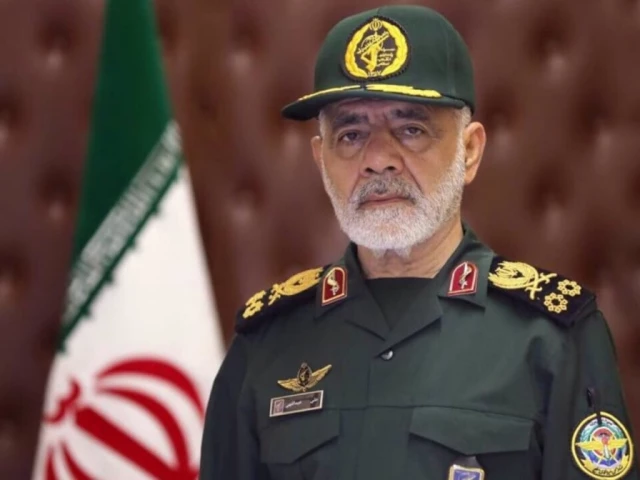
Iran’s army chief, Major General Ali Abdollahi, said on Sunday that Tehran would not yield to pressure from the United States, and that Washington’s turn to "economic, psychological and cognitive warfare" would fail just as its "military aggression" had, according to Press TV.
Press TV reported that Abdollahi said the US was trying to offset its "strategic shortfalls and battlefield setbacks" by shifting the fight onto other fronts.
Abdollahi underlined that Iran would not surrender, and that the enemy would not prevail in a "combined campaign of economic pressure, media operations and cognitive warfare against a nation that stands on divine and national foundations".
He further described Washington’s expectation of Iranian capitulation as a “false illusion” that would never be realised.
Abdollahi noted that for more than 80 years, the United States had grown used to facing no refusal from other countries, adding that its assumption before moving against Iran, that the "Iranian people would submit unconditionally", was therefore a "false dream".
Iran’s army chief stated that American and Israeli enemies were now attempting to close the gap left by their military and regional defeats through "soft war, cognitive operations and economic coercion", according to Press TV.
“The world of the future will be different from that of the past,” Abdollahi said, adding that this shift would inevitably mean a decline in US power.
Major General Abdollahi says US seeks to offset its military defeats through economic pressure
— Press TV 🔻 (@PressTV) September 6, 2026
Follow: https://t.co/GHI09iA8ru pic.twitter.com/dpPWTaCLAX
Ghalibaf warns any aggression against Iran will draw a ‘faster, heavier, more painful’ response
Iranian parliament speaker Mohammad Bagher Ghalibaf on Sunday said the United States had realised that the era of “proportionate responses” had come to an end, the ISNA news agency posted on X.
“From now on, any aggression against Iran's interests and security will receive a ‘faster, heavier, and more painful’ response,” Ghalibaf said.
قالیباف: آمریکاییها حتماً فهمیدهاند که دوران «پاسخهای متناسب» به پایان رسیده است؛ از این پس، هرگونه تجا،وز به منافع و امنیت ایران، پاسخی «سریعتر، سنگینتر و دردناکتر» دریافت خواهد کردhttps://t.co/CEyKaHR297 pic.twitter.com/ZuyXOtyewC
— خبرگزاری ایسنا (@isna_farsi) September 6, 2026
He said powerful strikes by Iranian military forces against US bases had left American leaders “in a state of utter helplessness”, IRNA news agency wrote on X.
Iran's Parliament Speaker @mb_ghalibaf has stated that the powerful strikes by Iranian military forces on American bases have left US leaders in a state of utter helplessness. pic.twitter.com/Hr8QZzcIHU
— IRNA News Agency ☫ (@IrnaEnglish) September 6, 2026
Iran’s Revolutionary Guards say missiles struck US aircraft carrier, destroyer
Iran’s Islamic Revolutionary Guard Corps (IRGC) said on early Sunday that it targeted a US aircraft carrier and a navy destroyer with ballistic missiles, claiming both were damaged and withdrew from the area.
The IRGC said in a statement published by IRNA news agency that its Aerospace Force launched the missiles at the two warships.
It claimed the vessels had harassed Iranian ships and were taking part in a maritime blockade, adding that both warships left the “engagement area” after sustaining damage.
The IRGC said the US military’s Central Command (CENTCOM) acknowledged that two navy warships were targeted, describing its statement as confirmation of the operation.
It also warned that continued US military action would draw “heavier” responses from Iran’s armed forces.
In a separate statement early Sunday, the IRGC said its navy attacked a remotely operated US military vessel that it claimed was attempting to enter a protected area of the Strait of Hormuz.
The IRGC did not provide details about the type of attack or whether the vessel was damaged.
The Guards also reiterated Tehran’s position that the Strait of Hormuz is under Iranian management and said the US should leave the region.
Read: US hits three Iranian oil tankers
Earlier on Saturday, the IRGC Navy said it targeted three oil tankers in the Strait of Hormuz and three US-linked vessels elsewhere in response to American attacks on Iranian tankers.
CENTCOM said Iran launched ballistic missiles toward two US Navy warships patrolling regional waters, and that both vessels evaded the attacks, with no American personnel harmed.
It said US forces subsequently struck three Iranian crude oil tankers.
Lebanese president condemns renewed Israeli strikes on Nabatieh, urges international action
Lebanese President Joseph Aoun on Sunday condemned renewed Israeli attacks on the southern city of Nabatieh and surrounding towns, saying the targeting of state institutions and health facilities marked a “dangerous escalation.”
In a statement posted by the Lebanese presidency on X, Aoun said the attacks caused civilian casualties, severely damaged a finance ministry building and destroyed Ghandour Hospital.
He said the attacks went beyond repeated violations of the cessation-of-hostilities arrangement and the framework agreement by attacking Lebanese state institutions, public service facilities, a hospital and health centers.
Aoun said the attack on the finance ministry building, following an earlier strike on a State Security centre that caused fatalities, demonstrated “a continuing pattern” of attacks extending beyond alleged military targets to civilian government and health facilities.
He accused Israel of seeking to disrupt the functioning of Lebanese institutions and services provided to the public.
The Lebanese president held Israel fully responsible for the continuing escalation and called on the US and the international community to act urgently to halt the attacks and hold those responsible accountable.
He said Lebanon remained committed to measures aimed at preserving its sovereignty, stability in the south and the safety of its citizens.
دان رئيس الجمهورية العماد جوزاف عون تجدد الاعتداءات الإسرائيلية على مدينة النبطية وبلداتها، والتي أسفرت عن سقوط ضحايا أبرياء وإلحاق أضرار جسيمة بمبنى وزارة المالية فيها، وتدمير مستشفى غندور ، مؤكداً أن هذا الاستهداف يشكل تصعيداً خطيراً يتجاوز حدود الخروقات المتكررة لاتفاق وقف…
— Lebanese Presidency (@LBpresidency) September 6, 2026
US forces redirect 92 vessels amid maritime blockade against Iran
US forces redirected 92 commercial vessels while enforcing a maritime blockade against Iran, the US military's Central Command said on Sunday.
"As of Sept. 6, US forces have redirected 92 commercial vessels, disabled 3 and boarded 2 to ensure strict compliance," Central Command said on X.
The command also said a US Air Force F-35A stealth fighter jet was patrolling regional waters.
A U.S. Air Force F-35A stealth fighter jet patrols over regional waters as CENTCOM forces continue to enforce the maritime blockade against Iran. As of Sept. 6, U.S. forces have redirected 92 commercial vessels, disabled 3 and boarded 2 to ensure strict compliance. pic.twitter.com/oXNN5zKx1t
— U.S. Central Command (@CENTCOM) September 6, 2026
Turkish, Iranian FMs discuss developments on negotiation with US
Turkish Foreign Minister Hakan Fidan and his Iranian counterpart, Abbas Araghchi, discussed regional developments on a telephonic conversation, Anadolu Agency reported according to Al Jazeera.
The two ministers discussed “comprehensively” the latest developments in the ongoing negotiations with the United States, the agency reported.
IRGC says US economic blockade could cost Washington more than Tehran
Iran's Islamic Revolutionary Guard Corps (IRGC) said on Sunday that the US economic and maritime blockade against Tehran could cost Washington several times more than Iran.
"If the US wants to inflict one dollar of economic damage on Iran, it may face several dollars in costs and losses itself," IRGC spokesman Brig. Gen. Hossein Mohibi told Mehr News Agency.
He asserted that Iran would not surrender to sanctions and pressure.
Mohibi claimed US President Donald Trump had believed Washington could force Iran to retreat by relying on its military power, naval fleet and aircraft carriers. However, he added, recent developments have shown those calculations to be wrong.
Mohibi argued that the US, already facing heavy debt and economic competition with China and other countries, would struggle to prevail in what he described as an economic war against Iran.
He also claimed that regional developments have put pressure on US strategic reserves and affected access to some raw materials, including through disruptions to aluminum production and exports in the region.
Mohibi said the developments showed that economic pressure and a blockade did not necessarily guarantee victory and could impose high costs on the country enforcing them.
US Centcom says it sank oil tanker in Gulf of Oman
US Central Command (Centcom) said it had sunk an oil tanker in the Gulf of Oman, according to a post on X.
“Thanks to the precision and professionalism of American service members, the M/T Kylo sank in the Gulf of Oman today and joined Iran’s navy at the bottom of the sea,” CENTCOM said.
Thanks to the precision and professionalism of American service members, the M/T Kylo sank in the Gulf of Oman today and joined Iran’s navy at the bottom of the sea. pic.twitter.com/OwSDMl8SSQ
— U.S. Central Command (@CENTCOM) September 6, 2026
Trump's threats over Kharg Island
While US President Donald Trump's administration seeks to pivot toward an economic clampdown on Iran by widening sanctions, the president himself has kept open the possibility of military action.
On August 31, Trump issued a one-line social media post accompanied by an AI-generated video depicting Kharg Island being "blown to smithereens." Iranian authorities have vowed a strong response if Kharg is attacked.
Iran is the third-largest producer in the Organisation of the Petroleum Exporting Countries and exported 90% of its crude via Kharg Island before the war. Flows have been disrupted since a US blockade of Iranian oil exports began in mid-April.
Trump has spoken of an attack on Kharg before. He said on June 11 that he wanted to take over the island, but then said a US military operation there was off the table, days before Tehran and Washington signed an interim agreement aimed at ending the war on June 17.
Read more: Who can mediate the US-Iran war?
A US attack on Kharg would further pressure Iran's oil industry and its wider economy, which is already reeling from the US naval blockade.
The US imposed its blockade on Iranian ports after Iran effectively shut the Strait of Hormuz, an important waterway that carried one-fifth of the world's oil supply before the war.
Brent crude futures closed at their highest level since July 24 on Friday, at $96.28 a barrel, as tensions in the Middle East drive global supply concerns.







This material may not be published, broadcast, rewritten, redistributed or derived from. Unless otherwise stated, all content is copyrighted © 2026 The Express Tribune.






COMMENTS (2)
Comments are moderated and generally will be posted if they are on-topic and not abusive.
For more information, please see our Comments FAQ