No progress in talks sans meeting with Imran: Salman Akram
Updated 1 hour ago

CM Murad takes notice, seeking details of the incident and the extent of the damage from fire brigade officials
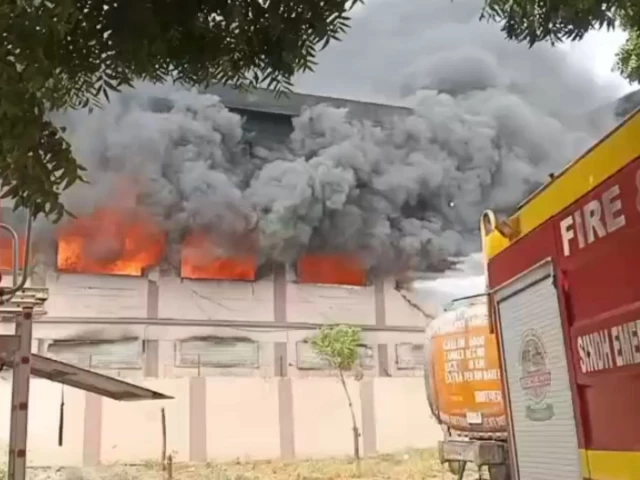
A fire broke out at an old-clothes factory in Karachi’s Landhi Export Processing Zone (EPZ) on Monday, prompting a large-scale response from the Karachi Metropolitan Corporation (KMC) Fire Brigade, Rescue 1122, Sindh Rangers and police.
The blaze later spread to an adjacent factory, while part of the original factory building also collapsed, a Rescue 1122 spokesperson said.
According to fire brigade officials, the factory comprised a ground floor and two upper storeys. The fire initially broke out on the ground floor before spreading to the upper floors. Officials said the smoke was particularly intense, with firefighting operations being conducted from outside the building.
KMC Fire Brigade and Rescue 1122 teams were engaged in a joint operation, with firefighting teams from Lyari also assisting at the scene.
The blaze was later classified as a third-degree fire, prompting authorities to call in additional fire tenders. Eleven KMC fire tenders, two water bowsers and a snorkel were deployed to tackle the fire, with further tenders subsequently called in.
Two men and a woman were initially reported to be in critical condition due to suffocation, according to Chhipa sources. The woman was taken to Jinnah Hospital after rescue teams and ambulances reached the scene.
Also Read: Fire breaks out in Bannu hospital, no casualties reported
Meanwhile, a Sindh Rangers spokesperson said personnel had reached the scene immediately given the severity of the fire and were assisting fire brigade and rescue teams in relief and rescue efforts.
A large contingent of Rangers was deployed to cordon off the factory, manage traffic and ensure the safety of citizens.
According to the spokesperson, the foremost priority was to protect human lives and prevent the fire from spreading further.
Malir senior superintendent of police (SSP) also said a large contingent of police was present at the scene and that no loss of life had been reported. He added that all workers present in the factory at the time had been evacuated before the blaze spread.
The SSP said authorities were facing no other major challenge apart from the firefighting operation. Rescue officials declared the factory unsafe, while media personnel and citizens were barred from entering the EPZ.
Sindh Chief Minister Murad Ali Shah has taken notice of the fire at the Export Processing Zone and sought details of the incident and the extent of the damage from fire brigade officials.
Last month, 14 newborns were killed after a fire broke out on the third floor of the Mother and Child Hospital at Islamabad's Pakistan Institute of Medical Sciences (PIMS), triggering widespread outrage and demands from people and political parties for action against those responsible.
The fire prompted authorities across Pakistan to review fire-safety arrangements at healthcare facilities and other public buildings.
In Sindh, a fire-safety assessment of 22 government hospitals found widespread shortcomings, including a lack of fire alarms, sprinklers and adequate firefighting equipment. The provincial chief secretary subsequently gave departments 15 days to certify that public buildings under their control complied with fire-safety regulations.
The tragedy also led to increased inspections and enforcement in Islamabad. The CDA sealed three buildings over fire-safety violations and later conducted a fire drill at Parliament House, while the Islamabad High Court sought a government report on fire-safety audits and mandatory NOCs for buildings in the capital.
Punjab also ordered fresh safety checks following the fire at PIMS. The provincial health regulator directed public and private hospitals to strengthen emergency preparedness, conduct fire-safety audits and hold regular drills, while Chief Minister Maryam Nawaz ordered reviews of firefighting equipment, emergency exits, hydrants and electrical systems at public health facilities.
Previous fire incidents in Karachi
On January 17, 2026, a fire at the Gul Plaza shopping mall killed over 70 people and injured over 20. The Sindh government formed a single-member judicial commission, led by Sindh High Court's Justice Agha Faisal, on February 4 to probe the cause of the tragedy.
The commission found that the dangers at the plaza were known well before the tragedy. Civil Defence inspections in 2024 and 2025 had identified the absence of fire-safety equipment, the presence of inflammable commercial material and deficiencies in exit routes. Yet the identified shortcomings were not rectified and no effective legal action followed.
The building's management was also held responsible for failing to rectify known defects. Its regularised plan provided for 1,102 shops, while 1,153 shops were actually operating in the building, with large quantities of inflammable commercial goods stored inside.
The Sindh Building Control Authority, too, could not escape responsibility by relying on the position that inspections were conducted only on complaints, the commission said. The Sindh Building Control Ordinance gave the authority powers to take corrective action against dangerous buildings, while Gul Plaza's incomplete records and ineffective fire-safety oversight also reflected institutional failure.
Read More: Fire safety crackdown puts fuel stations on the block
Overall, the commission rejected the idea that the tragedy could be attributed to one department, one institution or one government. It found that the legal powers, audit mechanisms, building-control authorities, firefighting services and emergency-response institutions existed across different periods. But the system as a whole failed to function effectively. The victims did not die from fire alone. Delays, darkness, blocked exits, obstructive windows, inactive safety systems, ineffective oversight and rescue opportunities that were not used in time all contributed to the loss of life.
In March, a fire erupted at a private super market in the Zamzama area, but emergency teams successfully evacuated all management personnel inside the building, and no casualties were reported.
Six fire tenders were deployed to control the fire and while the blaze was largely brought under control, it was dense smoke that remained a major challenge.
It was reported in March that the port city had witnessed nearly 240 fire incidents that far into the year, leaving at least 99 people dead, several others injured, and causing financial losses worth millions of rupees.













This material may not be published, broadcast, rewritten, redistributed or derived from. Unless otherwise stated, all content is copyrighted © 2026 The Express Tribune.



1727268465-0/Untitled-design-(42)1727268465-0-208x130.webp "roboking in pakistan")


COMMENTS
Comments are moderated and generally will be posted if they are on-topic and not abusive.
For more information, please see our Comments FAQ