Polish DPM commends Pakistan's role in US-Iran ceasefire in call with Ishaq Dar
Updated 1 hour ago

Nearly 240 fire incidents have occurred in the city so far this year, resulting in 99 deaths
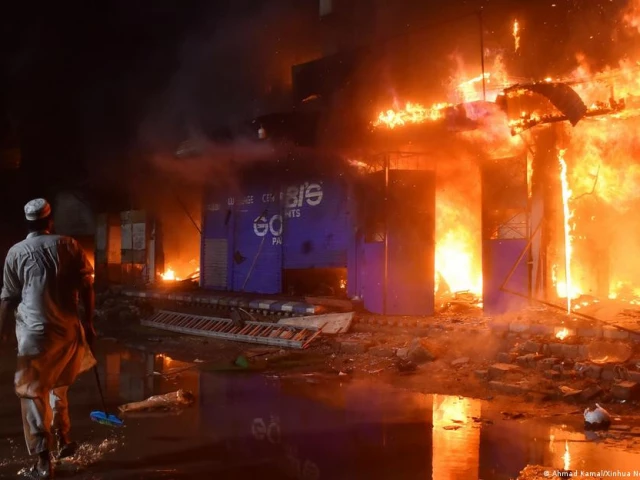
Karachi has witnessed nearly 240 fire incidents so far this year, leaving at least 99 people dead, several others injured, and causing financial losses worth millions of rupees. Recent tragedies—including the devastating incidents at Gul Plaza, Gul Rana Colony, and Hyderi—have once again exposed the city’s fragile fire safety framework.
Among the most serious incidents, the Gul Plaza fire proved the deadliest, claiming around 80 lives. Another tragedy in Gul Rana Colony left 17 people dead after a gas explosion caused a residential building to collapse, while an incident in Hyderi resulted in two fatalities. These disasters underline how faulty electrical wiring, gas leaks, illegal electricity connections, and the absence of fire safety systems continue to turn ordinary buildings into deadly hazards.
Reportedly, most incidents are linked to long-standing infrastructure problems. Faulty electrical systems, overloaded circuits, illegal hook connections—commonly known as the “kunda system”—and tangled overhead wiring across many neighborhoods and commercial areas are among the leading causes of fires.
At present, the Karachi Metropolitan Corporation (KMC) fire brigade operates with only 53 functional fire tenders and six snorkels, while just 28 fire stations serve the entire city. Most of these stations also face water shortages, which further hampers emergency response during major fires.
Read More: Fire breaks out yet again at Gul Plaza, two months after deadly blaze
A senior fire brigade official revealed that Karachi experiences around 2,500 fire incidents every year, ranging from minor blazes to major disasters. According to estimates, nearly 70 per cent of these incidents are caused by electrical faults, illegal connections, and tangled wiring networks.
The remaining 30 per cent are largely linked to gas-related factors. Due to persistent gas load-shedding, many households and businesses rely on gas pressure machines and cylinders to maintain supply. While these alternatives provide temporary relief, they also increase the risk of gas leaks and explosions in densely populated areas.
One such tragedy occurred in Gul Rana Colony, a densely populated settlement where narrow lanes severely restricted rescue access. The building where the explosion occurred was a ground-plus-three structure constructed on a 32-square-yard plot. Officials claimed gas had accumulated inside the house due to leakage. When a matchstick was lit, a powerful explosion caused the building to collapse instantly and also damaged a neighbouring structure.
Rescue teams struggled to reach the site because the alley leading to the building was barely two to three feet wide, forcing emergency workers to carry out manual rescue operations. Local representatives alleged that faulty gas infrastructure may also have contributed to the incident, claiming newly installed pipelines in the area were poorly constructed, and leaks had been observed near meter connections.
UC-2 Councillor Shafiq Ansari of Gul Rana Colony informed that due to gas load-shedding, most residents had installed pressure machines. "The accident occurred during Sehri on the first day of Ramazan when leaked gas inside the house ignited, collapsing the building and damaging a neighbour's property," said Ansari, who alleged that newly installed SSGC pipelines were of poor quality and were still leaking near meters.
A survey conducted by The Express Tribune found that many residential areas and markets in Karachi suffer from extremely narrow access roads. In several informal settlements, entry passages are only two to four feet wide, preventing fire tenders and heavy rescue machinery from entering during emergencies. The Sui Southern Gas Company (SSGC) and Sindh Building Control Authority (SBCA) were contacted for comments but did not respond.
Karachi is estimated to have around 600 informal settlements, commonly referred to as katchi abadis. About half have been regularized by the KMC, while the rest fall under other government departments. Officials from KMC Katchi Abadi Department say layout plans in many of these settlements include roads between 18 and 20 feet wide, but implementation has been hindered by encroachments, political pressure, and corruption.
Similar challenges exist in several commercial areas of the city. Markets in Saddar, Kharadar, Liaquatabad, Nazimabad, and Ranchore Line remain heavily congested due to encroachments, roadside stalls, and unregulated parking. Many major wholesale markets—including Jodia Bazaar, Bolton Market, Paper Market, and Bohri Bazaar—also have dense overhead wiring and lack fire safety installations such as hydrants, smoke detectors, and proper emergency exits.
Former chief fire officer Naeem Yousuf emphasized that firefighting in Karachi’s congested neighborhoods remains a major challenge. “Many six- to eight-story buildings in older areas lack proper staircases, ventilation, and emergency exits. Short-term measures such as provision of fire bikes at every station and long-term planning involving 200 fire stations, 600 fire tenders, and 5,000 firefighters are recommended,” said Yousaf.
In response, K-Electric (KE) clarified that it provides electrical connections only after fulfillment of all codal formalities under NEPRA’s Consumer Service Manual, including submission of a test form and a wiring test certificate issued by the Electrical Inspectorate Karachi (EIK), which certifies the safety and fitness of the internal distribution system before installation of electricity meters.
Regarding illegal connections, KE stated that it regularly conducts anti-theft operations. During the first seven months of the ongoing fiscal year, nearly 21,000 drives were carried out, resulting in the removal of approximately 250,000 kilograms of illegal hook connections. The utility also organizes facilitation camps across the city to create awareness about the hazards of illegal connections and to encourage consumers to shift to proper metered connections.
However, KE noted that in several commercial markets, shopkeepers display goods on push carts or stalls outside their shops and draw electricity through properly installed metered connections using their internal distribution systems for self-consumption. In cases where electricity is found to be used for unauthorized purposes beyond self-consumption, KE takes regulatory action, including issuing notices and disconnecting supply.
On the issue of haphazard wiring inside multi-occupancy buildings, KE explained that meters are usually installed in common meter rooms or designated areas provided by market associations.
After the metering point, maintenance and upkeep of the internal distribution system become the responsibility of consumers or the relevant market association, while EIK monitors the safety and fitness of the internal wiring.













This material may not be published, broadcast, rewritten, redistributed or derived from. Unless otherwise stated, all content is copyrighted © 2026 The Express Tribune.






COMMENTS
Comments are moderated and generally will be posted if they are on-topic and not abusive.
For more information, please see our Comments FAQ