Power supply chains face a new test
Updated 5 hours ago

KSE-100 settles below 174,000 as geopolitical tensions, higher oil prices unsettle investors
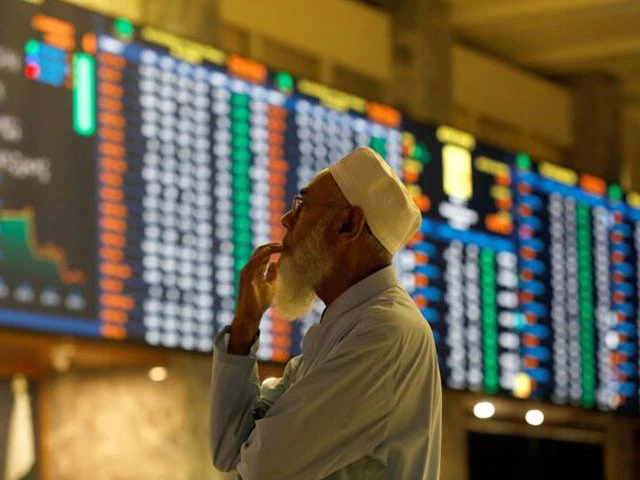
The Pakistan Stock Exchange (PSX) succumbed to heavy selling pressure on Monday, with the benchmark KSE-100 Index plunging 1,692.75 points, or 0.97% to settle at 173,636.07, as concerns over rising oil prices and escalating tensions around the Strait of Hormuz weighed on investor sentiment.
The index opened the week on a fragile note, falling 429.59 points, or 0.25% to 174,899.23 at 9:39am in early trading. It initially moved as high as 175,353.67, before selling intensified and dragged the index to an intraday low of 173,603.75.
The previous session had closed at 175,328.82, meaning Monday's decline pushed the benchmark below the 174,000 level.
Key sectors that came under pressure included oil marketing companies (OMCs), automobile assemblers, cement, commercial banks and refineries.
The sell-off came amid renewed pressure in global oil markets. Oil prices rose by more than $1 a barrel on Monday as tit-for-tat strikes between the United States and Iran involving vessels sailing in the Strait of Hormuz and other areas heightened concerns over a prolonged disruption to Middle Eastern supplies.
Iran also said it would announce a new restricted zone in the Gulf in the coming days, along with maps of a new shipping corridor through the Strait of Hormuz, after a weekend exchange of strikes involving shipping pushed oil prices higher.
Read: Geopolitical tensions drag stocks down
The development raised concerns among local investors over the potential impact of higher international oil prices on Pakistan's import bill and external account, while also increasing uncertainty for oil-sensitive sectors.
According to Arif Habib Limited (AHL), Monday saw 175,000 give way with the KSE-100 declining 0.97% to close at 173,636.07 and continuing to move towards July lows.
A total of 12 shares rose while 87 fell, with Pakistan Services (+7.55%), Askari Bank (+1.54%), Adamjee Insurance (+3.23%) contributing the most to index gains. In contrast, United Bank (2.69%), Oil & Gas Development Company (2.48%) and Pakistan Petroleum (1.78%) were the biggest index drags.
Pakistan Services rallied after media reports of an out-of-court settlement over a dispute that included the company's hotel properties and controlling vote in its operations. However, in a stock exchange filing, Pakistan Services said it had no knowledge of the contents of the media reports and that cases relating to its shareholding were currently sub judice.
Meanwhile, Iran said a deal with Oman to manage shipping through the Strait of Hormuz was just days away, a move likely to increase tension over the waterway. Oil prices continued to rise on Monday. AHL predicted that the July lows of 170,000 remain the near-term objective for the KSE-100 Index.
Cumulatively, trading volume decreased to 679.1 million shares versus Friday’s close of 874.3 million while the value of traded shares stood at Rs23.6 billion. In the ready market, shares of 495 companies were traded, of which 154 stocks closed higher, 311 fell, and 30 remained unchanged.
Cnergyico Pk led the volume chart with trading in 82.5 milion shares losing Rs0.09% to close at Rs13.02.









This material may not be published, broadcast, rewritten, redistributed or derived from. Unless otherwise stated, all content is copyrighted © 2026 The Express Tribune.









1727268465-0/Untitled-design-(42)1727268465-0-208x130.webp "the reverse renaissance")

COMMENTS
Comments are moderated and generally will be posted if they are on-topic and not abusive.
For more information, please see our Comments FAQ