Trump holds off on new measures against Russia to avoid undermining Ukraine peace talks
Updated 1 hour ago

.
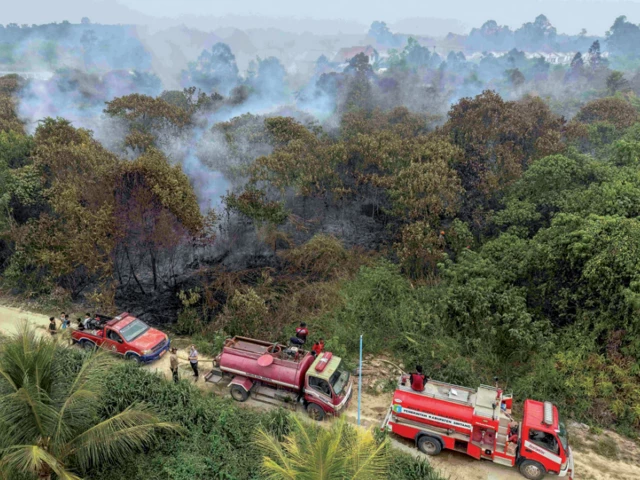
Thick smog has blanketed parts of Indonesia as the vast archipelago for weeks battles to contain fires that have burned large swathes of Borneo and Sumatra.
The hazardous smoke has led to an increase in respiratory problems, forced schools to close, and has been drifting to neighbouring countries including -- Malaysia, Singapore, and the Philippines.
Where are the fires?
Most of the fires are concentrated on Borneo island, home to vast tropical jungle that Indonesia shares with Brunei and Malaysia, as well as Sumatra.
So far this year, nearly 300,000 hectares of land have burned in Indonesia, according to an independent estimate from the Nusantara Atlas portal.
Indonesia saw an uptick in carbon emissions since late July, and by the end of last month the levels were comparable to previous El Nino years of 2015 and 2019, Copernicus Atmosphere Monitoring Service (CAMS) senior scientist Mark Parrington told AFP.
"We're seeing already now... really extreme fire emissions comparable to those previous strong El Nino years, and also the extent of the smoke and the haze and the air quality impacts," Parrington said.
Fires in the archipelago have released more than 23 million metric tons of carbon emissions between August 28 and September 3, according to CAMS' Fire Emission Watch portal.
It was higher than 20.7 million metric tons of emissions from fires over the same period in 2015, which was a strong El Nino year.
What causes the fires?
Analysts said that the El Nino weather phenomenon, which the United Nations said this week could turn out to be the strongest in four decades, has contributed to creating drier conditions in Indonesia and made it easier for fires to spread.
But slash-and-burn land-clearing practices also contributed to the damage, said David Gaveau, founder of the Nusantara Atlas.
"El Nino does not ignite fires. It creates the dry conditions that allow human-started fires to escape and become very large," he told AFP.
The fires are difficult to extinguish because many occurred on peatlands, a wetland ecosystem with layers of partially decomposed organic materials that become flammable when dry.
Between January and August this year, more than 210,000 hotspots were detected in peatland areas across the country, according to NGO Pantau Gambut. AFP














This material may not be published, broadcast, rewritten, redistributed or derived from. Unless otherwise stated, all content is copyrighted © 2026 The Express Tribune.





1727268465-0/Untitled-design-(42)1727268465-0-208x130.webp "sisyphus in the land of saviours")
COMMENTS
Comments are moderated and generally will be posted if they are on-topic and not abusive.
For more information, please see our Comments FAQ