India reduced to ‘side player’ as Pakistan facilitates US-Iran talks: Rahul Gandhi
Updated 47 minutes ago

Congress leader questions India's diminishing diplomatic influence, citing Pakistan's role in regional efforts

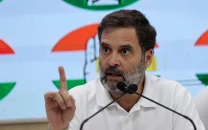
Indian opposition leader Rahul Gandhi has expressed surprise at Pakistan’s role in facilitating negotiations between the United States and Iran, saying India had been reduced to a “side player” in global affairs.
Speaking at the University of Chicago, he pointed to Pakistan’s diplomatic engagement with Washington and Tehran as an example of India’s diminishing influence in international affairs. “I’m pretty shocked that Pakistan is busy negotiating with the Iranians and the Americans, while India is just looking,” he said in a post on X on Friday.
He further stated that India had traditionally maintained an independent foreign policy since independence, guided by its national interests. “We had a mind of our own. Our foreign policy was guided by what benefits India,” he added.
I’m pretty shocked that Pakistan is busy negotiating with the Iranians and the Americans, while India is just looking.
— Rahul Gandhi (@RahulGandhi) November 19, 2026
India has always had a sophisticated geopolitical understanding, right from independence. We had a mind of our own. Our foreign policy was guided by what… pic.twitter.com/RFo2FA1xKI
Gandhi argued that India’s size, history and international relationships should give it a greater role in shaping global affairs, but said the country had retreated from major diplomatic conversations.
“By our size, our history and our relationships, we should be involved in these global conversations. But frankly, India has become a side player. We have stepped back from the stage. We have a voice and a view, but that view is missing,” he said.
He also highlighted the domestic consequences of regional conflicts, saying the war involving Iran had exacerbated existing hardships in India.
“There was already pain in India. The Iran war magnified it, pushing people over the edge. We cannot sit in India and remain unconcerned about what is happening in the rest of the world,” Gandhi said.
Calling for a more inclusive global security framework, he said the post-Second World War international order had largely been shaped by Western powers, while the emerging global architecture would involve multiple civilisations. “A nation of 1.5 billion people must help shape it,” he stressed.
Gandhi said India should contribute to building a global order based on stability, dialogue and mutual understanding. “We want stability. We want an order designed not just by speaking, but by listening equally,” he said.
Pakistan's mediation efforts gained momentum in March and April, as Islamabad sought to bring Washington and Tehran to the negotiating table following the outbreak of the US-Iran war on February 28.
Pakistan offered to host talks and subsequently facilitated negotiations in Islamabad on April 11, with Prime Minister Shehbaz Sharif reaffirming Islamabad's commitment to mediating a settlement. The initiative culminated in the Islamabad Memorandum of Understanding (MoU), signed by the US and Iranian presidents and endorsed by Shehbaz Sharif on June 18, formalising a diplomatic breakthrough brokered by Pakistan.
The MoU provided the framework for a ceasefire and a 60-day window for negotiations towards a lasting settlement, addressing contentious issues including sanctions, Iran's nuclear programme and maritime traffic through the Strait of Hormuz.
Pakistan subsequently continued facilitating the process, with its leadership participating in follow-up negotiations in Bürgenstock, Switzerland, alongside Qatar. However, renewed hostilities and disagreements over the implementation of the agreement undermined the initiative, with efforts to revive negotiations continuing in the following months.
Islamabad has nevertheless continued to pursue diplomatic engagement between the two sides, maintaining contacts with Tehran and Washington and working alongside regional partners to revive the peace process.
Pakistan reiterated its commitment to mediation in September, while the Islamabad Communiqué adopted at the Economic Cooperation Organisation's Council of Ministers meeting on November 17 welcomed Pakistan's role in facilitating the Islamabad talks and the resulting MoU, providing a fresh regional endorsement of its diplomatic efforts.








This material may not be published, broadcast, rewritten, redistributed or derived from. Unless otherwise stated, all content is copyrighted © 2026 The Express Tribune.


COMMENTS
Comments are moderated and generally will be posted if they are on-topic and not abusive.
For more information, please see our Comments FAQ