Pakistan extends airspace ban for Indian aircraft until October 23
Updated 10 hours ago

Leh reaches 19 feet at Katarian, 16.5 feet at Gawalmandi; warning sirens sounded

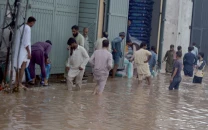
Torrential rain from late Saturday night until Sunday morning turned the twin cities of Rawalpindi and Islamabad into a virtual sheet of water, with the swollen Nullah Leh reaching dangerously high levels, low-lying areas inundated and water accumulating on major roads.
As the water level in Nullah Leh rose, warning sirens were sounded intermittently to alert residents living along its banks. The rain stopped at around 5am, after which the water level in the nullah gradually began to recede.
The twin cities experienced a severe storm, thunder and strong winds, followed by heavy rain from 1am to 5am. The few hours of rainfall resulted in water accumulating in low-lying areas and on roads, while the nullah and adjoining drains also experienced flooding.
The water level in Nullah Leh reached 19 feet at Katarian and 16.5 feet at Gawalmandi. In view of the situation, residents living around the nullah remained on alert, while the administration sounded warning sirens at intervals.
When the rain stopped at around 5am on Sunday, the water level in Leh also gradually declined and the situation began returning to normal.
Personnel from Rescue 1122 and other emergency services remained alert at key and sensitive locations to deal with any emergency. Teams from the Water and Sanitation Agency (Wasa) and Suthra Punjab also continued removing accumulated water from major roads in Rawalpindi, after which traffic resumed normal flow.
According to the Pakistan Meteorological Department, the highest rainfall between 1am and 5am on Sunday was recorded in Islamabad's Saidpur area at 85 millimetres. PMD H-8/2 and Golra each received 75mm, New Katarian and Shamsabad 65mm each, Pirwadhai 61mm, Bokra 52mm, Gawalmandi 43mm and Kachehri 35mm.
The average rainfall recorded in urban areas was 69.76mm.
The flooding in Nullah Leh during the rainfall also forced members of the business community and residents of surrounding areas to remain awake through the night.
Residents said the situation around Nullah Leh became a source of concern every year during the rainy season. They urged the government to devise a permanent and effective solution to protect citizens from the recurring ordeal.
Following the heavy rain, sunshine returned to Rawalpindi, although clouds remained visible in some areas. The reduction in humidity brought some relief, making the weather relatively pleasant.
BOX
Rain raises dengue threat in Rawalpindi
our correspondent
RAWALPINDI. The risk of dengue mosquito breeding and its spread has increased following six consecutive days of rain, prompting the District Health Authority to prepare a plan to launch a 14-day dengue surveillance campaign in 20 high-risk union councils from Monday.
According to details, the continuous six-day rainfall has increased the risk of large-scale breeding and subsequent spread of dengue mosquitoes at places where water has accumulated outdoors, as well as on rooftops, in gardens and at other locations.
So far, only six dengue-positive patients have been reported across the district.
Meanwhile, as the dengue threat has increased due to the rains, the 20 union councils from which dengue patients were reported last year have been marked for a 14-day anti-dengue surveillance campaign.
The union councils include Dhamial, Kotha Kalan, Kalyal, Dhama Syedan, Lakhan, Gangal, Dhok Munshi, Rehmatabad, Chak Jalal Din, Takht Pari, Morgah, Shakrial North, Khanna Dak, Awar and Chaklala.
District Health Officer Preventive Dr Hafiz Jawad Zahid said 542 teams had been formed for indoor surveillance and 373 for outdoor surveillance in the 20 union councils during the 14-day campaign.














This material may not be published, broadcast, rewritten, redistributed or derived from. Unless otherwise stated, all content is copyrighted © 2026 The Express Tribune.








COMMENTS
Comments are moderated and generally will be posted if they are on-topic and not abusive.
For more information, please see our Comments FAQ