PSX extends winning streak, gains 1,429 points
Updated 6 hours ago

Climate Prosperity Plan aligns with CPEC-II to tackle stagflation, create jobs
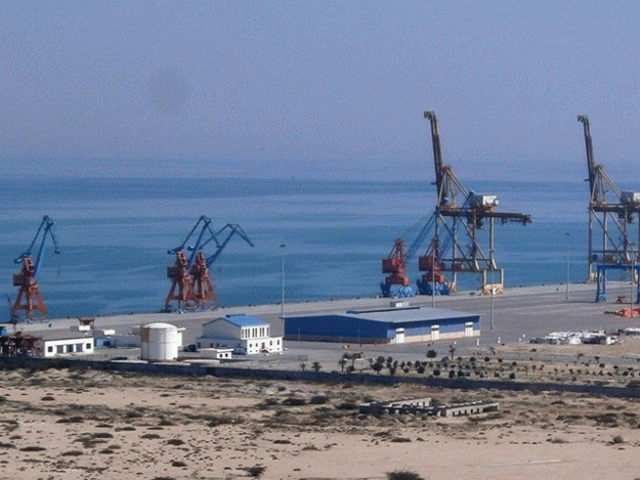
The dual problem of stagflation and climate change has put policymakers on notice. They struggle to find a solution that can satisfy the country's economic and development needs without compromising its climate change targets and ambitions. It is a tedious job amid shrinking economic opportunities driven by a wave of protectionism, unilateralism and trade wars. The challenge becomes even more difficult in the face of climate change, which is posing a threat to resources, infrastructure, humanity and the planet.
Against this backdrop, Pakistan is seeking opportunities that can satisfy both of its needs: economic development and climate change. In this context, CPEC offers Pakistan an excellent opportunity to revive its economy by prioritising climate change targets and ambitions while implementing the second phase of CPEC. How? Because the second phase focuses on green development, aligned with the goals and objectives of the second phase of the BRI, the green BRI. It also aligns with the vision of high-quality development and the construction of an ecological civilisation.
It is pertinent to highlight that green development is very close to President Xi's heart; he is passionate about it. Therefore, he has been working to transform the BRI into a Green BRI since its launch. He specifically directed the NDRC to develop the Green BRI concept and related policies. Accordingly, the NDRC began devising policies and frameworks to make the BRI greener. In continuation of these efforts, at the second BRI Forum, China announced various initiatives to transform the BRI into a Green BRI, including the Belt and Road Initiative International Green Development Coalition (BRIGC), Silk Road Environment Programme, Green Silk Road Envoy Programme, Big Data Platform, Belt and Road Environmental Technology Exchange, Transfer Centre, Green Lightning and Green Cooling Initiatives, among others, under the BRI.
The process has been further accelerated since the 3rd BRI forum. Against this backdrop, China and Pakistan will work to accelerate green investment, green infrastructure and climate-compatible industrial and agricultural development. They will promote green energy development and transportation. Moreover, China and Pakistan will invest in developing high-quality human capital to build an innovation and technology development base to support the green transition.
However, to fast-track the green transition of CPEC, Pakistan needs to develop concrete, bankable programmes and projects. IT is one area that has been a concern since the launch of CPEC, especially in B2B cooperation. Here comes the Climate Prosperity Plan (CPP) of Pakistan, issued by the Ministry of Finance. It was prepared by the Climate Vulnerability Forum and V20 (CVF-V20), which can help address this concern. The CPP is designed to address both of Pakistan's challenges, stagflation and climate vulnerability. It is an attempt to turn Pakistan's vulnerability to climate change into an opportunity to attract investment and prosperity.
Why? Because it does not present ideas only, but rather presents bankable projects for investment. The projects are grounded in realities on the ground and aligned with the Nationally Determined Contribution, National Adaptation Plan, URAAN 2025 and National Biodiversity Strategy and Action Plan, among other priority policies. The projects were devised and selected after close consultation with provincial governments, taking their preferences and priorities into account. Moreover, the projects have an economic rationale and are lucrative, with an average IRA of 31-34%, an EIRR of 22.24%, and a payback period of 4.8-5.2 years.
Therefore, the CPP is a comprehensive plan covering a wide range of investment areas. It includes the following areas: energy optimisation and just transition, green economic zones (SEZs), EV industry and transport, climate-resilient agriculture, building a circular economy, protecting natural capital through nature-based solutions, climate-resilient infrastructure and increasing access to financial protection. Of the listed projects, 34 relate to mitigation, 15 to adaptation and 20 to resilience. Moreover, it addresses the needs of Pakistan and its provinces and was developed after extensive consultations. In a nutshell, implementing CPP projects can attract investment and turn vulnerability into an opportunity.
Lastly, the CPP shares these objectives and goals with CPEC-II. Therefore, there is a need to create synergies between CPEC-II and the CPP to pursue the goal of green development in Pakistan. This would be easier, as both are government of Pakistan programmes. The CPP is issued and led by the Ministry of Finance, while the Ministry of Planning, Development and Special Initiatives is steering the implementation of CPEC-II.
Unfortunately, despite its importance and relevance to green development and green CPEC, the CPP is not part of public discourse. Moreover, the business community lacks knowledge of or understanding of its programmes. It is extremely important to garner support from the public and local communities and to attract the business community. It must be understood that without public and societal support, the plan will not be able to achieve the desired results.
Thus, the immediate task should be to devise a comprehensive communication policy and strategy for the CPP. It should cater to the needs of all stakeholders, especially of society and the business community. For that purpose, the CVF-V20 can be engaged to guide the process to prepare a communication plan.
Second, Pakistan should share the CPP with its Chinese counterparts and with the business communities in China and Pakistan that want to invest under CPEC. This is necessary because the business community often complains about a lack of investment opportunities. Third, the government of Pakistan should seek to create synergies between CPEC-II and the CPP's relevant ministries, namely the Ministry of Finance and the Ministry of Planning. It is suggested that the two ministries establish a joint committee to streamline work and facilitate implementation.
Fourth, there should be a comprehensive market strategy for CPP and the identified projects. Marketing events should be held not only in Pakistan but also in China for policymakers and the business community. To that end, the two ministries can engage the CVF-V20 to guide the development of a comprehensive market plan. In conclusion, the CPP offers an excellent opportunity to realise the vision of a green CPEC through concrete projects. The synergy between CPEC-II (green CPEC) and the CPP will also help to address the dual challenge of climate change and stagflation. It will create tens of thousands of jobs, lower vulnerability and GHG emissions, and help Pakistan to tackle poverty. Therefore, the synergy between CPEC-II and the CPP would be a win-win proposition for Pakistan, the business community and the general public.
THE WRITER IS A POLITICAL ECONOMIST AND A VISITING RESEARCH FELLOW AT HEBEI UNIVERSITY, CHINA








This material may not be published, broadcast, rewritten, redistributed or derived from. Unless otherwise stated, all content is copyrighted © 2026 The Express Tribune.







COMMENTS
Comments are moderated and generally will be posted if they are on-topic and not abusive.
For more information, please see our Comments FAQ