Trump, Zelensky clash diesel deal
Updated 22 minutes ago

Move comes as Tel Aviv rejects Gaza plan
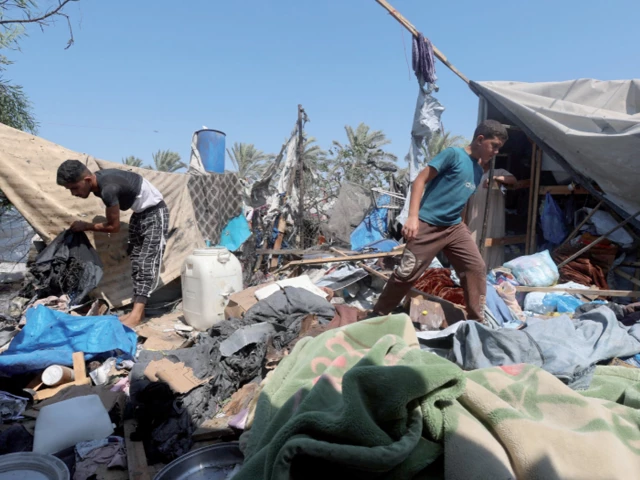
A bloc of eight Muslim countries on Sunday accused Israel of obstructing efforts to end the war in Gaza, saying its rejection of a US-backed roadmap and opposition to Palestinian statehood amounted to a direct repudiation of the framework endorsed by the United Nations Security Council (UNSC).
The foreign ministers of Pakistan, Egypt, Türkiye, Indonesia, Jordan, Qatar, Saudi Arabia and the United Arab Emirates said Israel's position jeopardised the implementation of President Trump's comprehensive plan to end the Gaza conflict and placed responsibility on Israel for any further deterioration of the situation.
The unusually strong joint statement came as American envoys stepped up efforts to revive the stalled Gaza plan. Jared Kushner, a senior adviser to President Trump, met Hamas leaders in Cairo on Sunday before travelling to Israel for talks with Prime Minister Benjamin Netanyahu.
The diplomacy reflects growing concern in Washington and regional capitals that the plan could collapse before its key provisions are implemented.
The dispute centres on a 15-point roadmap developed by the United States, Egypt, Qatar and Türkiye, together with the High Representative for Gaza and the Board of Peace. The roadmap is intended to complete implementation of the broader Trump plan, which was endorsed by the Security Council in Resolution 2803.
The resolution, adopted in November 2025 with 13 votes in favour and two abstentions, endorsed the Comprehensive Plan, welcomed the creation of the Board of Peace and authorised the establishment of an International Stabilisation Force for Gaza.
Under the roadmap, Hamas and other armed factions would give up their weapons and cease military, policing and administrative activities. An International Stabilisation Force would be deployed, while Israeli forces would withdraw in stages as disarmament was independently verified.
Civilian administration would eventually be transferred to the National Committee for the Administration of Gaza, a technocratic Palestinian body, while reconstruction would proceed under the framework established by the Board of Peace.
The United Nations has described the roadmap as the central mechanism for completing implementation of the Comprehensive Plan. A May report by the Board of Peace said the proposal envisaged "one authority, one law and one weapon" in Gaza, with the decommissioning of weapons and dismantling of military infrastructure proceeding in phases alongside corresponding Israeli withdrawals.
However, Israel has rejected the arrangement.
Netanyahu said earlier this month that Israel would not withdraw its forces from Gaza until Hamas was completely disarmed.
Israeli officials have objected in particular to the idea that an Israeli withdrawal should take place in parallel with the disarmament process rather than only after Hamas has surrendered all of its military capabilities.
That position has created one of the most significant obstacles to the Trump administration's latest attempt to bring the Gaza war to an end.
The eight foreign ministers said Sunday that the roadmap represented the culmination of extensive mediation by Egypt, Qatar, Türkiye and the United States, as well as the High Representative for Gaza and the Board of Peace.
They said the Palestinian factions had accepted the roadmap and argued that its rejection by Israel amounted to an explicit refusal to proceed with the implementation of the broader Comprehensive Plan.
The ministers also warned that the Israeli position could undermine the efforts personally led by President Trump to end the war.
They called on the United States to maintain an active role and, crucially, to ensure Israel complies with the commitments and arrangements envisaged by the plan.
"The Ministers underscore the importance of sustained and active US engagement," the statement said, calling on Washington to ensure and enforce Israel's compliance with the roadmap.
The ministers went further, saying Israel would bear "direct and full responsibility" for any consequences arising from continued rejection, obstruction, delay or non-compliance with the plan, including a deterioration in conditions on the ground and disruption of efforts to end the war.
The statement also linked the immediate Gaza crisis to the longer-term question of Palestinian statehood - an issue that has increasingly become a point of confrontation between Israel and the countries backing the diplomatic framework.
The eight countries categorically rejected what they described as any attempt to deny or foreclose Palestinian statehood, including through unilateral Israeli actions.
They reiterated their support for a two-state solution based on the 1967 borders, with East Jerusalem as the capital of an independent and sovereign Palestinian state, in accordance with international law and relevant United Nations resolutions.
They argued that denying Palestinian statehood would not merely affect the political status of the Palestinians but would undermine the prospects for peace and security throughout the Middle East.
The emphasis on statehood also highlights a potential contradiction at the heart of the current diplomatic effort.
The Security Council resolution endorsing President Trump's plan envisages a pathway toward Palestinian self-determination and statehood after the Palestinian Authority completes reforms and Gaza's reconstruction advances. The resolution therefore places Palestinian statehood within the broader political horizon of the plan, even though it does not establish an immediate timetable for creating a Palestinian state.
For the eight countries, however, the issue is no longer one that can be deferred indefinitely.
They said a "just, lasting and comprehensive peace" could only be achieved through the realisation of an independent Palestinian state based on the 1967 lines, with East Jerusalem as its capital.
The ministers also defended the continued role of the Board of Peace, calling on it to support implementation of the roadmap and advance the second phase of President Trump's plan.
They urged the Board, with active American support, to take "immediate and concrete measures" within its mandate to preserve the integrity of the plan and prevent any party from obstructing its implementation.
The stakes are high because significant elements of the broader framework are already in place.
According to a May report submitted to the United Nations, the Board of Peace had been established as an international organisation, the National Committee for the Administration of Gaza had been constituted, an International Stabilisation Force had completed a pre-deployment assessment, and billions of dollars had been pledged for reconstruction.
But the same report identified the unresolved roadmap - particularly the question of Hamas's disarmament - as the critical obstacle to moving from the framework to implementation.
That impasse has now become sharper with Israel's public rejection.
The latest diplomatic push therefore faces a difficult sequencing dispute: Israel insists on complete Hamas disarmament before an Israeli withdrawal, while the roadmap envisages a monitored and phased process in which Palestinian disarmament, international stabilisation and Israeli withdrawal proceed together.
Hamas, for its part, has signalled conditional acceptance of the U.S.-backed framework while demanding that Israel fulfil its own obligations, including a withdrawal from Gaza.
The eight countries are now asking Washington to resolve that dispute rather than allowing it to derail the entire framework.












This material may not be published, broadcast, rewritten, redistributed or derived from. Unless otherwise stated, all content is copyrighted © 2026 The Express Tribune.



1727268465-0/Untitled-design-(42)1727268465-0-208x130.webp "the poor man s burden")


COMMENTS
Comments are moderated and generally will be posted if they are on-topic and not abusive.
For more information, please see our Comments FAQ