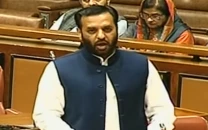
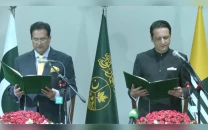
Barrister Iftikhar Gillani elected 17th AJK prime minister
Updated 2 hours ago

FO admits peace process on hold but not dead
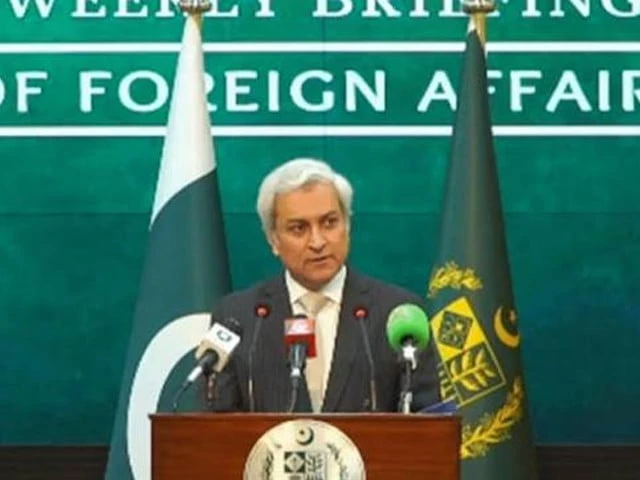
Pakistan on Thursday insisted it had not abandoned its efforts to mediate between Iran and the United States despite the collapse of the ceasefire, while subtly acknowledging that diplomacy has been overtaken by a renewed cycle of military escalation.
Responding to questions at his weekly news briefing, Foreign Office spokesperson Tahir Andrabi said the current environment was dominated by “the logic of escalation” but maintained that Islamabad’s diplomatic initiative remained relevant and could still serve as the basis for future negotiations.
“Let me dispel the impression that Pakistan has put its hands up. This is not the case,” Andrabi said. “Obviously, the mediation process is challenged as the logic of escalation is prevailing right now. But we hope that this logic of escalation will eventually be overcome by the rationality of peace and dialogue.”
The remarks amounted to Islamabad’s clearest acknowledgment yet that its mediation efforts have effectively been placed on hold after Iran and the United States resumed hostilities.
However, Andrabi argued that the peace process was “on the back burner” rather than dead, insisting that the Islamabad Memorandum of Understanding (MoU) remained the only viable framework for a negotiated settlement.
“Whenever the parties feel that their logic of escalation is exhausted, the return to peace will be through the template provided in the Islamabad MoU,” he said.
He added that Pakistan’s position had remained consistent since February 27, when Islamabad first called for restraint, respect for sovereignty and territorial integrity, and a diplomatic resolution to the conflict.
The spokesperson said Pakistan had continued diplomatic engagement at the highest level despite the renewed fighting, noting that Prime Minister Shehbaz Sharif had recently spoken with the Emir of Qatar and Iranian President Masoud Pezeshkian, while Deputy Prime Minister and Foreign Minister Ishaq Dar had remained in contact with his Iranian and Saudi counterparts.
He ruled out the need for a fresh mediation initiative, saying the framework negotiated during the Islamabad talks in April and endorsed through the Pakistan-Qatar joint statement issued in Bürgenstock in June remained sufficient.
“The template exists,” Andrabi said. “Whenever the parties exhaust the logic of escalation, the formula for peace is there for the taking.”
Separately, the Foreign Office rejected reports suggesting Chinese concerns over the security of its nationals working on projects in Pakistan.
Without directly commenting on media reports, Andrabi said Pakistan and China maintained close consultations on all aspects of their relationship, including security cooperation.
“As the host of these projects, Pakistan guarantees impeccable security to our Chinese guests who are working on various economic projects, including technicians and workers,” he said.
On Afghanistan, Andrabi said Pakistan would continue facilitating the delivery of humanitarian assistance despite strained bilateral relations.
He said around 45 humanitarian aid trucks had already crossed into Afghanistan and reaffirmed Islamabad’s commitment to ensuring unhindered passage of United Nations and other relief supplies.
However, he made clear that there would be no political breakthrough with Kabul unless the Afghan Taliban took concrete action against militant groups targeting Pakistan.
“The ice has not broken,” Andrabi said. “The ice will not break until Afghanistan renounces its support for terrorism against Pakistan.”
He demanded that the Afghan Taliban provide “verifiable written assurances” that Afghan territory would not be used to plan, sponsor or execute terrorist attacks against Pakistan, adding that only concrete actions—not promises—could pave the way for improved relations.
Responding to a question on India, Andrabi reiterated Pakistan’s longstanding position that meaningful dialogue remained the only way to resolve outstanding disputes, while stressing that Islamabad continued to advocate diplomacy and peaceful engagement despite persistent regional tensions.
Meanwhile, Pakistan distanced itself from the case of Shabir Ahmed, the convicted ringleader of the Rochdale child grooming gang, saying the matter was entirely an internal issue of the United Kingdom and denying any connection with decisions regarding his release or legal status.
Andrabi said Pakistan had no role in the case and rejected any suggestion of an understanding or arrangement with the British government over the individual.
“Pakistan strongly condemns incidents of child sexual abuse in the strongest possible terms. Perpetrators of such heinous crimes must be investigated, prosecuted and punished to the fullest extent of the law, irrespective of race, ethnicity or religion,” Andrabi said.
His remarks came after a question on reports that Ahmed, who was released from prison earlier this month after serving 14 years, could face removal from the UK and whether British authorities had formally approached Pakistan on the matter.
The spokesperson, however, did not confirm whether any formal contact had taken place between the two governments.
Instead, he stressed that the case fell exclusively within the jurisdiction of the UK. “The matter in question is entirely an internal matter of the United Kingdom. The individual concerned is a British national who has spent his entire adult life in the United Kingdom and was duly convicted by a British court for reprehensible offences committed on British soil,” Andrabi said.
He added that any decision regarding Ahmed’s release, supervision or future legal status rested solely with the competent British authorities under UK law.
“Regardless of where he was born, the onus lies on where he grew up, was raised, groomed and, unfortunately, was spoiled. His heinous crimes demand serious introspection rather than a quest to search for extraneous causes,” he said.
Andrabi reiterated that Pakistan had “no connection whatsoever” with the matter and could not be associated with decisions relating to Ahmed’s release or subsequent treatment under British law.
Responding to a follow-up question, he also dismissed speculation about any quid pro quo between Islamabad and London.
“I am not aware of any quid pro quo in this regard, and my statement very clearly dispelled any such impression. As I said, we have no connection whatsoever with this matter, and we cannot be associated with any decision relating to the individual’s release or subsequent treatment under British law,” he said.





This material may not be published, broadcast, rewritten, redistributed or derived from. Unless otherwise stated, all content is copyrighted © 2026 The Express Tribune.





COMMENTS
Comments are moderated and generally will be posted if they are on-topic and not abusive.
For more information, please see our Comments FAQ