Trump ignored top-level warnings before launching Iran war: report
Updated 3 hours ago

Says President Trump remains open to diplomacy with Iran
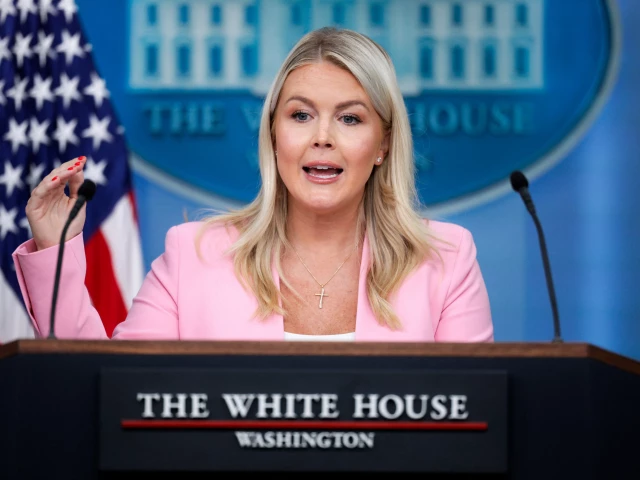
The White House on Thursday said Iran continued to talk to the US and wanted to make a deal, despite the US launching strikes on Iran after the latter violated the memorandum of understanding by firing on commercial vessels in the Strait of Hormuz.
“I’ve spoken with the president about this … Iran very much continues to talk to the United States of America and express that they want to make a deal with us because they are suffering devastating blows on behalf of our United States military,” White House
spokesperson Karoline Leavitt said while responding to a question during a press briefing.
"The reason for the recent strikes over the course of the last several days is because Iran violated the memorandum of understanding that we struck with them," she added.
Reporter: President Trump recently said it’s a waste of time dealing with Iran; they’re liars, there is something wrong with them. Vice President JD Vance said on Joe Rogan that he’s very frustrated with the Americans and frankly people in other countries that say you cannot… pic.twitter.com/HccWWqu5dD
— RedWave Press (@RedWavePress) July 16, 2026
"Specifically, in the memorandum of understanding that they signed, they were not to fire on commercial vessels moving through the Strait of Hormuz, and unfortunately, they have made
the tragic decision for them to do that," said the spokesperson.
Karoline said that the Strait of Hormuz is open to ships not travelling to or from Iranian ports and that the US Navy remains there "to ensure that it can take place."
While reiterating the US commitment, she said that President Donald Trump remained open to diplomacy with Iran.
"The president will hold them accountable when they turn their back on the words that they state to the United States. But he is always open to diplomacy at the very same time," Leavitt told reporters.
Houthi leader calls US, Israel ‘source of evil, instability’
Earlier, the leader of Yemen’s Houthi rebels, Sayyed Abdul-Malik Al Houthi, had accused the US and Israel of fueling global instability while blaming the Saudi leadership for advancing US and Israeli objectives in the region in a televised address.
According to a report by Al Jazeera, al-Houthi said that “the United States and Israel are the source of evil and instability in the world.”
🔴 Leader of Yemen's Ansarullah Movement Abdul Malik Al-Houthi delivers speech
— Press TV 🔻 (@PressTV) July 16, 2026
🔺 Al-Houthi: If the oppressed do not seek justice, tyrants will continue their oppression unchecked
🔺 Al-Houthi: Zionists are worst of tyrants
🔺 Zionists show no respect for humanity pic.twitter.com/E8VVNwwmEy
He added that the US, Israel and their allies “fuel instability through warmongering and the plundering of the wealth of nations, from Palestine to other regions”.
Al Houthi also said that Israel’s aim of changing the map of the Middle East to create a “Greater Israel” is the “driving force behind all the wars in the region”.
“This axis has no respect for international agreements and United Nations resolutions, but also boasts of genocide against nations and the destruction of civilisations,” Al Houthi added.
He alleged that Saudi Arabia’s attacks on Yemen were ongoing for years, had no legal justification, and were “carried out within the framework of alignment and loyalty to the United States and Israel”.
US VP Vance slams Israeli effort to thwart peace talks with Iran
US Vice President JD Vance said some members of the Israeli government had tried to influence US public opinion to oppose a deal by the US to end the war with Iran, in a podcast episode with host Joe Rogan posted on Wednesday.
The comments echoed earlier criticism of Israeli government policy by Vance, who many view as a potential future presidential candidate, in a widening public rift between the two countries. "You have seen this very discreet, extremely well-funded campaign to try to derail the negotiation and try to derail the deal,” he said.
“A bunch of people who have quite literally been paid by a former Trump campaign person who was himself paid by certain elements within the Israeli government. And those people are attacking me viciously,” he added.
Vance defended a deal reached last month to end the war with Iran, which critics in the US and Israel have slammed for failing to curb Iran's missile program and providing no clear path to dismantling its nuclear facilities, while constraining Israel in its war with Hezbollah militants in Lebanon.
"I know beyond a shadow of a doubt that there have been people within the Israeli government who are trying to, like, actually shift us away from that policy because they want to continue the military campaign," Vance said.
JD Vance exposes Israel:
— Clash Report (@clashreport) July 15, 2026
I know beyond a shadow of a doubt that there have been people within the Israeli government who are trying to actually shift us away from that policy because they want to continue the military campaign.
There are some people within their system, we know… pic.twitter.com/KG163nrgfP

The vice president said that, while he has "good relationships" with some members of the Israeli government, "there are some people within their system that we know beyond a shadow of a doubt that are manipulating and trying to change American public opinion to keep the war going on indefinitely".
He said that many countries, allies and adversaries try to influence American policy and that "it doesn't bother me that Israel tries to do this, it frankly doesn't even bother me that Russia or some of these other countries do it". He said it was "just the nature of being a political leader in 2026".
"What does bother me is when those operations, those influence campaigns, actually affect American political judgment," said the vice president.
Vance lashed out at Israeli critics of the Iran deal in June, saying President Donald Trump is Israel's only ally, in a sharp rebuke that referenced the billions in US defence aid the country receives.
Israeli senior officials, speaking anonymously, have said the deal's terms were bad for Israel because they failed to address concerns over Iran's nuclear and ballistic missile program, a view they say is shared across Israel's leadership.
When asked if he thought the US would have engaged in the most recent war with Iran were it not for Israeli influence, he said, "yes, yes I do." "I think the president, separate from any influence from Israel, believes very strongly, and again I agree with this, that Iran should not have a nuclear weapon," he added.
The Israeli Prime Minister's Office did not immediately respond to a request for comment.
'Barbaric attack': Baghaei condemns US strike near children's cancer hospital in southwestern Iran
Iran condemned the United States' “barbaric attack” on a cancer hospital in Iran’s southwest after it was forced to evacuate because of nearby heavy air strikes.
“This barbaric attack – reminiscent of Israel’s atrocities against healthcare facilities – caused severe suffering and anxiety upon the hospitalised children,” Iran's Foreign Ministry spokesman Esmaeil Baghaei posted on X.
Shahid Baqaei Hospital, a children's cancer treatment centre in Ahvaz, was evacuated last night after the US attacked a nearby location.
— Esmaeil Baqaei (@IRIMFA_SPOX) July 16, 2026
This barbaric attack, reminiscent of Israel’s atrocities against healthcare facilities, caused severe suffering and anxiety upon the… pic.twitter.com/xv3W7SY2X9
He said that the attack “ caused severe suffering and anxiety upon the hospitalized children, and forced the emergency evacuation of 211 patients undergoing chemotherapy".
"This constitutes a cowardly war crime against the most innocent of human beings — children who are bravely fighting for their lives."
In a separate interview with Press TV, he further said the US aggression against the country was a "blatant violation" of international law and the MoU signed between the two parties.
When asked about any further room for diplomacy, Baghaei said that "we are focused on defending our territory, our national security and we have to continue as long as it takes."
"This is a crime of aggression that is committed by the US against Iran, and our armed forces have resolutely responded to these attacks. They are determined to continue defending our sovereignty and territorial integrity."
There was no immediate US response for the strikes.
Kuwait military responding to new Iranian drone attacks
Kuwaiti air defences are confronted attacks by “hostile drones” as strikes on the US’s Gulf allies continued on Thursday.
“The General Staff of the Army notes that any explosion sounds heard are the result of air defence systems intercepting the hostile attacks,” the military said in a statement on X, denouncing “the sinful Iranian aggression”.
JUST IN: KUWAIT SAY AIR DEFENSE IS CURRENTLY ACTIVE AGAINST DRONES pic.twitter.com/s5rmv2LvEW
— Sulaiman Ahmed (@ShaykhSulaiman) July 16, 2026
“Everyone is requested to adhere to the security and safety instructions issued by the competent authorities,” it added.
Iran will 'neutralise US interventions in the region', says army spokesperson
Iran said on Thursday that the Strait of Hormuz was an inviolable "red line", warning that if US President Donald Trump carried out his threat to attack Iran's infrastructure, it would strike all infrastructure across the Gulf region.
The US launched a fifth night of attacks on Wednesday and reimposed a naval blockade of Iran's ports, which Washington says is aimed at reopening the Strait of Hormuz, closed by Iran last Saturday after a fragile truce collapsed.
Spokesperson for the Iranian army Brigadier General Mohammad Akaminia stressed over Iran's strategy in controlling the Strait of Hormuz, and said that "We will undoubtedly resist until the end and will neutralise the US' interventions in the region," according to IRNA on.
Spokesperson for the Islamic Republic of Iran Army Brigadier General Mohammad Akaminia, stresed Iran's definitive strategy in controlling the Strait of Hormuz, and said: "We will undoubtedly resist until the end and will neutralize US' interventions in the region." pic.twitter.com/wOBJtiY6qj
— IRNA News Agency ☫ (@IrnaEnglish) July 16, 2026
The news outlet stated on its X account that the US "miscalculated" that striking certain bases would allow it to take control of the strait, and asserted that Iran can enforce its "dominance" over the strait "regardless of coastlines or islands".
Akraminia said that the Strait of Hormuz, which carried about a fifth of global oil and gas shipments before the war, was a "red line" for Iran over which it maintains firm control.
"The Islamic Republic of Iran has the ability to exert control over the Strait of Hormuz from every single point of its territory, and this matter is never dependent on coasts and islands."
Israel tells Pentagon chief it will keep troops in occupied ‘security zones’
Defence Minister Israel Katz told US counterpart Pete Hegseth that Israel will keep its forces in “security zones” carved out inside Lebanon, Syria, and the Gaza Strip, according to Al Jazeera.
In a statement, Katz’s office said the two men spoke overnight and the minister “emphasised Israel’s determination to remain in the security zones in Syria, Gaza, and Lebanon in order to protect Israel’s borders and communities”.
The conversation comes despite a US official saying the staunch allies made progress on a plan for Israel to withdraw from “pilot zones” in southern Lebanon, following two-day US-mediated diplomatic talks between Lebanon and Israel in Italy that ended on Wednesday.
Sites in western Iran come under attack amid US escalation, no casualties reported
Several sites in Kabudarahang County in western Iran's Hamadan province came under attack early Thursday amid a new wave of US strikes, with no casualties reported, Iran's Fars News Agency said, citing a local official.
Hamzeh Amraei, political and security deputy at the Hamadan Governor-General's Office, said all provincial and county emergency and relief agencies were on full alert and prepared to respond to any emergency.
The attack followed the latest wave of US strikes on Iran announced by the US Central Command (CENTCOM) hours earlier.
US attacks areas near Iranian hospital
IRIB reported on Thursday that US forces struck areas near Ahvaz’s Shahid Baghaei Hospital, which IRIB said treats children with cancer.
U.S. forces attacked areas near Ahvaz’s Shahid Baghaei Hospital, which treats children with cancer. The facility is being temporarily evacuated following the strikes. Families have moved into the streets to ensure their children's safety.
— IRIB (Islamic Republic of Iran Broadcasting) (@iribnews_irib) July 15, 2026
"Families have moved into the streets to ensure their children's safety."
Iran trades strikes with the US
IRIB reported on the specific US assets targeted during strikes on the Sheikh Isa Air base in Bahrain.
US Army Super Hawk radars, facilities, and Patriot systems were targeted using Arash suicide drones.
Iranian Army: US Army Super Hawk radars, facilities, and Patriot systems at Sheikh Isa Air Base, Bahrain, were targeted using #Arash suicide drones.
— IRIB (Islamic Republic of Iran Broadcasting) (@iribnews_irib) July 16, 2026
Additionally, IRIB reported that Iranian air defence systems shot down a US MQ-9A Reaper drone over the city of Andimeshk in the Khuzestan Province.
Iranian air defense systems have shot down a U.S. Air Force MQ-9A Reaper drone over the city of Andimeshk, Khuzestan Province, Iran.
— IRIB (Islamic Republic of Iran Broadcasting) (@iribnews_irib) July 16, 2026
Drones downed over Iraq's Erbil: Kurdish forces
The US-led coalition shot down several drones on Wednesday over Erbil, the capital of Iraq's northern Kurdistan region, Kurdish forces said.
AFP journalists reported seeing several drones hovering over Erbil, before being hit by air defences, resulting in explosions and visible smoke near the US consulate, which was a target of repeated drone and rocket attacks during the Middle East war.
These are the first reported drone attacks near the consulate in Erbil since a fragile ceasefire began in April.
Kurdish counterterrorism forces said that "coalition forces downed and destroyed eight explosive-laden drones over Erbil between 8:53 and 9:20 PM (10:53pm and 11:20pm PKT)".
No group has claimed responsibility for any attacks, and no casualties were reported.
They coincide with Iraqi Prime Minister Ali al-Zaidi's one-week visit to Washington, where he met Trump, and also come against the backdrop of renewed military escalation between the United States and Iran.
During the Middle East war, the Kurdistan region, which hosts US troops and numerous foreign oil companies, was a primary target for drone attacks, carried out mostly by pro-Iran Iraqi armed groups.
Those groups, operating under the umbrella of the Islamic Resistance in Iraq, targeted US facilities in Iraq more than 600 times in support of Tehran.
Zaidi has given pro-Iran armed groups, which Washington designates as terrorist organisations, until September 30 to disarm, coinciding with the end of the US-led coalition's mission.
While some armed groups have said they would cooperate, others remain firm in their refusal to disarm, instead vowing to strengthen their capacities.
Since the start of the war, and even after the ceasefire, Iran has also repeatedly struck Iranian Kurdish rebel groups, which have camps and bases in Iraq's Kurdistan.
Iran threatens to ‘crush’ regional infrastructure if US attacks Iranian infrastructure
Brigadier General Ebrahim Zolfaghari, spokesman for Iran’s Khatam al-Anbiya Central Headquarters, has threatened to respond to any US attacks on Iranian infrastructure with strikes on regional infrastructure, according to Al Jazeera.
In a statement carried by Iranian state media, he said if Trump follows through on his threats, “all the infrastructure in the region will be crushed under the steel blows of the powerful armed forces of the Islamic Republic of Iran, so that no trace of them will remain, as if they had never existed in the first place.”
He also said Iran will not allow US interference in the Strait of Hormuz.
“Under no circumstances and in no way will we allow America, as a foreign and extra-regional country, to interfere in the Strait of Hormuz. This is Iran’s invincible red line,” he said.
Iraq PM condemns 'drone attack' over Erbil
Iraqi Prime Minister Ali al-Zaidi condemned a "drone attack" that violated the airspace of Erbil in the northern Kurdistan region, his office said Thursday, after several drones were shot down.
"We have directed the relevant security agencies... in coordination with the Region's security forces, to take all necessary measures to prevent the recurrence of such attacks and to thwart anyone attempting to harm the security of our noble Iraqi society, wherever they may be," he said, without identifying the source of the drones.
IRGC claims missile attack on Jordan airbase
The IRGC claimed missile attacks on Jordan’s Azraq airbase after attacking the same base with drones, according to Al Jazeera.
In a message addressed to the Jordanian people, the IRGC said its forces “targeted and destroyed the American fighter jet storage ramp and the new American command and control centre in West Asia in a very large base in Al-Azraq, Jordan, with Khyber-Shakan ballistic missiles”.
It said the strikes were in retaliation for US attacks that forced the evacuation of 121 children with cancer in Ahvaz, as well as US attacks in March that killed 168 children at a school in Minab.
It urged the Jordanian public not to allow their land to be used “for these crimes against children”.
The IRGC statement came after the Jordanian military said it intercepted eight Iranian missiles this morning.
US completes 'wave of strikes' on Iran as Tehran retaliates with attacks on military bases in Bahrain, Jordan, Kuwait
The US launched two waves of attacks on Iran's coastal defences and missile sites on Wednesday after reimposing a naval blockade of its ports, while Iran struck back by targeting US military sites in neighbouring countries in what it called an "existential war" with America.
The latest escalation comes days after a fragile truce collapsed, raising the spectre of a return to full-scale war, with Iran once again threatening to shut off more regional energy exports.
— U.S. Central Command (@CENTCOM) July 16, 2026
Hostilities have intensified since Iran said late on Saturday it had closed the Strait of Hormuz. Military operations are also keeping ships from transiting the vital artery, which carried about a fifth of global oil and gas shipments before the war. Brent crude oil, the international benchmark, closed at a one-month high of $84.95 a barrel on Wednesday.
US Central Command said the military had attacked coastal defence systems and cruise missile storage and launch sites on Iran's Greater Tunb Island starting around 6am EDT (3pm PKT), then launched a second wave of strikes against multiple cities nine hours later.
Read: 'They better behave,' Trump warns Iran amid fresh hostilities
"US forces struck Iranian command centres, air defence sites, missile and drone capabilities, and coastal surveillance facilities," it said in a statement, adding it also hit targets in Bandar Abbas, home to Iran's largest port and key navy and Iran's Revolutionary Guards facilities on the Strait of Hormuz.
"Earlier this morning, American forces struck coastal defence and cruise missile sites on Greater Tunb Island during a 90-minute wave," the US military added.
The Islamic Revolutionary Guard Corps said on Wednesday it had struck US military targets in the region, including in Bahrain, Kuwait and Jordan. The Guards said they targeted a gathering for US military personnel and a radar system at Ali Al Salem air base in Kuwait with a missile and drone attack.
مرحله دهم عملیات صاعقه ارتش؛ پایگاهها و مراکز آمریکا در کویت و بحرین هدف حملات پهپادی ارتش قرار گرفت pic.twitter.com/5lIDMjpJSC
— خبرگزاری ایسنا (@isna_farsi) July 16, 2026
The Bahraini Defence Ministry said the country's air defence systems had intercepted and destroyed a number of Iranian aerial attacks targeting the kingdom on Thursday.
Three US officials told Reuters that US strikes aimed at forcing open the strait are also targeting Iranian military capabilities that the US would want to destroy before executing more complex operations.
The US military also said it disabled an unladen oil tanker attempting to sail toward Iran's Kharg Island after it ignored multiple warnings, firing Hellfire missiles into the ship's smokestack. Since resuming a naval blockade against Iran on Tuesday, the US has redirected two ships and disabled another, the military said.
Iranian news media reported a series of explosions, mainly in coastal areas such as Bandar Abbas. Other explosions or projectile strikes were reported around the city of Ahvaz, just inland from the northern end of the Gulf, and Konarak, Sirik and Qeshm in southern Iran.
Press TV reported at least two explosions in the central Iranian city of Khondab, about 250 km (155 miles) southwest of Tehran. Mehr news agency reported Iran activated its air defences in Tehran to counter hostile threats.
Iranian state broadcaster the Islamic Republic of Iran Broadcasting (IRIB) reported that the US attacks struck near a hospital in Ahvaz that houses a pediatric cancer centre, forcing the temporary evacuation of the hospital. Families have come out to the streets around the hospital to care for their children, the IRIB said.
Read more: Iran vows to defend ‘every inch’, says MoU with the US no longer stands
After the first wave, Tehran's top negotiator, Mohammad Bagher Ghalibaf, issued a statement declaring that Iranian security depended on maintaining what he called "Iranian arrangements" in the strait.
"We are in an essential and existential war with America," Ghalibaf said.
The war has killed thousands of people and displaced millions, mainly in Iran and Lebanon, where the conflict restarted between Israel and Hezbollah. In July alone, US attacks have killed 35 people, Tasnim reported, citing a health ministry official.
Jordan says it intercepted 8 Iranian missiles
Jordan's Armed Forces announced on Thursday that their air defence units intercepted eight Iranian missiles aimed at the kingdom during the early morning hours
According to a statement from a military official at the General Command of the Jordanian Armed Forces carried by Roya News, the interceptions were part of defensive and operational efforts to protect the country's sovereignty, secure its airspace and ensure the safety of its citizens.
The military confirmed that the incident resulted in no casualties or property damage.
It also said that teams from the Royal Engineering Corps were deployed to collect missile debris that landed in various parts of the country, securing the affected areas in line with established technical and security protocols.
The military official emphasised that Jordan's armed forces remain on full alert and continue to monitor the nation's airspace, warning that any threat will be addressed in accordance with the military's rules of engagement.
The statement came amid escalating tensions between the US and Iran over the Strait of Hormuz, with the two sides exchanging attacks despite a Pakistani-mediated memorandum of understanding aimed at ending their conflict and reaching a lasting peace agreement.
Lebanon calls for end to Israel’s occupation
Lebanon’s Foreign Minister Youssef Raggi has said that the goal of the country’s armed forces is to “gradually extend their authority over all Lebanese territory, including the south”, according to the National News Agency (NNA), as per Al Jazeera.
Speaking at a conference held by the French Senate in Paris, he said achieving this objective remains contingent upon a complete Israeli withdrawal from all Lebanese territory.
“No state can complete the building of its institutions and sovereignty while part of its territory remains under occupation. Occupation undermines state institutions, fuels tensions, delays the return to political and security stability, and prevents the state from exercising its full authority over its territory,” Raggi said.
The minister also said that the decision to end Hezbollah’s military presence was not “a response to external pressures, nor the fruit of diplomatic negotiations, but rather an expression of a pure national will”.
Trump says Iran wants to settle
Trump struck a triumphant note, as he has repeatedly since the US and Israel started hostilities on February 28, saying, "We'll have Iran defeated soon. They'll be defeated very soon."
Speaking at a roundtable event at the Pennsylvania Defence and Innovation Summit, Trump also claimed the Iranians want to "settle so badly."
"They don't like what we're doing, and they do want to settle. We'll find out whether or not we settle with them, or we just finish it off," Trump said.
On Tuesday, Trump said US negotiators had been in touch with their Iranian counterparts to tell them "you better make a deal."
Iran's military spokesperson said that the only way to reopen the Strait of Hormuz was for the US to comply with the 14-point memorandum of understanding that the two sides signed in June, and the implementation of "Iranian regulations" regarding ship traffic in the strait.
Even amid the hostilities, there was a possible sign of goodwill. Trump said Iran had allowed an American who was "wrongfully detained" under the Biden administration in 2024 to leave the country.
"The United States of America appreciates this gesture of Goodwill by Iran," Trump wrote on Truth Social.
Human rights attorney Jared Genser identified the released American as Dena Karari, who had been prevented from leaving Iran since December 2024.
"Dena is now safe and travelling back to the United States," Genser wrote on X, thanking Trump for his efforts to free her.










This material may not be published, broadcast, rewritten, redistributed or derived from. Unless otherwise stated, all content is copyrighted © 2026 The Express Tribune.






COMMENTS (2)
Comments are moderated and generally will be posted if they are on-topic and not abusive.
For more information, please see our Comments FAQ