Israeli minister under fire over 'inhumane' Gaza remarks
Updated 3 hours ago

The burial in Mashhad in northeast Iran follows a week of mass funeral processions, rallies and mourning ceremonies
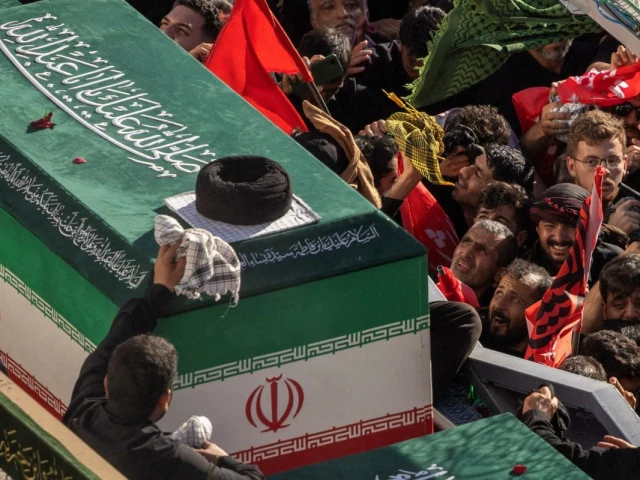
Iran buried its slain Supreme Leader Ayatollah Ali Khamenei at a shrine in Mashhad, the culmination of a week of mass funeral processions and rallies. Khamenei was assasinated in a US airstrike on the first day of the war on February 28.
Khamenei's body was carried by truck slowly through crammed streets towards the Shrine of Imam Reza. Black-clad mourners waved Iranian flags, photographs of the late leader and red placards with revolutionary slogans.
Braving sweltering heat and calling for revenge, Iranians loyal to the Islamic Republic massed on Thursday for the burial of slain supreme leader in his hometown of Mashhad.
Thousands of people filled the streets of the eastern city of Mashhad, home to one of the holiest sites in the Shia branch of Islam, which is prevalent in Iran.
With new hostilities breaking out with the United States even after an accord last month to end the war, at least one fighter jet escorted the plane carrying the late Iranian leader's coffin to Mashhad.
The burial marked the final act in a six-day series of funeral ceremonies that allowed people to pay tribute in Tehran, the clerical hub of Qom, and also Iraq.
Men wore black shirts while women were clad in black chadors, many waving red flags that symbolise the search for vengeance in Shia Islam, AFP correspondents said.
"People here all seek revenge," said Mohammad Afsharian, 41, a shop owner.
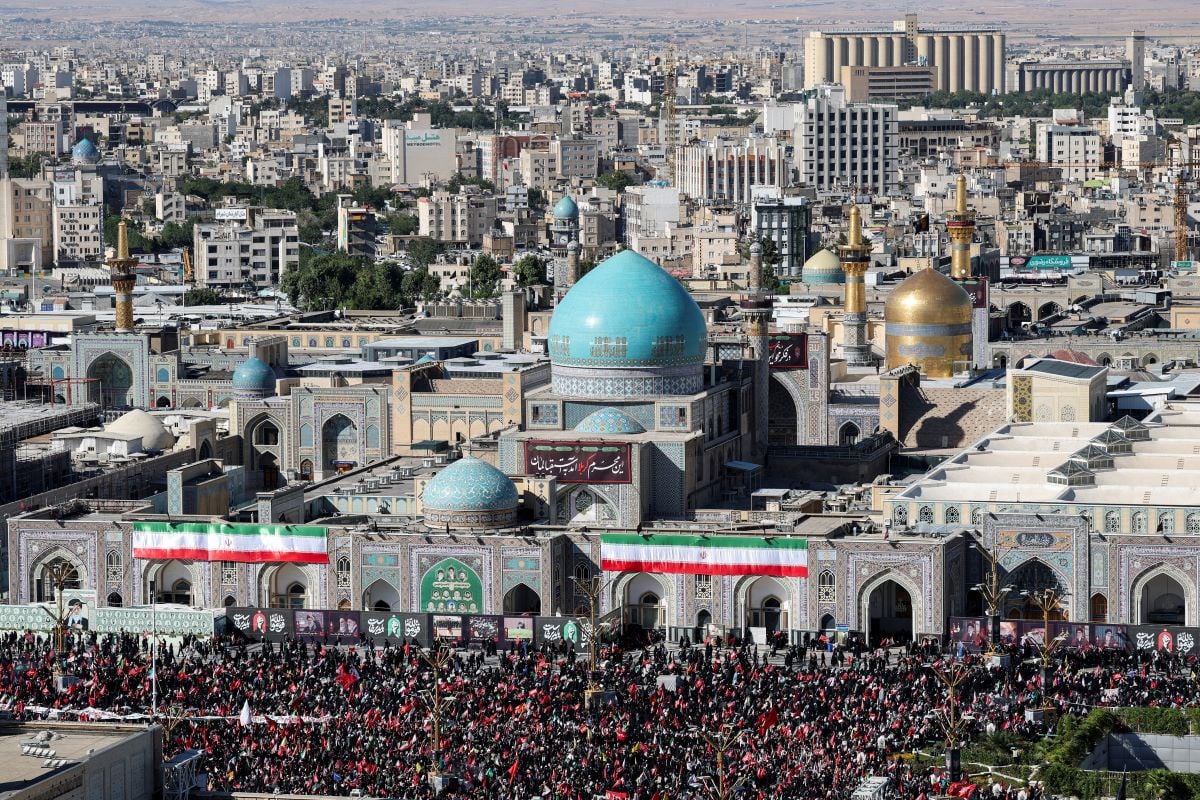
Mourners gather by Imam Reza shrine, on the day of of the burial of Iran's late Supreme Leader Ayatollah Ali Khamenei, who was killed on February 28 in Israeli and US airstrikes, in a culmination of a mass funeral, in Mashhad, Iran, July 9, 2026. REUTERS
"I don't know what's the story with diplomacy and what's the policy to continue diplomacy, but all the people are carrying red flags in a sign of seeking revenge," he said.
'There will be blood'
Observers have been watching closely for any signs of Khamenei's son and successor, Mojtaba Khamenei, who has yet to make any public appearances and was said to have been injured in the same strike that killed his father.
Mashhad Governor Hassan Hosseini was quoted on state television as saying he "expects 15 million people" to attend Khamenei's funeral.
Near the mausoleum, many children were present. Many came with their families, wearing caps in the colours of the Islamic Republic.
With temperatures reaching 35C, water sprinklers were used to keep the faithful cool.
At the foot of a hotel called Miami, a giant banner showed a caricature of US President Donald Trump with a bounty on his head.
Another sign showed Israeli Prime Minister Benjamin Netanyahu with a message in English: "There will be blood."
The funeral was originally scheduled to begin on Thursday at 6:00 am (0230 GMT), but local media later cited organisers as saying it would begin at 2:00 pm because ceremonies in Iraq had run late.
Meanwhile, the eruption of fighting forced the closure of the rail link between Tehran and Mashhad, a city located about 800 kilometres (500 miles) east of the capital. Road transport was being organised for stranded passengers, the state rail company said.
'Here for our martyred leader'
According to the official IRNA news agency, Khamenei was to be buried Thursday evening in the Shrine of Imam Reza, Iran's most revered place of worship.
Imam Reza is the only one of the 12 Shia imams buried in Iran.
The prayer was to be led by Hossein Noori Hamedani, a 101-year-old ayatollah and conservative figure in the Islamic Republic.
Khamenei's funeral ceremonies included a series of locations reflecting the religious, political and ideological pillars of the Islamic Republic.
His chief of staff, Mohammad Mohammadi-Golpaygani, had previously said on state television that Khamenei himself had wished to be buried in Mashhad.
Several notable figures have been buried in the shrine over the centuries, including former Iranian shahs and former president Ebrahim Raisi, who died in a helicopter crash in 2024.
The Islamic Republic hopes the ceremony will project strength and unity following the Middle East war and six months after a crackdown on anti-government protests.
"We are here for the sake of our martyred leader, Seyyed Ali Khamenei, for Iran, or my country, for my beliefs, for Seyyed Mojtaba Khamenei, for the existence of Iran that ages for millennia and had thousands of years of civilisation," said shop owner Afsharian.
Khamenei was to be buried with his infant granddaughter, son-in-law, daughter and Mojtaba Khamenei's wife Zahra Haddad Adel, who were all killed in the February 28 strikes.
Read: US military carries out fresh strikes on Iran, prompting Iran attacks on Kuwait and Bahrain
Crowds marched through Mashhad on Thursday morning, the golden dome and minarets of the Shrine of Imam Reza glinting in the morning sun, as they waved Iranian flags, photographs of the late Khamenei and placards with revolutionary slogans.
As Khamenei's body was transported around Iran and Iraq over the past week, the Islamic Republic's clerical leaders encouraged huge crowds to attend in an effort to vaunt the might and ideological fire of their state.
However, despite it having survived a months-long blitz by its strongest enemies, the United States and Israel, Iran faces internal challenges and the legacy of Khamenei's 37-year rule is bitterly disputed.
'Kill Trump' placards appear at burial ceremony
The whereabouts of Mojtaba Khamenei, proclaimed supreme leader by a clerical assembly a week after his father's death, have remained a mystery to Iranians.
He has not appeared in public since the war began with the strike that killed Ali Khamenei on February 28, and while he has issued written statements, no image or video or voice recording of him has been issued.
He suffered debilitating injuries in that same strike, his face disfigured and limbs badly wounded.
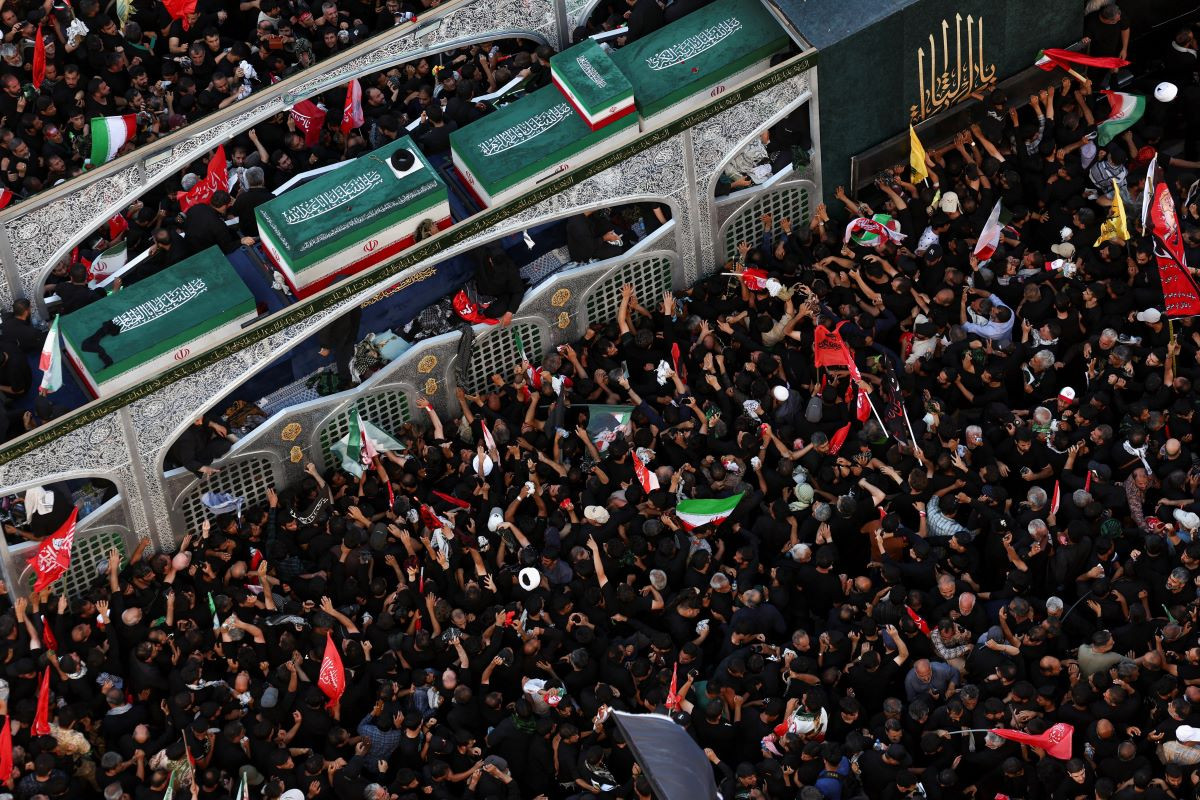
Mourners gather around a vehicle transporting the coffin of Iran's late Supreme Leader Ayatollah Ali Khamenei, who was killed on February 28 in Israeli and US airstrikes, and coffins of his family members, on the day of his burial, in a culmination of a mass funeral, in Mashhad, Iran, July 9, 2026.PHOTO: REUTERS
Senior sources in Tehran have said he is recovering but that he has not yet been well enough to manage public appearances and state security services are also trying to limit his exposure in case of more US attacks.
As crowds jostled in Mashhad awaiting Khamenei's funeral cortege, the crowd chanted slogans demanding revenge on US President Donald Trump for his murder.
“I swear by the blood of the supreme leader, Trump, we will kill you!” they shouted, with women holding up placards reading "Kill Trump".
Khamenei's remains, along with those of four family members killed alongside him, have already been paraded through Tehran, the clerical centre of Qom, and the Iraqi shrine cities of Najaf and Karbala.
At each event, huge crowds have thronged the streets to the mournful accompaniment of sung laments and chanted revolutionary slogans.
Martyrdom holds a central place in Islamic theology, and Khamenei's death at the hands of foreign enemies has played into a religious and political tradition that runs deep through the Islamic Republic.
Khamenei's long rule and legacy
The funeral comes at a critical moment for Iran, turning the page of nearly four decades of Khamenei's rule and months after the latest round of foreign-fuelled and funded mass nationwide protests against the Islamic Republic.
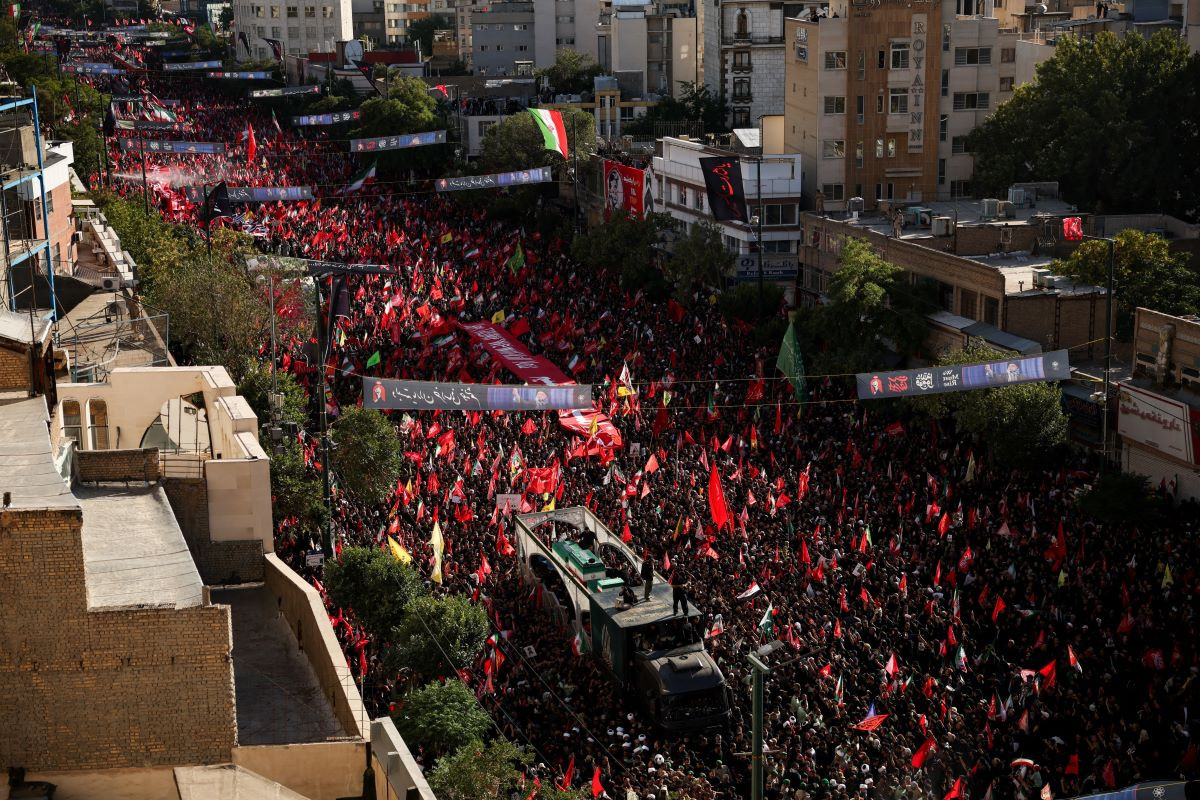
Vehicle transports the coffin of Iran's late Supreme Leader Ayatollah Ali Khamenei, who was killed on February 28 in Israeli and US airstrikes, and coffins of his family members, on the day of his burial, in a culmination of a mass funeral, in Mashhad, Iran, July 9, 2026. REUTERS
Security forces put down that unrest, sparked by anger over the sanctions-throttled economy and fanned along by Israeli and US support, which resulted in the deaths of many protesters.
While analysts see Iran as having emerged from the war strategically strengthened, with its grip over the vital Strait of Hormuz intact, it has suffered widespread damage due to the US and Israel's bombing of civilian and oil infrastructure, which has added to internal economic woes.
The late Khamenei was appointed supreme leader in 1989, a decade after the Islamic revolution, and over the decades he consolidated political, economic and military power in his office.
That effort, which increasingly marginalised the elected president and parliament, was conducted in concert with the Islamic Revolutionary Guard Corps, which grew in influence throughout Khamenei's rule.
Mojtaba Khamenei was appointed with the backing of the Guards, who are now seen as the dominant force in Iranian political and strategic thinking.



This material may not be published, broadcast, rewritten, redistributed or derived from. Unless otherwise stated, all content is copyrighted © 2026 The Express Tribune.
COMMENTS (1)
Comments are moderated and generally will be posted if they are on-topic and not abusive.
For more information, please see our Comments FAQ