Banks urged to focus on private credit
Updated 10 hours ago

Aurangzeb announces finance task force, AI tax model & privatisation
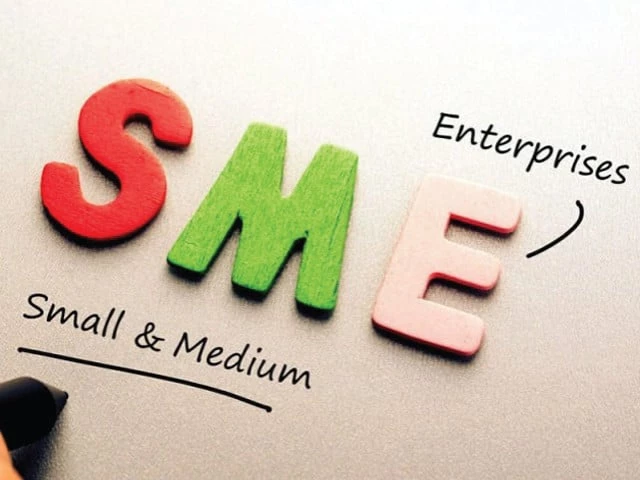
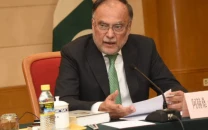
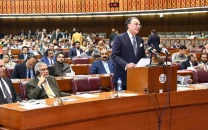
Federal Minister for Finance and Revenue Senator Muhammad Aurangzeb on Tuesday announced the formation of a dedicated SME Finance Task Force to expand access to credit for small and medium enterprises, declaring that "lending to SMEs can no longer remain a limited initiative of a few banks but must become an industry-wide priority."
Addressing the second Pakistan Banking Summit 2026 (PBS'26), organised by the Pakistan Banks Association (PBA), Aurangzeb said the State Bank of Pakistan (SBP) would lead the task force, which would include representatives from the PBA, Smeda, chambers of commerce and industry, and the Ministry of Finance.
"We cannot have SMEs not getting access to finance going forward. It's as simple as that," the minister emphasised and called for moving beyond "lip service" and making SME financing a collective responsibility across the banking sector. The announcement came during the opening session of the summit, which brought together over 600 participants, including bankers, regulators, policymakers, and international experts for two days of dialogue on Pakistan's financial future.
Aurangzeb underscored that the banking industry remains "absolutely critical" in Pakistan's journey from economic stabilisation to sustainable, investment-led growth. He urged banks to significantly increase lending to priority sectors, including SMEs, exporters, agriculture, manufacturing, construction, and IT.
He revealed that a constructive meeting was held with bank CEOs the previous day in the presence of the SBP governor, during which the need for broader access to SME credit was discussed at length. He welcomed the continued scaling up of risk-sharing and partial guarantee schemes, particularly for SMEs and small farmers, to mobilise private capital. He also reaffirmed the government's commitment to subsidised financing, especially for export-oriented sectors.
The finance minister painted an encouraging picture of economic performance in the last fiscal year. He highlighted an all-time low fiscal deficit, a debt-to-GDP ratio well below 70%, and a GDP growth hitting 3.7% on the back of a strong rebound in large-scale manufacturing.
Current account performance remained robust, supported by record remittance inflows. Aurangzeb said remittances were expected to close between $41 billion and $42 billion for the year. Foreign exchange reserves are projected to stay higher, at $18 billion, than earlier estimates, while value-added exports, particularly textiles, continue to show year-on-year growth despite pressure in the food segment.
In the capital market, company registrations crossed 300,000 for the first time, while 11 IPOs on the Pakistan Stock Exchange marked a 20-year high. Corporate profitability returned to double digits, with growing participation from Gen Z investors.
Utilising fiscal space for relief, growth
Aurangzeb explained that the government used the available fiscal space prudently. In response to the 2025 floods, Pakistan managed relief and rescue operations with locally mobilised resources without making international appeals.
In the budget, the Tax Policy Office, now under the Finance Division, led efforts with a focus on economic value rather than mere revenue arithmetic. Key relief measures included removal of super tax for businesses earning below Rs500 million, elimination of transaction taxes in construction, and zero duties on agricultural and industrial machinery to promote mechanisation and competitiveness. The government maintained the five-year tariff rationalisation roadmap despite requests for suspension, signalling policy consistency.
The minister announced work on a medium-term tax strategy in consultation with stakeholders. He also highlighted a major overhaul in tax administration: a new AI-led, technology-driven model that would minimise human discretion in assessments, audits, and notices to reduce harassment and improve trust. While acknowledging possible initial false positives, he described it as a fundamental shift necessary for a country of 250 million people.
Aurangzeb touched upon progress in the new economy. Parliament has passed the Virtual Asset Act 2026, establishing PVARA as a statutory regulator. NOCs have been issued to exchanges, a regulatory sandbox is live, and banks can now open accounts for licensed virtual asset service providers under strict compliance. The government is also exploring tokenisation of its outstanding international public debt, starting with Eurobonds.
On privatisation, he noted that PIA had been transferred to private hands, roadshows for three DISCOs had been completed, and more entities were in the pipeline. Banks were invited to actively participate in both buy and sell sides through investment banking and structured finance teams.
He also called for greater alignment with the State Bank's Green Taxonomy to accelerate financing for renewable energy, water management, and climate-smart agriculture.
The summit was inaugurated by Zafar Masud, Chairman PBA, who stressed collaboration for priority-sector financing, digital transformation, and financial inclusion. Keynote addresses were also delivered by Bilal Azhar Kayani, Minister of State for Finance, and senior officials from the SBP, Citi, the IFC, and Mastercard, among others.








This material may not be published, broadcast, rewritten, redistributed or derived from. Unless otherwise stated, all content is copyrighted © 2026 The Express Tribune.







COMMENTS
Comments are moderated and generally will be posted if they are on-topic and not abusive.
For more information, please see our Comments FAQ