'Imran Khan would not have spent three years in jail if he wanted a deal,' says Barrister Gohar
Updated 1 hour ago

Says Pakistan has been making all the efforts for the sake of regional peace and security
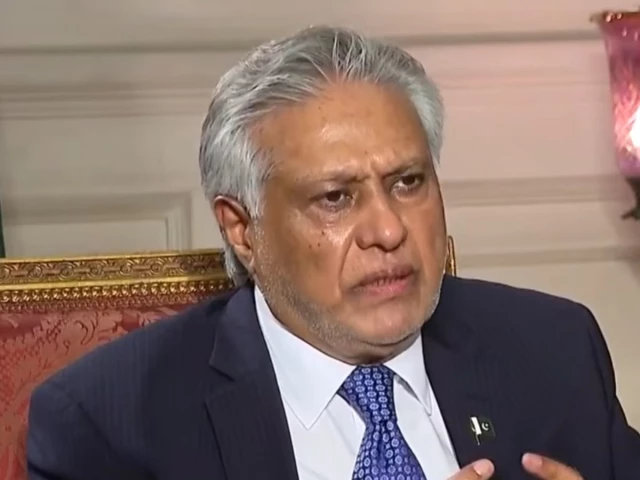
Deputy Prime Minister and Foreign Minister Ishaq Dar said on Tuesday that Israeli attacks on Lebanon had almost derailed the process ahead of US-Iran talks in Switzerland.
In an interview with Al Arabiya recorded before the Switzerland talks, Dar acknowledged that spoilers remained active, pointing to heavy Israeli bombing in Lebanon after the deal was signed, which he said “actually derailed everything and stopped everything”.
“This is something which actually is to provoke the parties to give a pause, don’t move,” he said, adding that wisdom had to prevail and that “the world community should convince and persuade and influence Israel not to do what they are doing”.
Exclusive Interview: Pakistan Foreign Minister Ishaq Dar tells Al Arabiya that Israeli attacks on Lebanon nearly derailed US-Iran talks, while confirming no fees will be imposed on ships passing through the Strait of Hormuz during the current 60-day period.@MIshaqDar50 pic.twitter.com/83jP94oQA3
— Al Arabiya English (@AlArabiya_Eng) June 22, 2026
Speaking about Iran’s stance on uranium, DPM Dar said that Iran was willing to downblend its enriched uranium stockpile and showed no resistance to the proposal during 21 hours of direct talks hosted in Islamabad in April.
Dar said the stockpile question, which US President Donald Trump framed as a demand for the elimination of what he called "nuclear dust", had been a central point of discussion during the April 10-11 sessions. "Iran was flexible to talk," Dar said. "Iran was not willing to give it to the US, the stockpile. But the neutral thing is that it can be downblended."
DPM Dar also said he had consulted International Atomic Energy Agency Director General Rafael Grossi on the mechanics of reducing Iran's stockpile, which Tehran claimed was enriched to above 60%, to 0.7% through downblending. He added that the quantity to be downblended remained subject to agreement, and noted that the question was complicated by the bombing of Iranian nuclear facilities.
"Iran was happy to DOWNBLEND its nuclear stockpile."
— Al Arabiya English (@AlArabiya_Eng) June 23, 2026
Pakistan Foreign Minister Ishaq Dar reflects on Iran's position during negotiations and the challenges that remain before a final agreement can be reached.@MIshaqDar50 pic.twitter.com/SG092X9BnD
"As long as it's not started being discovered and pulled out, it is already settled and the Iranian facilities have been bombarded. The question of a civil nuclear ban and the number of years it would run was also discussed," he said.
Dar added, "We have discussed a number of years' ban for civil-nuclear. We have discussed how to deal with the nuclear dust. Everything was discussed."
Saying the Islamabad Talks were the first direct contact between the US and Iran in 47 years, coming after Pakistan had already secured a ceasefire between the parties, Dar noted that the US delegation was led by Vice President JD Vance and included Steve Witkoff and Jared Kushner, while Iran sent parliamentary Speaker Mohammad Bagher Ghalibaf, Foreign Minister Abbas Araghchi and the secretary of the national security committee. Pakistan, meanwhile, attended in a mediator capacity, represented by Dar, Chief of Army Staff and Chief of Defence Forces, Field Marshal Asim Munir and the national security adviser.
The MoU itself, Dar said, went through dozens of rounds of shuttling between the parties, with Pakistan carrying draft proposals and amendments back and forth before the text was finalised. The unsigned ceremony originally planned for June 19 became redundant as Trump signed the document in France on June 17, followed by Iranian President Masoud Pezeshkian signing electronically and Prime Minister Shehbaz Sharif completing the process. "As long as the work is done, we should all celebrate and be happy," Dar said.
Read: What's in the MOU
Further, he discussed the nuclear matter, saying that it had been undertaken by one of three technical working groups formally convened under the Burgenstock process. The other two groups cover sanctions and the de-freezing of Iranian assets, as well as the situation in Lebanon. Dar said the parties had 60 days to reach a final deal, with the timeline mutually extendable, and that for certain items the deadline was 30 days.
DPM Dar also pushed back on speculation that the MoU was too vague, saying he had shared the text with the foreign ministers of Egypt, Saudi Arabia and Turkey and that "professionally we don't see anything which is negative in this memorandum." He added, "We should not doubt that, you know, going ahead there will be any negative playoff by any party."
Regarding sanctions on Iran, Dar noted that no sanctions would be lifted immediately and no assets would be unfrozen pending the conclusion of the nuclear and Lebanon tracks. He also acknowledged that whether sanctions relief would be formally coupled to nuclear progress was not definitively settled in the current document. "I hope they complete the work in 60 days," he said.
"No sanctions are being IMMEDIATELY lifted."
— Al Arabiya English (@AlArabiya_Eng) June 22, 2026
Pakistan Foreign Minister Ishaq Dar explains how sanctions, Iran's nuclear program, and Lebanon will be negotiated together during the next phase of the US-Iran talks.@MIshaqDar50 pic.twitter.com/QPBgPYOboa
Discussing his trip to Beijing at the invitation of the Chinese foreign minister, DPM Dar said the two sides agreed on a five-point peace proposal for the Middle East, one point of which addressed the Strait of Hormuz.
"We both agreed that there should be no fee, no permission, no permits, no toll, no additional charge, whatever you name it. And it should be free movement, Sea lanes should be freely moving both sides," he shared.
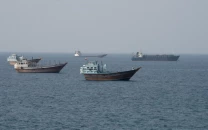
On Hormuz, Dar reiterated that Pakistan's stance remained unchanged. "No matter what you call it, service fee, toll or fee, whatever it is, or service charges, our understanding is there should be nothing," he said, adding that the pre-28 February status quo should be restored.
Read More: Beijing sees tougher US-Iran talks ahead
He also acknowledged the dispute over language in the MoU, with Iran maintaining it can levy what it terms service charges and the US rejecting any fees, but said a 60-day free passage guarantee was now in place and that ships had been moving freely since the MoU was signed.
Qatar also played a supporting role alongside Pakistan's mediation, Dar said, with Doha activating heavily to convince both sides in the rounds after April 11 and through to the final hours before signing. He also named Egypt, Saudi Arabia, the United Arab Emirates, Bahrain, Kuwait and Jordan as "bortherly countries" Pakistan remained in close contact with them throughout, as well as international partners including the European Union, Canada, Australia, Japan and China.
"Pakistan has been lucky to have a brother like Saudi Arabia."
— Al Arabiya English (@AlArabiya_Eng) June 22, 2026
Pakistan Foreign Minister Ishaq Dar reflects on Saudi Arabia's support for diplomatic efforts to advance the US-Iran negotiations.@MIshaqDar50 pic.twitter.com/3NXYkAEwd2
"Not only were we mediating between the US and Iran, but we were also keeping our allies, our friends in the region, connected with us and in that process, we saw that a regional forum has been created, which is Pakistan, Egypt, Saudi Arabia and Turkey, the four countries. You know, side by side, we were dealing with other Gulf countries, be it Qatar, Bahrain, Kuwait, Jordan, and also international partners, the European Union, then Canada, then Australia, Japan, China," Dar noted.
Also Read: Iran parliament, IRGC, army back leadership's conditions in US deal, warn against violations
Further, Dar said he had spoken with counterparts approximately 150 times since the conflict began on February 28, compared to 61 calls during the India-Pakistan confrontation, saying he was "250% more than how busy I was then." The FM also described Pakistan's involvement as driven by no personal vested interest, saying "Let's hope for the best, we have to be sincere to the cause."
He also noted that the country had suffered economically, with energy prices rising sharply, and that the government had temporarily subsidised fuel costs before passing relief on to consumers once prices fell. "Thank God in Pakistan we managed that there were no shortages like few countries but we had to work, you know, very, very hard under the leadership of Prime Minister Shehbaz Sharif to make sure it doesn't happen," he said.
"So I hope, you know, this stays because of the energy crisis, everybody has seen it has increased the prices sort of 80%." FM Dar said.
"Everybody SUFFERED."
— Al Arabiya English (@AlArabiya_Eng) June 22, 2026
Pakistan Foreign Minister Ishaq Dar reflects on the regional impact of the conflict and the urgency of reaching a final agreement.@MIshaqDar50 pic.twitter.com/ri4ZaKSyoo
He also said the UN Security Council system had shown itself incapable of enforcing compliance, citing Indian Illegally Occupied Jammu and Kashmir (IIOJK) and Gaza as examples. "You know, the UN Security Council system, which is meant for peace and security, seems not to be fully functional."
On Gaza, Dar said Pakistan and its R4 partners had agreed during the meeting to revive the Palestine cause, saying, "Look at the bloodshed in Gaza. Innocent lives are being killed every day. And hundreds of, you know, people are martyred."
"Conflict and confrontation take you NOWHERE."
— Al Arabiya English (@AlArabiya_Eng) June 22, 2026
Pakistan Foreign Minister Ishaq Dar reflects on the efforts to bring Washington and Tehran to the negotiating table and the economic costs of continued conflict.@MIshaqDar50 pic.twitter.com/tlqZKW1HK6
Describing himself as a "born optimist" on the prospects for a final deal, Dar noted, "With our efforts, with the global community, with the brotherly countries' support, these two countries will reach a final deal." He added, "No matter how big the wars you fight, at the end of the day, you have to sit on the table, talk, dialogue, and then find a way to diplomacy," he said, adding, "So that's what we have been working very hard on."



This material may not be published, broadcast, rewritten, redistributed or derived from. Unless otherwise stated, all content is copyrighted © 2026 The Express Tribune.

COMMENTS (1)
Comments are moderated and generally will be posted if they are on-topic and not abusive.
For more information, please see our Comments FAQ