Iran has detailed plans to hit Gulf undersea cables if war resumes, officials say
Updated 47 minutes ago

Iran says no current talks with US, talks with Oman over Strait of Hormuz only
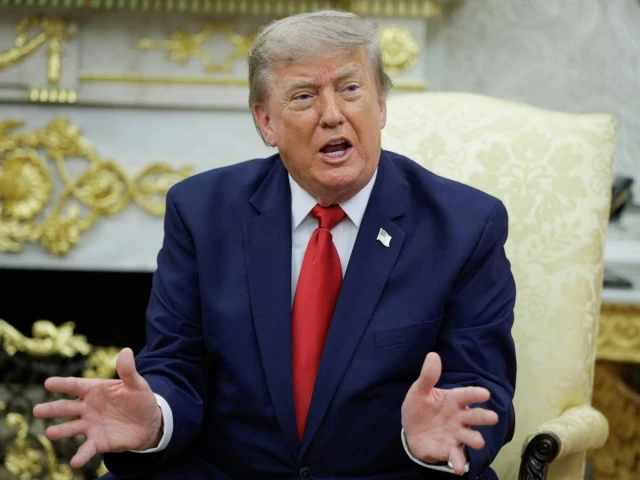
US President Donald Trump on Monday said Iran faced "decapitation" if it did not agree a pact to end the conflict between the two nations, saying Tehran had one last chance to strike a deal.
"I think we're going to maybe get something, but I want to give them every last chance before decapitation," he said, reiterating a threat to launch a major attack on Iran.
Earlier on Monday, after Iran said there were no talks under way, Trump slammed what he called Iran's "unbelievably duplicitous" leadership.
Trump, asked about the status of the negotiations, told reporters "they are going on right now," adding that the two sides were speaking at the request of Iran, Saudi Arabia, the United Arab Emirates and Qatar among others.
"This is a last chance for them to sign a good document," he said, referring to Iran.
Trump lashed out on Monday after Iran denied it was in negotiations with the United States, declaring in an angry social media post that a US military blockade would continue until there was a "Deal, or Total surrender."
Calling Iran "duplicitous" for "openly and proudly" saying it was not negotiating, Trump wrote: "Whether Iran wants to admit it or not, we are, in fact, talking of a solution to a problem that they have caused, for decades."
Read More: How Iran is widening its pressure campaign to force US concessions
Trump's statement on Truth Social came after Iran said there were no direct talks with Washington, as Trump had insisted there would be when he called off a threatened round of heavy bombing against Iran over the weekend, citing what he said were appeals from regional powers and Tehran.
The Iranian foreign ministry said on Monday that the only talks it was holding were with Oman to discuss plans for sharing control over the Strait of Hormuz, a vital passage for the global energy trade.
Trump insisted Iran had asked for talks -- "some would say 'beg'" -- but was now giving "their usual blather" about controlling Hormuz.
The strait, Trump insisted, "is already completely controlled by the United States Navy and our 'Blockade' or, as some say, 'The United States Wall of Steel!' Nothing gets through to Iran, unless we want it to, and nothing will get through, unless a Deal, or Total Surrender, is accomplished."
Trump launched a war, together with Israel, against Iran on February 28. Original goals included destruction of the country's nuclear industry, missiles and backing for a popular uprising against the government.
More than five months later, Iran remains able to fire missiles and drones at US and allied targets in the region, and retains its enriched uranium stockpiles. Despite the US pressure, Iranian attacks on ships in Hormuz have severely impacted global energy trading, giving Tehran a strong new card in the standoff.
‘No date or venue’ finalised yet for resumption of US-Iran direct talks: sources
“No date or venue” has yet been finalised for the resumption of long-stalled direct talks between the United States and Iran aimed at ending their months-long war, Pakistani government sources told Anadolu.
“There is no meeting [between US and Iranian negotiators] scheduled in Islamabad, at least in the next 24 hours,” a senior Pakistani official said.
The official was responding to US President Donald Trump’s statement that new negotiations with Iran would begin on Monday afternoon after he decided to hold off on striking the Islamic republic.
Pakistani and Qatari mediators are in contact with Washington and Tehran to finalise a date and venue for the resumption of direct talks, the sources said.
Also Read: Trump accuses Iran of mixed signals, repeats demand for nuclear deal or 'total surrender'
Islamabad and Doha are among the expected venues for the talks, according to the sources.
Interior Minister Mohsin Naqvi is expected to visit Tehran “in a day or two” to discuss matters related to reviving the talks, they said.
Naqvi’s office did not respond to Anadolu’s request for comment.
The sources said “positive developments” concerning the resumption of talks were expected this week as both sides exchanged messages through mediators in an effort to revive direct negotiations under the Islamabad Memorandum of Understanding.
Washington and Tehran signed the memorandum on June 17, agreeing to advance negotiations towards a permanent settlement on several contentious issues, including Iran’s nuclear programme, within 60 days.
However, hostilities that began last month have cast uncertainty over the future of the agreement.
The US and Iran are expected to hold indirect talks through mediators in the initial phase to reach a “minimum understanding” before direct negotiations resume, according to the sources.
They added that the nuclear issue would not be included in the first phase of direct talks.
“The prime focus will be on consolidating the latest pause in the hostilities and returning to the pre-July 9 position,” one source said, referring to a joint de-escalation formula drafted last month by Pakistan and Qatar in consultation with “regional partners”.
Under the proposal, Tehran would reopen the Strait of Hormuz, which handled one-fifth of global oil supplies before the war began, while Washington would lift its blockade of Iranian ports.
No transit fee would be imposed on vessels passing through the strait until a final agreement on the issue was reached, the sources said.
Implementation of the ceasefire in southern Lebanon would also be among the leading items on the talks’ agenda, they added.
US military asks for 'unconventional’ ideas from troops to 'punish Iran'
According to a CNN report released on Monday, a senior officer at the US military command carrying out the US war on sent an email request to troops for ideas on how to "punish Iran".
Exclusive: The request from a senior officer at the US military command carrying out President Donald Trump's war with Iran came in an email: We need ideas.
— CNN (@CNN) August 3, 2026
"We are looking for new creative and unconventional ways to pressure and punish Iran," an officer in US Central Command's… pic.twitter.com/cLUJIYWQ5T
“We are looking for new creative and unconventional ways to pressure and punish Iran,” the officer in US Central Command’s intelligence branch wrote in a message sent on Wednesday to a broad group of military analysts, according to a source familiar with the message.
A second source also said that a senior US military officer sent the message last week soliciting new ideas for how to deal with Iran.
CNN reported that the crowdsourcing-style query was one sign of the limited — and potentially unpalatable —options available to Trump to force Iran into a deal on his terms, an option, which military officials said was unusual over email.
The official at CENTCOM began the brainstorming session via email to see if anyone had better ideas. The second source said CENTCOM acknowledged it needs to reevaluate the strategy by looking at everything.
“US Central Command has a long history of thinking and working in innovative ways,” Capt. Timothy Hawkins, a spokesperson for CENTCOM, said in a statement. “Admiral Cooper, in particular, reaches out to members of our great team, regardless of rank, to achieve the highest levels of operational performance possible.”
Iran says no current talks with US, talks with Oman over Strait of Hormuz only
Iran is not currently holding talks with the United States and is now in discussions with Oman over a temporary safe route through the Strait of Hormuz, Iranian Foreign Ministry spokesperson Esmaeil Baghaei said on Monday.
Baghaei added that reaching an agreement with Oman is not sufficient to reopen the strait, as the situation will remain unchanged while US "aggression" continues.
He said that there was no plan to send or receive a delegation during "these days".
Read More: Negotiations between Iran and Oman over Hormuz in final stages, Tehran says
Speaking on the new Hormuz path, Baghaei said that the route being discussed would be one path with entry and exit lanes
Drone shot down over Hormuz; Yemen forces Saudi tankers off-course
The IRGC aerospace force said they shot down a US MQ-9 Reaper drone over the Strait of Hormuz on Monday, according to Fars news.
Additionally, Fars reported that "at least six oil tankers altered their course from the Bab al-Mandab Strait toward the Cape of Good Hope in southern Africa to avoid attacks by Yemeni forces."
Fars stated that, according to a Windward report, rerouting these tankers increases the costs of the transit "2 to 2.5 million dollars more expensive."
Israeli army launches naval, ground drills amid escalating US-Iran tensions
The Israeli army launched two-day naval and ground drills on Monday as regional escalation continues to rise between the US and Iran.
A military statement said the exercise will continue until Tuesday evening in the area between Shavei Tzion in the north and Ashdod in the south.
The drills would include intensive movements of ships and security forces, the army said, adding that the exercise had been planned and was not linked to any security incident.
The army also announced another military drill in Raanana in central Israel on Monday evening that will include the use of lighting equipment and intensive movement of army forces and rescue vehicles.
Israel launches new attacks on southern Lebanon, violating truce
Israel continued its attacks on southern Lebanon on Monday, targeting several areas with drones and artillery despite a ceasefire between the two sides, according to IRNA.
IRNA reported that according to reports from Lebanon on Monday, the latest Israeli attacks targeted neighbourhoods in the cities of Tyre, Marjayoun, and Bint Jbeil, as well as surrounding villages. Israeli drones also carried out bombing runs over the Ali al-Taher Heights in Nabatiyeh, dropping explosive and incendiary munitions.
In the village of Chamaa, near Tyre, the Israeli military fired artillery shells, while military personnel set fire to olive groves in the villages of Tayibe and Yaroun.
Trump says US-Iran talks to begin Monday after shelving planned strike
US President Donald Trump said on Sunday that talks with Iran will begin Monday afternoon, expressing optimism that an agreement on the Strait of Hormuz and Iran’s “denuclearisation” could soon be reached.
Speaking to reporters aboard Air Force One en route to Joint Base Andrews in Maryland, Trump said conversations with Saudi Arabia, the United Arab Emirates, Qatar and Iran had prompted him to cancel a “massive attack” on Friday.
"We were asked by the three primary groups. We were also asked by Iran very strongly," he said. “They said we'd like to make a deal.”
He said the planned military operation was called off after Iran and neighbouring countries urged Washington to hold back.
"It was going to be a massive attack. They asked us not to do it. They said: 'Please don't do it.' Their neighbours said that too. We are just going to see whether or not we can make a deal," he said.
“They didn't want us to do it, and frankly, Saudi Arabia didn't want it either. They thought that a deal is imminent ... having to do with the Hormuz Strait and also ultimately denuclearisation,” he added.
Asked whether Iran had a deadline to reach an agreement, Trump said there was no set timeline.
"We'll just see," he said, while emphasising that the US remained prepared to use military force if necessary.
"We're ready to go anytime we want. Would I rather make a deal? I'm not looking to kill people because people die, a lot of people die, and we don't want that," he said.
He said the planned operation would have been "disastrous" for Iran and claimed it would have taken the country "many, many years" to rebuild.
Asked whether the operation would have targeted Iran's energy infrastructure, Trump declined to elaborate.
Iraq's SOMO offers deep discounts for oil loading inside Hormuz, document shows
Iraq's state oil marketer SOMO has offered steep discounts on its August-loading Basrah crude to entice buyers to lift cargoes from inside the Strait of Hormuz, a document reviewed by Reuters showed.
SOMO invited term buyers to nominate their contractual volumes of Basrah Medium or Basrah Heavy crude on a free-on-board basis from the Basrah Oil Terminal or Iraq’s single-point moorings and associated facilities, the document showed.
For Basrah Medium, SOMO offered discounts of $25 to $27 a barrel to the relevant destination benchmarks, depending on the loading window. It offered discounts of $27.80 to $29.80 a barrel for Basrah Heavy.
SOMO did not immediately respond to a request for comment.
Iran executes two accused of spying
Iranian news outlet ISNA said on Monday that two Israeli "mercenaries" who were caught sending "coordinates, images, and information on military and security centers to Mossad officers and communication channels affiliated with this espionage service" were executed.
قوه قضاییه: امید بهزاد و پوریا صفوت، ۲ مزدور اسرائیل که در جریان جنگ رمضان و جنگ ۱۲ روزه با ارسال مختصات، تصاویر و اطلاعات مراکز نظامی و امنیتی برای افسران موساد و کانالهای ارتباطی وابسته به این سرویس جاسوسی کمک شایانی به آنها در رسیدن به اهداف خود کرده بودند اعدام شدند
— خبرگزاری ایسنا (@isna_farsi) August 3, 2026
Explosion reported near tanker off Oman: UK maritime agency
An explosion was reported early on Monday near a tanker off the coast of Oman, the UK Maritime Trade Operations (UKMTO) centre said.
The agency said it received a report of an incident about 20 nautical miles northeast of the town of Khasab after the master of the tanker reported hearing an explosion in close proximity to the vessel.
The vessel and its crew were reported safe while authorities launched an investigation into the incident, UKMTO said.
The agency also advised vessels transiting the area to exercise caution and report any suspicious activity.
Hormuz will never return to pre-war state: Baghaei
Iranian Foreign Ministry Spokesperson Esmaeil Baghaei said that the Strait of Hormuz will never return to its pre-war state, stressing that the agreement with Oman does not mean reopening the strait, according to IRNA.
Speaking in a televised interview on Sunday night, Baghaei said that discussions between Tehran and Muscat over the future of the Strait of Hormuz had been underway for some time, with the aim of reaching a specific framework to ensure safe maritime navigation in the area.
Read More: How Iran is widening its pressure campaign to force US concessions
“Under no circumstances will the Strait of Hormuz return to the situation before the war (February 28),” Baghaei said.
Greek shipper Gas Log says LNG tanker stable after Strait of Hormuz incident
A liquefied natural gas vessel controlled by Greek shipping company Gas Log was stable after an incident while exiting the Strait of Hormuz, with everyone on board safe and accounted for, the company said.
An "incident" had occurred on its Gas Log Shanghai LNG vessel on July 31, said Gas Log in a statement. It did not provide details about the incident or whether the ship or its cargo had sustained any damage.
"Gas Log LNG Services immediately activated their emergency plan, notified all relevant authorities, and is currently assessing the condition of the vessel and assure the safety of our people," the statement said.
The Gas Log Shanghai had loaded an LNG cargo at Qatar's Rash LAFSA export terminal on July 27-28, according to ship-tracking data from analytics firms Kepler and LSE.
The vessel was observed inside the Strait of Hormuz on July 31, before reappearing outside the waterway on August 2, the data showed. Ship-tracking data show the vessel is currently off Oman's Musandam Peninsula, just outside the entrance to the Strait of Hormuz.
Quaternary did not immediately respond to a request for comment outside of business hours.
Trump's threats
Trump has repeatedly issued threats that he would escalate the war on Iran he launched along with Israel in late February, only to allow more time for talks, which have so far not led to a comprehensive deal.
Read: Negotiations between Iran and Oman over Hormuz in final stages, Tehran says
Trump's apparent de-escalation after days of threats of new attacks from each side was the latest twist in the war. Attacks have spread across the Gulf to the Red Sea and even a Mediterranean facility in Egypt.
Iran has largely closed the Strait of Hormuz, a conduit for 20% of the world's oil and liquefied natural gas, before the start of the war, causing energy prices to rise and stoking broader inflation.
The US president has argued that his stated goal of keeping Iran from gaining nuclear weapons justifies higher fuel costs in the near term, but the economic pain has put political pressure on him to find a way to end the conflict.
Oil prices were down more than 4% in early trading on Monday.
Iranian diplomacy
Iran's Foreign Minister Abbas Araghchi held phone calls with his Saudi counterpart Prince Faisal bin Farhan and Chief of Defence Forces Field Marshal Asim Munir to discuss diplomatic efforts, Iran's state media reported on Sunday.
The official Iranian news agency IRNA reported earlier that negotiations between Tehran and Oman over the Strait of Hormuz were in their final stages, citing Iran's Foreign Minister Abbas Araghchi.
Iranian Foreign Ministry spokesperson Esmaeil Baghaei said negotiations were focused on agreeing a new route through the strait, adding that it had "no link to the Strait of Hormuz being opened or closed. That is a separate discussion."
Last month Iran publicly rejected an Omani proposal, backed by Gulf states, to manage the strait they share. People familiar with the matter had told Reuters the plan included the collection of voluntary fees for using the strait.
Eli Cohen, Israel's energy minister and a member of Prime Minister Benjamin Netanyahu's security cabinet, said there was close security and intelligence coordination between Israel and the US on everything happening in the region.
But he added: "With or without an agreement, and regardless of any external commitments, if Iran attempts to renew its nuclear program or advance its ballistic missile industries, we will be there. We will take action, and we will strike."
Trump and Netanyahu met on Tuesday in Washington, with an Israeli official saying they had explored all possible paths to curb Iran's nuclear program, including diplomacy, economic pressure and force. Tehran denies it is seeking a nuclear weapon.
Israel ‘left in dark’ on joint Iran attack, knew Trump’s decision to call off strike from social media
US President Donald Trump has left Israel in the dark on a planned attack on Iran, as he suddenly called off the joint strike, with Israeli officials knowing about the decision from social media, according to Israeli media on Sunday.
“For hours, we were in real uncertainty,” a senior official told Channel 12.
“President Trump left us in the fog. Senior officers were updated about what was happening from Trump’s social media,” he added.
Trump said Saturday that he cancelled a planned military strike against Iran after Tehran and “other Middle Eastern countries” requested time to finalise the framework of a peace deal, saying Israel has joined the commitment.
In a post on his social media platform Truth Social, Trump claimed that the sides agreed to the “perimeters” of a potential deal that would include the "immediate, complete, and total" reopening of the Strait of Hormuz and an end to Iran's nuclear threat.
“The feeling was, they left us behind,” the Israeli official said.







This material may not be published, broadcast, rewritten, redistributed or derived from. Unless otherwise stated, all content is copyrighted © 2026 The Express Tribune.






COMMENTS (1)
Comments are moderated and generally will be posted if they are on-topic and not abusive.
For more information, please see our Comments FAQ