Australia sanctions North Koreans over 'fraudulent' IT work, cybercrime
Updated 1 hour ago

Iran denies seeking halt to US attacks, agreement to reopen Strait of Hormuz
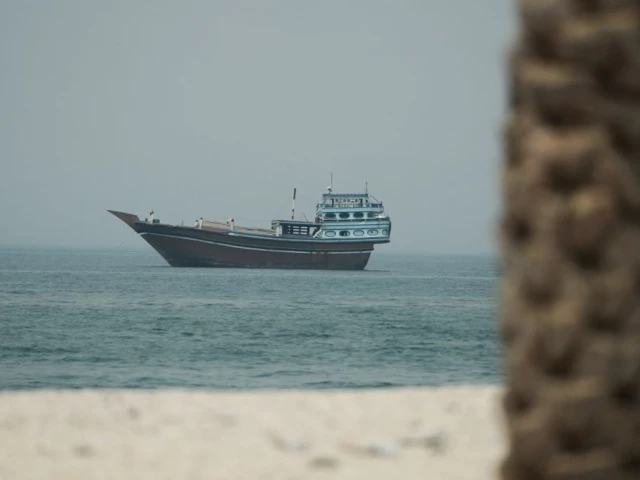
Negotiations between Iran and Oman over the Strait of Hormuz are in their final stages, Iran's Foreign Minister Abbas Araqchi said on Sunday, according to official news agency IRNA, after the US said it had called off an attack on Iran to give room for diplomacy.
At the beginning of Sunday cabinet session, Foreign Minister @araghchi briefed members on the current state of Iran–Oman negotiations, noting that discussions have entered their final phase. pic.twitter.com/YHqqVjHc5Z
— IRNA News Agency ☫ (@IrnaEnglish) August 2, 2026
Iran denies seeking halt to US attacks, agreement to reopen Strait of Hormuz
Iranian military officials on Sunday dismissed US President Donald Trump’s claim that Tehran had asked for a halt to a planned US attack as a “lie,” as sources denied reports of an agreement to reopen the Strait of Hormuz.
“Trump’s claim that Iran asked for the attacks to be halted is merely another lie and a desperate attempt to blackmail Gulf rulers and pressure them through threats,” the officials were quoted as saying by Mehr News Agency.
They said Iranian forces remained at the “highest level of readiness” and were prepared for all possibilities.
“If confrontation becomes inevitable, the battlefield will be decisive,” the officials said. “At that point, everyone will understand who holds the power and who will have the final say.”
Separately, a source close to Iran’s negotiating team denied reports that an agreement had been reached to reopen the Strait of Hormuz.
“No agreement has been reached on reopening the Strait of Hormuz,” the source told the semi-official Fars News Agency.
An informed military source also told Fars that the strategic waterway would remain closed as long as the US continued “hostile actions.”
The source said vessels would be allowed to pass only through the designated route and with authorization from the Islamic Revolutionary Guard Corps.
Trump said Saturday that he canceled a planned military strike against Iran after Tehran and “other Middle Eastern countries” requested time to finalize the framework of a peace deal, saying Israel has joined the commitment.
In a post on his social media platform Truth Social, Trump claimed that the sides agreed to the “perimeters” of a potential deal that would include the "immediate, complete, and total" reopening of the Strait of Hormuz and an end to Iran's nuclear threat.
Saudi crown prince called Trump for diplomacy
Saudi Crown Prince Mohammed bin Salman stressed to US President Donald Trump the need to do everything possible to prevent the region from sliding into a broader conflict, the Saudi Press Agency (SPA) reported on Sunday.
In a phone call, the crown prince emphasised the need to prioritise dialogue to reduce tensions and stressed the importance of making “all possible efforts” to achieve de-escalation to pave the way for diplomatic solutions with positive outcomes, said the agency.
Such efforts are essential to preserving the security and stability of the region and preventing it from being drawn into a wider regional conflict whose repercussions affect regional and international security and stability, he added.
The two leaders also reviewed existing areas of cooperation between Saudi Arabia and the US and discussed ways to further strengthen bilateral ties.
Iran sees every threat from adversaries as ‘real and credible’: Minister
Majid Ibn al-Reza, Iran’s acting defence minister, said threats are taken seriously “even if made as part of psychological warfare”, according to Al Jazeera.
“We will neither be caught off guard nor remain passive,” he was quoted as saying by Iran’s Mehr news agency. Tehran would use threats as a basis to increase its military readiness, strengthen deterrence and enhance its military capabilities, he added.
US strikes made Iran more willing to negotiate: Rubio
US Secretary of State Marco Rubio said on Sunday that Iran is more willing to negotiate, including on its nuclear programme and the Strait of Hormuz, as a result of Washington’s military attacks, according to Al Jazeera.
In an interview with Fox News, Rubio repeated his claims the attacks had destroyed Iran’s navy, air force, missile defences, launchers and weapons-production facilities, and had “severely degraded” its defensive capabilities.
“They still have missiles, and they still have drones, and they can still do damage,” Rubio said. He claimed, however, that Iran no longer had the “conventional shield that they were going to hide behind”.
“And that’s changed the whole dynamic. It’s the only reason why they are now willing and in some cases, seem eager, to do a deal on denuclearisation, to do a deal on the straits. Because we are now approaching them from a position of strength, not from a position of weakness,” he said.
Trump says he will hold off on fresh Iran attack in hope of quick deal
US President Donald Trump said late on Saturday he would hold off on a fresh attack on Iran as long as a deal could be reached quickly to halt Iran's nuclear ambitions and reopen the Strait of Hormuz.
Iran and "other Middle Eastern Countries" asked for a time to complete a deal that would lead to "the Immediate, Complete and Total" reopening of the Strait and "an end to Iran's nuclear threat," Trump wrote on his Truth Social platform.
"Based on this request, I have agreed, for the future benefit of the WORLD and, likewise, the survival of a successful and prosperous Iran, to cancel the attack, subject to being able to rapidly make a DEAL."
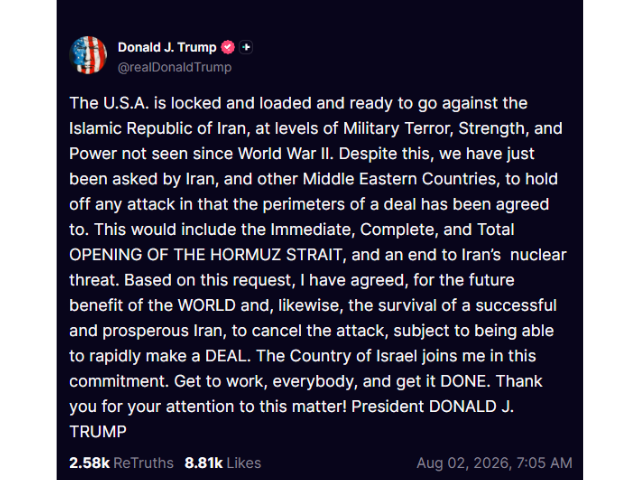
Israel "joins me in this commitment," Trump wrote. Israel did not immediately make a public statement on the issue.
Iran warned the US this weekend against any “adventurous action” and said it would retaliate decisively if American forces followed through on Trump's threats of fresh attacks on Iranian targets.
Iranian Foreign Minister Abbas Araqchi’s comments in separate phone calls on Saturday with senior Turkish, Pakistani and Saudi officials came just hours after Kuwait's army said it destroyed hostile drones launched by Iran against several vital facilities.
Speaking to Chief of Army Staff and Chief of Defence Forces Field Marshal Asim Munir and Turkish Foreign Minister Hakan Fidan, Araghchi said Iran would respond decisively to any "aggression" and discussed the consequences of “destabilising actions" by the US, as well as prospects for heightened regional insecurity, according to Araqchi's Telegram account.
Araghchi later told Saudi Foreign Minister Prince Faisal bin Farhan that any attacks by the US and Israel or participation by regional countries in such actions would be met with a “proportionate response.” Saudi Crown Prince Mohammed bin Salman spoke to Trump on Saturday and "expressed concern and asked for clarity" about US plans for Iran, a US official told Axios.
The Saudi crown prince spoke to Trump, a White House official told Reuters, but did not provide details.
Nournews, a media outlet affiliated with Iran's top security body, said on Saturday that US attacks on Iranian energy infrastructure would prompt Iranian strikes on oil fields in Saudi Arabia and the United Arab Emirates, as well as the gas fields of Qatar and Israel, saying, "all will be burned to ashes."
At a cabinet meeting on Friday at the Camp David retreat, Trump said he believed US negotiators, including his son-in-law Jared Kushner, special envoy Steve Witkoff and Secretary of State Marco Rubio, could still reach a deal with Iran.
But Trump also said he was losing faith in the Iranians, saying, "They break their word so often" — a claim Tehran has frequently levelled at Washington — and said he would be "hitting them."
Iranian lawmaker accuses US of threatening attacks in public while pushing for talks behind the scenes
Writing before Trump cancelled the planned attacks, Hassan Ghashghavi, a senior Iranian lawmaker and spokesman for the Parliament’s Commission on National Security and Foreign Policy, said regardless of how the war progresses, traffic in the Strait of Hormuz will be managed by Tehran, according to Al Jazeera.
“In the media, they speak of escalation, while through existing channels they demand negotiations,” Ghashghavi said. “They cannot deceive the Islamic Republic of Iran. Whether by escalating or by negotiating, Iranian arrangement for passage through the SoH [Strait of Hormuz] is the only option on the table.”
Meanwhile, Majidreza Hariri, president of the Iran-China Chamber of Commerce and Industry, said Washington does not have the “courage” to target the country’s energy infrastructure.
“They don’t have the courage to carry it out because Iran’s resilience is far greater than that of the countries in the region against the destruction of infrastructure,” Hariri said in a post on X.
امریکا دو نقشه برای حمله به میهن در سر دارد:
— Majidreza Hariri مجیدرضا حریری (@MajidRezaHarir1) August 1, 2026
یکم
بمباران زیر ساختها!
جرات اجرا ندارند چون تاب آوری ایران بسیار بیشتر از کشورهای منطقه است در مقابل ویرانی زیر ساخت
دوم
حمله پیاده نظام
حتما ۴ تا عاقل در بین مشاورین کاخ سفید هستند که نقشه ایران را با دقت دیده باشند#بجنگ_تا_بجنگیم
Iran’s electricity grid is reportedly one of the most decentralised in the world and contains up to 150 power plants across the country. The network’s extensive size makes it far more difficult to cause a nationwide blackout through an aerial assault.
Strait of Hormuz
Oil prices have stayed high since US and Israeli forces started the war with strikes on Iran on February 28. Trump has argued that his stated goal of keeping Iran from allegedly gaining nuclear weapons justifies higher fuel costs in the near term, but the economic pain has put political pressure on him to find a way to end the war.
Benchmark Brent crude futures rose 24% in July, and analysts polled by Reuters expect prices to rise further this year.
Read more: Trump convenes Cabinet at Camp David amid simmering Iran war
The risk of Iranian attacks has deterred most shipping through the Strait of Hormuz, an important conduit for global energy supplies, since the start of the conflict, sending shockwaves through the world economy.
A government facility in northern Kuwait and civilian property belonging to a company on Bubiyan Island were hit on Saturday, with falling shrapnel causing material damage but no casualties, the Kuwaiti army said.
Adding to the energy industry's concerns, Iran's Houthi allies in Yemen recently began threatening the Bab el-Mandeb, the strait at the other end of the Red Sea from the Suez Canal, another export route for Saudi crude.
The United Kingdom Maritime Trade Operations said on Saturday it had received reports of two maritime incidents off Oman, including one in which a tanker was struck by an unknown projectile that damaged the engine room. In the other incident, the master of a tanker reported seeing a large splash and an explosion close to the vessel, though no damage was reported.

1721375063-0/BeFunky-collage-(14)1721375063-0-208x130.webp "story")








This material may not be published, broadcast, rewritten, redistributed or derived from. Unless otherwise stated, all content is copyrighted © 2026 The Express Tribune.






COMMENTS
Comments are moderated and generally will be posted if they are on-topic and not abusive.
For more information, please see our Comments FAQ