Spotify music platform reaches historic milestone
Updated 1 hour ago

Actor criticises opinion-driven entertainment coverage, says journalists should refrain from sharing opinions
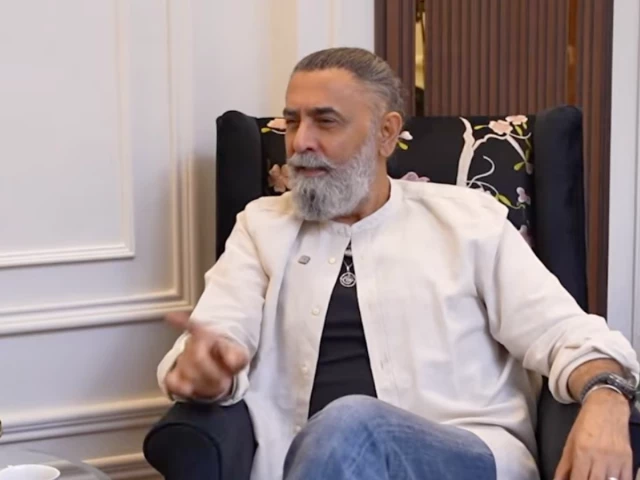
Actor Shahzad Nawaz criticised opinion-driven entertainment coverage, arguing that journalists should focus on reporting facts. Speaking in a recent interview, the Doctor Bahu actor shared his views on journalism, awards, salaries and public perceptions within the entertainment industry.
Discussing the role of critics and reporters, Nawaz said media professionals should prioritise accuracy, context and constructive engagement rather than personal opinions.
“When we talk about critics, it is their responsibility to help new people in the industry or call the writer and confirm the review. Please start improving your content,” he said. “You are a reporter. You report, not judge. That’s the role of journalists,” he added.
Nawaz also questioned the significance often attached to prestigious state honours, arguing that awards should not be viewed as the ultimate measure of a person’s worth or contribution. Referring to distinctions such as the Tamgha-e-Imtiaz and Sitara-e-Imtiaz, he said, “When you want to get a reward, it should not be a measure of your merit.”
The actor acknowledged that many people may be more deserving of recognition than he is and said he has long accepted that reality. “I’ve said on record that I won’t accept an award, and even if I do, I won’t accept it because lots of more deserving people should get it before me,” he said.
Nawaz also reflected on success and longevity in the industry, noting that records are ultimately meant to be surpassed. “At the end of the day, a record is a record. You go on making one so it can be broken,” he said, adding that he currently appears in only a handful of projects rather than maintaining an extensive television portfolio.
The conversation also touched on storytelling and the way audiences interpret fictional narratives. According to Nawaz, interviewers and viewers often discuss characters and storylines without fully understanding the distinction between fiction and reality.
“We are meeting for the first time, but you should understand the storyline first, or else questions are based on other things,” he said. “If you write it as a scene, you will force reality, but storylines are a fictional account of reality. It’s not real—it’s just based on truth. People watch it, and their imagination makes them think they’ve seen this.”
On the subject of money, Nawaz stressed that acting is not his primary source of income and that he evaluates projects based on the time and effort they require rather than financial rewards. “I don’t weigh my work in monetary terms. It will make me a small person. I just give it time. I don’t sell my work; I sell my time,” he said.
He added that while acting may be rewarding creatively, financial considerations are not his main motivation. “If your question is about the time I’m giving to this particular art and if it’s rewarding me, then yes, it is. If your question is monetary, then it is not my primary source of income,” he said.
Nawaz noted that artists enter the industry fully aware of its realities, including contractual obligations and payment disputes. “In this industry, there is a stage where everything is done through contracts. Each clause is read through with clarity. Everything is done through your own decisions,” he said.
Commenting on broader industry challenges, he added: “When it comes to payments overall, that phenomenon will stay forever because, like yin and yang, there is good and bad. Where there is Allah, there is shaitan.”
The actor also offered a philosophical reflection on public perception and how narratives shape opinions. “One man’s hero is another man’s terrorist. It depends on which side of the divide you stand,” he said.
Also during the interview, Nawaz addressed the internet's fascination with describing him as an “uncle with aura”, saying he finds the label amusing rather than offensive. “For some people I am also young and for others old; it depends. It’s a big variable. For the word ‘uncle’, I am okay with it. I don’t mind. I know the nuance also,” he said.
He joked that social media users often mix contradictory descriptions together. “If someone says you are not an uncle and I have a crush on you, it’s funny how people use those in the same breath,” he said.
Nawaz suggested that some of the confusion stems from language and cultural differences, particularly when online users attempt to express admiration in English.
The actor concluded by discussing his experience portraying antagonistic characters and warned about the dangers of audiences becoming overly influenced by narratives without critical thinking.
“People need to have some logic. It is a very scary thought. They are easily manipulated by narratives,” he said. “Those who are easily manipulated can lead to anarchy, confusion, unrest and polarisation without firing a single shot.”
He added that narratives can dramatically alter how people view historical figures, events and even heroes. “One set of narrative can change your entire outlook of history, an incident, or a hero in history,” he said.












This material may not be published, broadcast, rewritten, redistributed or derived from. Unless otherwise stated, all content is copyrighted © 2026 The Express Tribune.




COMMENTS
Comments are moderated and generally will be posted if they are on-topic and not abusive.
For more information, please see our Comments FAQ