Turkish president says Makkah Joint Defence Agreement targets no country, open to other friendly nations
Updated 2 hours ago

Says US Navy will remain in the general area to ensure all aspects of US-Iran agreement are adhered to, obeyed
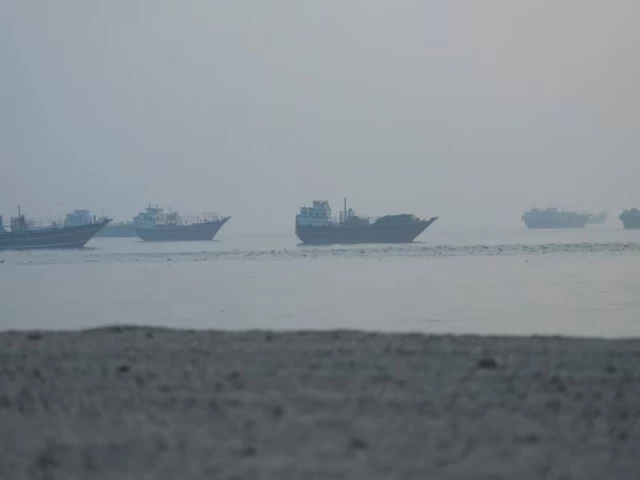
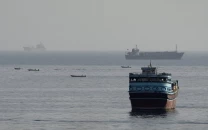
The United States Central Command (CENTCOM) said on Thursday that it had lifted the blockade of Iran's ports and coastal areas with traffic open for all vessels after the signing of a memorandum between the US and Iran.
In a post on X, CENTCOM said: "Today, US forces lifted the blockade on all maritime traffic entering and exiting Iranian ports and coastal areas, in accordance with the President's direction. American forces are not impeding the transit of vessels to or from Iranian ports on the Arabian Gulf and Gulf of Oman. All US military blockade enforcement efforts have ceased. Our great naval ships will remain in the general area to make sure that all aspects of the agreement are adhered to, obeyed and in full force and effect."
Today, U.S. forces lifted the blockade on all maritime traffic entering and exiting Iranian ports and coastal areas, in accordance with the President's direction. American forces are not impeding the transit of vessels to or from Iranian ports on the Arabian Gulf and Gulf of…
— U.S. Central Command (@CENTCOM) June 18, 2026
Vance criticises Israel 'freakout' over Iran deal
United States Vice President JD Vance criticised Israel for a "weird panic" and "freakout" over the agreement struck between the US and Iran, in an interview released on Thursday as the Trump administration sought to tamp down criticism of the deal.
Israeli officials across the political spectrum, including some of Prime Minister Benjamin Netanyahu's allies, have criticised the agreement, saying it did not address their concerns over Iran’s nuclear and ballistic missile programmes and would tie down Israel's military operations against Hezbollah in Lebanon.
"There is this weird panic almost in the Israeli system that I’ve picked up on where they assume that everything that is contemplated that is good for Iran will happen — but that will happen without the Iranians changing any behaviour," Vance said in an interview with the New York Times.
"That's not how the deal is written."
The US would not remove sanctions on Iran if it were still funding a terrorist organisation, he said, in an apparent reference to Hezbollah, which Washington has long labelled a foreign terrorist organisation.
Vance accused Israel of a lack of trust in its strongest ally.
"I find this whole freakout in Israel a little bit odd because I think that it comes from a place of mistrust, and I think that America has earned the trust of that region of the world," Vance said.
"We’ve done a very good job by that particular country and that particular government," he said of Israel. "And I think that the idea that we’ve made a terrible deal is not supported by the facts, but just doesn’t make any sense if you consider the broad length of the relationship."
Citing specific critics of the deal — far-right Israeli cabinet ministers Itamar Ben-Gvir and Bezalel Smotrich — Vance said: "I guess my response to them would be: What is your exact proposal? You’re a country of nine million people. You can’t just kill your way out of solving every single national security problem that you have."
Ben-Gvir responded in a post on X: "This is the proposal, JD Vance: To deal with the Nazis of the 21st century, just as the United States dealt with the Nazis of the 20th century."
This is the proposal, @JDVance:
— איתמר בן גביר (@itamarbengvir) June 18, 2026
To deal with the Nazis of the 21st century, just as the United States dealt with the Nazis of the 20th century. pic.twitter.com/kv0wbRa9gi
Trump says critics of his Iran deal are 'jealous, bad people, or stupid'
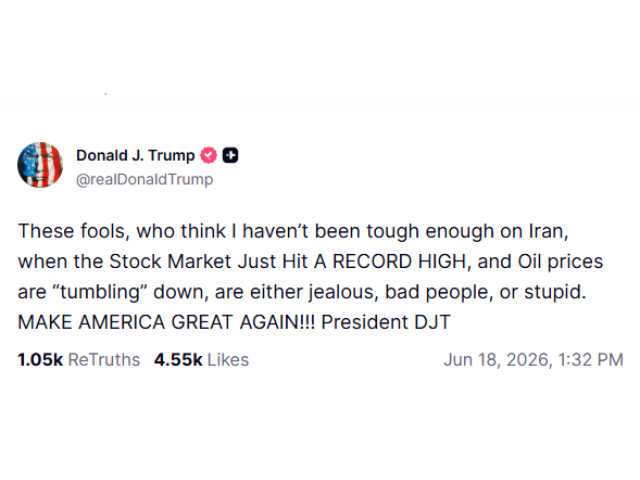
Earlier, US President Donald Trump wrote a Truth Social post slamming everyone who, in his words, believed he wasn't "tough enough on Iran".
Calling them out as "fools", he drew attention to the stock market hitting "a record high" and oil prices "'tumbling'" down, going on to say that these individuals were "either jealous, bad people, or stupid".
His comments come as US Democratic lawmakers have voiced scepticism towards the deal.
Senate Foreign Relations Committee ranking member Jeanne Shaheen, D-NH, said during remarks at the Atlantic Council in Washington, DC that she hasn’t seen the actual text of the MOU, calling the reported text a “full capitulation”
"The devil is in the details, and so far we haven't gotten a real signed agreement. That's why I would urge the president and the White House to release the agreement, whatever it is, as soon as possible to Congress...Based on the scorecard I'm keeping, I don't see what the wins are," she said.
Senior House Democrats also demanded a briefing on the agreement, with Representatives Gregory Meeks, Adam Smith and Jim Himes — ranking members of the Foreign Affairs, Armed Services and Intelligence committees — sending a letter to US Secretary of State Marco Rubio.
"For more than 15 weeks, the Administration left Congress and the American people in the dark about a war of choice that has proved to be a strategic failure," the lawmakers wrote, citing 14 service members killed and disrupted traffic in the Strait of Hormuz.
"While we welcome the Administration's turn toward diplomacy and its decision to end this war of choice, the Administration must provide Congress with greater details about the MoU, any side agreements, and the Administration's plan and strategy for the 60-day ceasefire period; including its approach to sanctions relief, Iran's nuclear program, and reported economic and reconstruction funds," they added.
The letter posed seven questions to Rubio, including whether the administration is complying with the Iran Nuclear Agreement Review Act of 2015, how Iran's nuclear compliance will be monitored, what was agreed on Lebanon, whether limits exist on Iran's ballistic missile program, and how much the US has committed to the reported $300 billion reconstruction fund.
Representative Pramila Jayapal, D-WA, released a video message on the US social media platform X demanding answers on the MOU, saying that the deal leaves the US worse off than before the war.
"The Strait of Hormuz apparently is now going to be open after 30 days. Well, guess what? It was open before the war started...We are literally going back to a position that is worse than when we started," she said.
PM Shehbaz signs 'Islamabad MoU' as mediator between US and Iran
Prime Minister Shehbaz Sharif on Thursday signed the 'Islamabad Memorandum of Understanding' as a mediator, formalising a major diplomatic breakthrough between the United States of America and the Islamic Republic of Iran, according to the Prime Minister's Office (PMO).
The memorandum also carries the signatures of US President Donald Trump and Iranian President Masoud Pezeshkian.
اسلام آباد: 18 جون 2026.
— Prime Minister's Office (@PakPMO) June 18, 2026
وزیراعظم پاکستان محمد شہباز شریف نے اسلام آباد مفاہمتی یاداشت (Islamabad Memorandum of Understanding) پر بطور ثالث دستخط کردئے۔
اسلام آباد مفاہمتی یاداشت پر امریکی صدر ڈونلڈ ٹرمپ اور ایران کے صدر مسعود پزشکیان کے دستخط موجود ہیں۔ pic.twitter.com/af1F81DobA
Earlier, he announced the electronic signing of the "Islamabad Memorandum of Understanding" between US President Donald Trump and Iranian President Masoud Pezeshkian.
In a post on X, he stated that "the Memorandum has been signed by the honourable Presidents of both countries and also endorsed by me as the mediator."
I am honoured to announce that the historic ‘Islamabad Memorandum of Understanding’ has been electronically signed today between the United States of America and the Islamic Republic of Iran. The Memorandum has been signed by honourable Presidents of both the countries and also…
— Shehbaz Sharif (@CMShehbaz) June 18, 2026
He added that the memorandum would enter into force immediately and as a "first step, Islamic Republic of Iran will instantly reopen the Strait of Hormuz and the United States of America will immediately lift the naval blockade."
He extended his congratulations to Trump and the US negotiating team comprised of Vice President JD Vance, Steve Witkoff and Jared Kushner, and extended his "profound respect and appreciation" to Iranian Supreme Leader Mojtaba Khamenei and Pezeshkian for "their wisdom, foresight and statesmanship in embracing the cause of peace."
"I also wish to recognise the efforts of the Iranian negotiating team, including Mohammad Bagher Ghalibaf, Abbas Araghchi and Eskandar Momeni, whose patience, perseverance and commitment to constructive engagement were instrumental in bringing this agreement to fruition," he added.
Shehbaz also acknowledged the efforts of Qatar, Saudi Arabia, Turkiye and Egypt for their contributions.
US and Iran presidents sign ceasefire agreement at Versailles
The US and Iran released the text of the Islamabad MoU that their presidents have signed to end their war on Wednesday.
Le Président Trump a signé ce soir à Versailles l’accord entre l’Iran et les États-Unis.
— Emmanuel Macron (@EmmanuelMacron) June 18, 2026
Cet accord ouvre la voie à une paix durable et permet la réouverture du détroit d’Ormuz.
C’est un pas important dans la bonne direction pour nos compatriotes… pic.twitter.com/b1XgZrBv0m
However, US President Donald Trump threatened to resume attacks and kill Iranian officials if they failed to honour their commitments.
Trump, attending the G7 with other leaders in France, also withdrew at least one of his stated rationales for attacking Iran in the first place, saying it would be "unfair" for Tehran not to have ballistic missiles, having previously vowed to obliterate them.
"We're going to bomb the hell out of them if they violate the agreement," Trump said of Iran at a press conference. "I don't want them to. I want them to honour the agreement." He also called Iranians "smart people" as US and Iranian negotiators work on a permanent truce over the coming 60 days, which Trump said he hoped would usher in peace in the Middle East and lower oil prices.
Read: Trump says Iran accord to be signed 'shortly', 'maybe' Thursday or Friday
Earlier, he had said: "If I don't like it, if they don't behave, we'll go right back to dropping bombs right smack in the middle of their head, OK?"
Iran's leaders did not address the new threats while celebrating the moment, releasing photographs of what is believed to be the first agreement signed by both a US and Iranian president since the Islamic Republic's founding in 1979.
"Everything we sought to achieve through military action, we obtained several times over through negotiation; it was not even comparable," Iran's lead negotiator Mohammad Baqer Qalibaf told state television about the agreement, which includes the unfreezing of billions of dollars in Iranian assets.
📸 Iran’s President Pezeshkian and his US counterpart Trump signed the MoU between Tehran and Washington digitally and remotely.
— PressTV Extra (@PresstvExtra) June 18, 2026
Follow: https://t.co/7Dg3b41hTx pic.twitter.com/8GtQFZhuZ0
The US and Israel launched the war on Iran on February 28, assassinating the 86-year-old Supreme Leader Ayatollah Ali Khamenei along with his family and young granddaughter, and other military leaders on the first day. It quickly spiralled into a regional conflict that has killed more than 7,000 people, mostly in Iran and Lebanon; driven up energy prices; renewed inflationary pressures and sparked concerns about a major food supply crisis in developing countries.
The 14-point agreement extends a ceasefire announced in April by another 60 days, including in Lebanon, to allow the two sides to negotiate a final truce. Both Trump and Iranian President Masoud Pezeshkian have digitally signed the memorandum in English and Farsi, US and Iran officials said, with Iran's foreign ministry saying the agreement was already in effect as of Wednesday.
Pezeshkian shared images of the MoU on his X account.
این یک سند تاریخی و پیامی از ایران مقتدر است: صلح در سایه احترام متقابل تحقق خواهد یافت.
— Masoud Pezeshkian (@drpezeshkian) June 18, 2026
جمهوری اسلامی ایران به صلح جهانی با حفظ عزت و استقلال، پیشرفت و همکاری منطقهای همواره متعهد و پایبند است. pic.twitter.com/FgbeHSioKX
Trump signed just before a grand dinner with French President Emmanuel Macron at the Palace of Versailles, the site of the signing of the eponymous treaty that formally ended World War One.
Iran's President Dr. Pezeshkian and U.S. President Trump have BOTH Signed the MoU
— Ryan Rozbiani (@RyanRozbiani) June 18, 2026
At 00:00 Eastern time, U.S. sanctions on Iranian oil, gas, and petrochemical products will be lifted
HUGE: Sources are reporting that as part of the clause on non-interference in Iranian domestic… https://t.co/mHCQmNaLtI pic.twitter.com/6kn7If9h88
Trump also recanted his February promise to destroy all of Iran's missiles and "raze their missile industry to the ground."
"I'm saying that if other countries have them, it's a little bit unfair for them not to have some," Trump told reporters in Paris after leaving the summit.
"It's signed."
— Fox News (@FoxNews) June 17, 2026
President Trump told reporters he signed the Iran memorandum of understanding in Versailles as he departed the palace following a dinner with French President Emmanuel Macron.
A White House official says a photo of the signed agreement was sent to Iran and the… pic.twitter.com/HVELS6RYVB
Germany says two ships heading to Red Sea for potential Hormuz mission
Defence Minister Boris Pistorius has said Germany is deploying two ships to the Red Sea to prepare for a potential mine-clearing mission in the Strait of Hormuz, according to Al Jazeera.
Speaking as he arrived for a NATO meeting in Brussels, Pistorius said: “As we speak, our minesweeper Fulda and the supply ship Mosel are sailing through the Suez Canal towards the Red Sea.”
Pistorius said approval would be needed from Iran and Oman before any participation in a minesweeping operation, and added any mission would also depend on developments in further talks between Iran and the US.
US ready to restart war, reimpose blockade if Iran doesn’t comply
US Defence Secretary Pete Hegseth says the US will be ready to resume military action and reimpose a blockade if Iran fails to meet its commitments under the US-Iran deal, according to Al Jazeera.
“The president has pointed out that we will be prepared to recommence if underneath the timeline of these talks Iran does not do what it says it’s going to do,” Hegseth said in Brussels after meeting NATO defence ministers.
“If Iran doesn’t comply then we’re more than able to reimpose an ironclad blockade,” he added.
Switzerland says talks planned for Friday between Iran and US
Initial talks between the United States and Iran are planned at the Buergenstock mountaintop resort in Switzerland on Friday, following the signing of a ceasefire agreement between Tehran and Washington, the Swiss government said on Thursday.
"As things stand, the plan is still for the US and Iran, along with mediators Pakistan and Qatar and other involved countries, to meet tomorrow at Buergenstock for initial negotiations about implementing the agreement.
"No further information is currently available regarding the schedule and details of this meeting," the Swiss foreign ministry said in a statement.
G7 leaders welcome Iran deal
G7 leaders hailed the agreement at their summit, held in the French town of Evian-les-Bains, an hour's drive along the shore of Lake Geneva from where the US has said a formal signing ceremony for the US-Iran agreement was due to be held across the Swiss border on Friday.
But Iranian foreign ministry spokesperson Esmaeil Baghaei cast doubt on this, telling IRIB's News Network that, because the two presidents had already signed, "No signing ceremony will be held in Switzerland."
European leaders share US concerns about Iran's nuclear program, but never endorsed his decision to go to war without United Nations authorisation, and worry Iran has gained leverage by withstanding the superpower onslaught and asserting control over the strait.
The leaders of France, Germany, Britain, Japan, Italy, Canada and the US demanded in a joint statement an immediate ceasefire in Lebanon, where the memorandum calls for a halt to hostilities between Israel and the Iran-backed Hezbollah group that have killed thousands of people and displaced more than a million more.
Fighting there has abated but not ceased since the agreement was reached on Sunday, and Israel, which was not part of the negotiations and whose military is occupying southern Lebanon, says it retains the right to use force.
‘Hormuz closed once and it can be shut down again’: IEA
International Energy Agency (IEA) chief Fatih Birol welcomed the US-Iran deal and called for the Strait of Hormuz to be reopened without conditions, as per Al Jazeera.
Birol noted that several countries are reviewing their energy policies as it’s clear the waterway could potentially be shut again given Iran closed it during the US-Israeli war.
The IEA will discuss new strategies with several nations as the crisis has redrawn the global energy map, Birol said at an event in Istanbul, adding that “trust” is critical in global energy markets.
The agreement includes Tehran reopening the key strait and the US lifting its naval blockade of Iran, potentially bringing an end to the largest oil supply disruption in history.
“We will now see the details of the agreement and the negotiation process, and what happens next. The vase is broken. Now all actors know that the Strait of Hormuz was closed once and it can be shut down again.”
US-Iran deal awaits resolution of technical issues: Turkish foreign minister
Turkish Foreign Minister Hakan Fidan said the US and Iran have reached an agreement in principle on key elements, but technical issues, including the fate of Iran's enriched uranium and the implementation of a future enrichment moratorium, remain unresolved.
Speaking to journalists during his visit to Russia, Fidan said technical teams still needed to determine how 400 kilograms of enriched uranium in Iran would be diluted, monitored and verified.
"There is a principled understanding regarding the dilution of 400 kilograms of enriched uranium in Iran. But who will carry out the dilution, who will oversee it, and how it will be verified still need to be discussed," he said.
Fidan said wartime conditions, mutual distrust and regional developments, including Israel's occupation of Lebanon, had slowed negotiations between Washington and Tehran.
"While the US side could respond within an hour, the Iranians sometimes needed a week," he said, adding that he had encouraged both sides to engage in direct talks.
The Turkish foreign minister also criticised Israel's regional policies, calling them "a global problem."
"Israel wants destruction in the region. It wants to occupy some countries and employ terrorism. This has consequences for global security as well as the economy. We are seeing Israel face increasing diplomatic backlash.
"We hope this diplomatic response will produce results and that all countries in our region will live in peace, stability and prosperity," he said.
Fidan said the conflict involving Iran, the US and Israel had shifted international attention away from Gaza but expressed hope regional countries would refocus on the enclave once the crisis eased. He added that efforts to reach a framework agreement for the second phase of Gaza ceasefire negotiations were continuing with the involvement of Türkiye's National Intelligence Organisation (MIT).
Russia welcomes US-Iran memorandum, urges all sides to prevent renewed escalation
The Russian Foreign Ministry said on Thursday that it welcomed the signing of the memorandum of understanding between the US and Iran aimed at ending the war.
In a statement on its website, the ministry said, "We welcome the agreement reached remotely by the presidents of the two countries, Donald Trump and Miroslav Pezeschkian, to end the military conflict between the US and Iran. We note the firm mutual commitment demonstrated by Washington and Tehran to strictly adhere to the terms."
Calling on all parties involved in the confrontation to adhere to the agreement and avoid renewed violence, the ministry praised the mediation efforts of Pakistan and Qatar.
Moscow said it was important that all parties involved in the conflict strictly follow the understandings during the period of negotiations and refrain from actions that could increase tensions in the region, including in Lebanon.
The ministry expressed hope that peace would restore trust among Persian Gulf states and help resume safe navigation through the Strait of Hormuz, potentially reducing volatility in global energy and food markets.
"We hope that the establishment of peace will help restore trust in relations between states on both sides of the Persian Gulf, and that the resumption of safe and unimpeded navigation through the Strait of Hormuz," it said.
The ministry welcomed Iran’s reaffirmation of its commitment to the Non-Proliferation Treaty (NPT) in response to criticism of its nuclear program, while also supporting Iran’s right to peaceful nuclear energy.
"We express our readiness to continue to provide significant diplomatic support for efforts aimed at sustainable and long-term stabilisation of the situation in the Middle East," it said.
China urges US, Iran to ‘uphold spirit’ of Islamabad MoU
China on Thursday urged Washington and Tehran to “uphold the spirit” of the Islamabad Memorandum of Understanding signed by US President Donald Trump and Iranian President Masoud Pezeshkian.
The signing of the first-stage agreement between the US and Iran has a “positive significance for easing tensions and consolidating the momentum for ceasefire,” China’s Foreign Ministry spokesman Lin Jian told reporters in Beijing.
According to Pakistan, which mediated between the two warring sides since April 08, weeks after the US and Israel initiated war on Iran, the Islamabad MoU has entered into force with “immediate effect” after Trump and Pezeshkian electronically signed it during the intervening night of Wednesday and Thursday.
“China welcomes it,” said Lin, calling on the two sides to “uphold the spirit of the contract and earnestly fulfil their commitment.”
“Force is no solution,” said Lin, adding: “Negotiation on an equal footing is the right choice.”
Pakistan's Prime Minister Shehbaz Sharif, who announced the signing of the Islamabad MoU, said Iran will instantly “reopen the Strait of Hormuz and the United States of America will immediately lift the naval blockade.”
“It is hoped that the US and Iran will both approach the second stage of negotiations with a rational and practical attitude, working in the same direction and stride for the outcomes,” said the spokesman of the Chinese Foreign Ministry.
Iran says memorandum of understanding with US formally finalised after presidents sign text
Iranian Foreign Ministry spokesperson Esmail Baghaei said the “Islamabad memorandum” had become fully official after being signed by both Tehran and Washington, according to remarks carried by Iran’s semi-official Mehr News Agency.
Baghaei said the agreement would be signed digitally and confirmed that negotiations under the memorandum would focus exclusively on nuclear issues and sanctions relief.
He said the two sides would hold talks for up to 60 days, with the possibility of extending negotiations if necessary due to the complexity of the issues involved, but added that Tehran’s missile programme was off the table. “Iran’s missiles are only for firing, not for negotiation. Iran’s defence capabilities will not be discussed in any process with any party,” he said.
🇮🇷 Esmail Baghaei:
— Ryan Rozbiani (@RyanRozbiani) June 17, 2026
You know, our MISSILES don't like to be talked about at all.
Our missiles are just for launching, not for negotiating. https://t.co/53I68n3Vwi pic.twitter.com/FzEgkZvjFv
The spokesperson also said US commitments regarding the lifting of its naval blockade had effectively begun following urgent talks after Israeli attacks on Beirut’s southern suburbs and Iranian threats of retaliation.
He added that Iranian vessels had already entered and exited ports “without problems,” describing it as a sign that US commitments were beginning to take effect.
Baghaei said Iran’s commitments regarding the Strait of Hormuz would begin following the signing and implementation of the memorandum.
On Lebanon, Baghaei said Iran has shown it “does not abandon its friends” and that it was the US’s responsibility to compel Israel to respect commitments to Iran, as per Al Jazeera.
Baghaei added that Iran would not ship its stockpile of highly enriched uranium abroad and that dilution of the material was “introduced as an option to close the door on other possibilities”.
On the Strait of Hormuz, Baghaei said Iran will finalise a new regime to manage the waterway along with Oman and will “charge fees for services” there.
Iran releases 14-point draft agreement outlining US deal
IRNA on Wednesday published the text of an Islamabad memorandum of understanding between Iran and the US that outlines a roadmap to end their military conflict and negotiate a final agreement.
Below is the 14-point document released by Tehran:
‘We’ll know how to say no to the US,’ says Israeli minister
Amichai Chikli, a minister in the far-right government, said on Thursday that he doubts Israel will withdraw troops to the “Blue Line” – the UN-marked unofficial boundary separating Israel and Lebanon – even it faces pressure to do so from the US, as per Al Jazeera.
“If we return to the Blue Line it will be a failure,” Chikli was quoted by Israel’s Army Radio as saying. “I don’t think we’re going to withdraw. If necessary, we’ll know how to say no to the United States.”
Tension is rising between the United States and Israel after President Trump publicly scolded Prime Minister Netanyahu for his handling of Israel’s war on Lebanon and the killing of “too many people”.
Iran has insisted that any long-term deal must include the end of Israel’s occupation of the south.
Netanyahu rejects ceasefire deal
Israeli Prime Minister Benjamin Netanyahu has distanced Israel from the US-Iran agreement over his tactics in Lebanon against Hezbollah. The two men have repeatedly clashed over Israel's refusal to constrain its pursuit of Hezbollah in Lebanon, where a cessation of hostilities is a key Iranian demand.
Trump told reporters regarding Netanyahu that, "You don't have to knock down a building every time somebody walks into it that's from Hezbollah."
Lebanese state media reported fresh Israeli air strikes and artillery fire in several southern towns throughout Wednesday. Lebanese security sources said Hezbollah had also launched two drone attacks on Israeli forces in the south. The group did not publicly claim the attacks.
Israel later said five of its soldiers had been injured in two Hezbollah drone attacks in southern Lebanon.
Israel says troops will ‘continue to remove threats’ in south Lebanon
Israel’s military has released a map showing what it says are the current positions of its forces inside southern Lebanon, extending about 10km (6.2 miles) into Lebanese territory, as per Al Jazeera.
Soldiers “are stationed in the designated area of operation in southern Lebanon and will continue to remove threats”, a statement said.
As we’ve reported, the 14-point deal signed by the US and Iran declares “the immediate and permanent cessation of military operations on all fronts, including in Lebanon”.
Israel says troops operating 10 km inside Lebanon despite US-Iran accord
The Israeli military said on Thursday that its forces were operating in a security zone extending about 10 km (6 miles) into southern Lebanon, despite a provision in the interim US-Iran agreement calling for an immediate halt to military operations in Lebanon.
The military said the deployment was dictated by operational needs and that troops remained stationed in their designated area of operations.
Israeli strike kills 1 in Lebanon despite US-Iran deal taking effect
One person was killed and another critically injured Thursday in an Israeli drone strike targeting a car in southern Lebanon, according to Lebanese state media, despite a US-Iran understanding aimed at ending the war on all fronts, including Lebanon, taking effect.
The strike hit a vehicle near the Kfar Tebnit-Arnon roundabout in the Nabatieh area, Lebanon’s National News Agency reported.
The incident came amid continued tensions along the Lebanese-Israeli border despite a recent understanding between Washington and Tehran aimed at ending hostilities following attacks launched by Israel and the US against Iran on February 28.
Iranian officials have repeatedly said that halting Israeli military actions across regional fronts, particularly in Lebanon, is among the key objectives of a memorandum of understanding expected to be concluded between Tehran and Washington.
Israel continues to occupy areas in southern Lebanon, some for decades and others since the latest conflict between the two sides. During the recent military campaign, Israeli forces advanced more than 10 kilometres into Lebanese territory.
Israeli drone attack on southern Lebanon injures 2
A strike carried out by an Israeli drone in the town of Beit Yahoun in the Nabatieh governorate has wounded two people, the official National News Agency says.
The agency reported an earlier drone strike targeted a car near the town of Kfar Tebnit, killing one person and seriously wounding another.
Iran has demanded that Israel stop its attacks on Lebanon and pull out all occupying forces as part of the agreement with the US to end the broader war.
Israeli soldier killed by ‘Hezbollah explosive device’
The Times of Israel, citing an "Israeli military investigation", is saying that a soldier killed in southern Lebanon died in a blast from a Hezbollah explosive device, according to Al Jazeera.
It said the attack took place at 5pm (19:00 PKT) on Wednesday as a group of soldiers from the Israeli military’s 36th Division were walking along the Litani River. The attack killed 29-year-old combat soldier Alexander Filin and injured seven other soldiers, according to the military.





This material may not be published, broadcast, rewritten, redistributed or derived from. Unless otherwise stated, all content is copyrighted © 2026 The Express Tribune.






COMMENTS (2)
Comments are moderated and generally will be posted if they are on-topic and not abusive.
For more information, please see our Comments FAQ