Trump announces Russia-Ukraine 'energy ceasefire'
Updated 1 hour ago

Order says Congress has not ceded authority to the Exec branch to dramatically redesign, reconstruct the White House
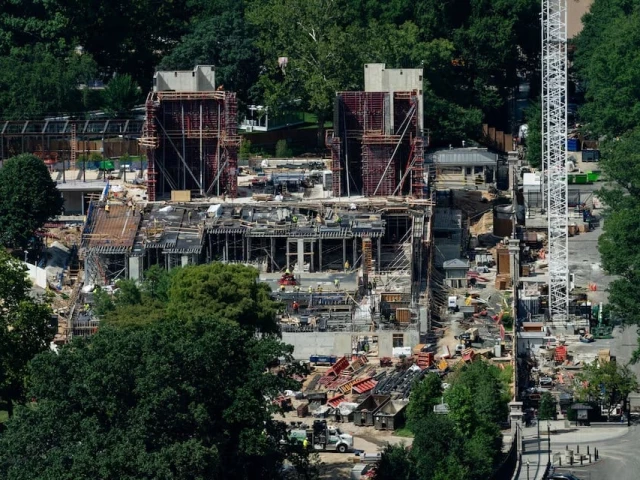
A United States federal appeals court on Friday ordered President Donald Trump’s administration to stop construction on a $400 million ballroom on the site of the White House's demolished East Wing, dealing the Republican leader a major setback in a case testing his presidential authority.
The Washington-based US Court of Appeals for the District of Columbia Circuit, in a divided 2-1 order, upheld a preliminary injunction won by the National Trust for Historic Preservation, which sued last year after the administration tore down the East Wing and began building a 90,000-square-foot (8,360-square-metre) ballroom without seeking authorisation from Congress.
"Whether or not a massive ballroom should be constructed is for Congress to decide and is not a matter for Executive self-help," the panel's majority wrote. "Congress has not ceded unfettered authority to the Executive Branch to dramatically redesign, reshape, and reconstruct the White House — the People’s House — to fit a particular president’s desires."
READ: Donald Trump to fund $200 million White House ballroom expansion
The appeals court placed its ruling on hold for 14 days to allow the Trump administration to appeal to the US Supreme Court.
The White House and Justice Department did not immediately respond to requests for comment.
Trump appealed after US District Judge Richard Leon twice blocked above-ground construction on the site while allowing underground work to continue.
Leon, an appointee of Republican former president George W. Bush, had ruled that no federal statute “comes close to giving the president” the required authority to construct the ballroom without congressional approval.
The ballroom plan, which the administration has described as necessary for large formal functions and to preserve the safety of the White House, is the grandest of several Trump efforts to reshape central Washington's landscape of government buildings and national monuments.
A judge in a separate lawsuit recently said Trump’s name was illegally added to the exterior of the Kennedy Centre for the Performing Arts and ordered its removal.
READ MORE: US judge orders suspension of Trump's White House ballroom construction
In the ballroom case, Justice Department attorney Yaakov Roth said during DC Circuit arguments on June 5 that the courts have no role in weighing the privately funded project and that it would have been improper to block it at any point.
Roth said the National Trust’s "architectural preference" against the ballroom shouldn't take precedence over national security concerns, claiming evidence that the former East Wing left the president and others in the White House vulnerable to attack.
"They just don't want to go to Congress," countered Thaddeus Heuer, a lawyer for the preservation group.
Trump has defended his ballroom and its price tag, which has doubled from initial projections. Trump said in a post on Truth Social last month that the cost rose because "it is approximately twice the size, and a far higher quality, than the original proposal" and promised, "it will be magnificent, safe, and secure!"













This material may not be published, broadcast, rewritten, redistributed or derived from. Unless otherwise stated, all content is copyrighted © 2026 The Express Tribune.






1727268465-0/Untitled-design-(42)1727268465-0-208x130.webp "the poor man s burden")
COMMENTS (1)
Comments are moderated and generally will be posted if they are on-topic and not abusive.
For more information, please see our Comments FAQ