PM Shehbaz briefs President Zardari on Makkah defence agreement
Updated 5 hours ago

Tax revenue target raised to Rs15.26tr; provinces to get Rs8.8tr from NFC; little room for new welfare measures
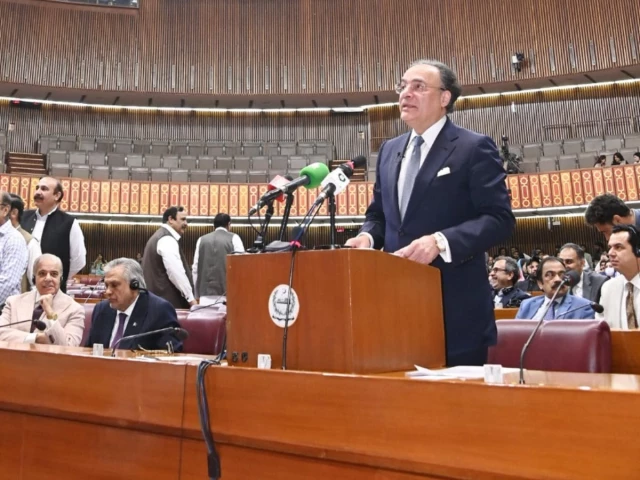
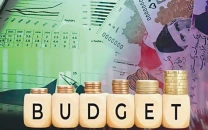
Backed by first-ever provincial grants of over Rs1 trillion, Finance Minister Muhammad Aurangzeb on Friday unveiled a Rs18.8 trillion federal budget, proposing to significantly reverse punishing taxes imposed on the salaried class and the real estate sector while deepening economic liberalisation.
The Rs18.8 trillion expansionary budget was 20% or Rs3.1 trillion higher than the outgoing fiscal year's revised outlay, indicating the government's intentions to shift the gear from consolidation to spending.
Despite significant contributions by four provinces, the federal government has announced a Rs7 trillion deficit, which is higher than this fiscal year and will be filled by taking more loans. The government also plans to get $23.4 billion foreign loans, including $2 billion through Euro and Panda bonds.
The government of Prime Minister Shehbaz Sharif also reintroduced a ban on major purchases of over Rs100 million if these assets are not supported by declared white money. But it also tried to encourage capital formation by abolishing super tax on up to Rs500 million annual incomes and lowering it to 8% for higher than this threshold. However, the super tax rate will stay at 10% for banks, fertilizer and oil sector companies.
It was the fifth budget that Prime Minister Shehbaz Sharif oversaw since 2022 and the third of his current five years constitutional terms.
Both the government's ally Pakistan Peoples Party, and the opposition party – the Pakistan Tehreek-e-Insaf - staged protests but for different reasons.
The finance minister's speech was inaudible because of the noise created by the PTI that was demanding the release of its leader Imran Khan. The PPP protested against high mobile phone taxes and water scarcity in Sindh.
Leader of the Opposition Mehmood Khan Achakzai walked to the seat of Prime Minister Shehbaz Sharif and shook hands. There was also a scuffle between a couple of PTI and PML-N members of the assembly.
The proposed budget seems a step towards growth but a deeper look suggests that the higher spending is mostly for defence purposes and for construction of water sector projects to fight Indian water aggression.
The Finance Bill 2026-27 was aimed at striking a balance between reversing the injustice being meted out to the salaried class, helping the real estate sector to kick start the business and lowering tax burden of the corporate sector. The income from social media was once again targeted by imposing a 5% income tax.
The government has proposed a total over Rs306 billion worth of tax measures in the budget but also gave Rs360 billion worth of relief. In addition, the government has proposed Rs354 billion worth enforcement measures. But the FBR's tax-to-GDP ratio would remain around 10.5% in the next fiscal year.
The petroleum and carbon levy targets have been set at Rs1.748 trillion for the next fiscal year on the back of Rs80 per liter levy. The minister also announced a 7% increase in the salaries and pensions, which did not make the public sector employees happy.
The salaried class got Rs52 billion tax relief while Rs115 billion worth of tax relief was given to the real estate sector. The government imposed 30% federal excise duty on electric vehicles valued up to Rs30 million and 40% on electric vehicles above Rs30 million cost.
The sources said that the discussions with the IMF over the property sector tax relief were still ongoing, as the IMF was not in favour of halving the withholding tax rates.
It also imposed a 5% income tax on the income from social media platforms and reintroduced a ban on purchases of major assets if the declared income does not support the purchase. The 18% sales tax has been imposed on hybrid vehicles.
The government imposed Rs306 billion in additional taxes and took Rs354 billion worth of enforcement measures to chase the new tax target of Rs15.264 trillion by the Federal Board of Revenue. The Petroleum Levy target is set at Rs1.68 trillion, climate support levy Rs50 billion and electric vehicle adoption tax Rs22.8 billion.
Some of the measures are expected to kick start the economy, including the decision either to abolish or reduce regulatory duties on 1,914 tariff lines. The government has also proposed to reduce custom duties on 3,125 tariff lines, including abolishing the 5% custom duty.
For the first time three provinces, except for Balochistan, have given Rs1.035 trillion in grants to the FBR on the basis of a Rs15.264 trillion target. In case of any slippage, the grant amount would automatically reduce. The finance minister said that the provincial shares would be determined on the basis of Rs13.35 trillion taxes and the additional amount of Rs1.9 trillion would go to the federal government, including Rs1.035 trillion provincial share.
For the next fiscal year, four provinces would get a combined Rs8.85 trillion but out of this Rs1.035 trillion would return to the federal kitty in grant. Punjab would get Rs4.4 trillion but would donate a significant amount of it to the Centre. Sindh would get Rs2.2 trillion. Khyber-Pakhtunkhwa would get Rs1.44 trillion in gross, including the grants.
Muzzammil Aslam, the finance adviser to the K-P chief minister, reiterated on Friday that his province would give money only after a meeting is arranged with the party founding chairman Imran Khan. Khan is serving jail sentence and is not allowed to meet with the visitors.
For the first time, the government has tried to ease the fiscal constraints by proposing a higher expenditure envelope. The total size of the budget is Rs18.8 trillion, which is Rs3.1 trillion higher than this year's revised budget.
The proposed federal budget deficit is 4.9% of the GDP or Rs7 trillion, which is significantly higher than this fiscal year. The federal deficit is Rs1.9 trillion or 36%higher than the outgoing fiscal year, which shows that the government is not adopting the fiscal consolidation path any more.
The defense budget has been proposed at Rs3 trillion, which is 16% or Rs413 billion higher than this fiscal year due to hostilities with India and Afghanistan. Out of the Rs1 trillion provincial grant, Rs335 billion has been given in the stated defense budget.
In addition, the cost of military pensions is Rs822 billion and Rs319 billion have been given for the armed forces development programme.
The government is projecting gross federal revenues at record Rs20.6 trillion for the next fiscal year, higher by Rs1.3 trillion or 7%. The gross revenues are based on the FBR's tax target of Rs15.264 trillion and Rs5.3 trillion non-tax revenues.
The non-tax income will mainly come from the Petroleum Levy where the government wants to collect nearly Rs1.7 trillion and the Rs1.435 trillion profit by the State Bank of Pakistan. The Rs1 trillion reduction in the central bank's profit due to lower interest rates is compensated by provincial grant that are shown as non-tax revenue in the budget.
The Finance Minister stated that the provinces would give grants for three consecutive years.
Out of the Rs15.264 trillion FBR tax collections, the provinces will get Rs8.8 trillion as their shares in the federal taxes under the National Finance Commission award.
This leaves the federal government with Rs11.8 trillion net revenues for next fiscal year, which will not be sufficient to meet the interest payments and inclusive of all defense spending. The government will borrow Rs7 trillion in the next fiscal year to finance the Rs18.8 trillion total federal budget.
Over Rs8 trillion or 43% of the total budget is allocated for interest payments. Pensions would eat Rs1.17 trillion, subsidies Rs1.1 trillion, running of the civil government Rs1.07 trillion and only Rs1 trillion is given for development.
Under the IMF programme, the four provinces are also required to save Rs1.8 trillion from their revenues as cash surplus to bring down the national budget deficit to Rs5.2 trillion or 3.6% of GDP. The
The Finance Minister announced a Rs838 billion BISP programme aimed at expanding the net to over 12 million beneficiaries and adding more children in the conditional cash transfer programmes.
The government also expects Rs160 billion earning from the privatisation of power distribution companies during this fiscal year.
The government has estimated receiving $23.4 billion in foreign loans in the next fiscal year, including rollover of $12 billion debt by China and Saudi Arabia.






This material may not be published, broadcast, rewritten, redistributed or derived from. Unless otherwise stated, all content is copyrighted © 2026 The Express Tribune.






COMMENTS
Comments are moderated and generally will be posted if they are on-topic and not abusive.
For more information, please see our Comments FAQ