Alphabet's SpaceX bet grows to $94b
Updated 3 hours ago

Rs3.67tr plan approved; debt, defence, administration crowd out PSDP

Despite Finance Minister Senator Muhammad Aurangzeb's assertion in his budget speech that the government is transitioning from stabilisation to a growth phase, the federal government has notably decreased the size of the Public Sector Development Programme (PSDP) for the fiscal year 2026-27.
The move comes despite the government's continued emphasis on economic growth, infrastructure development and implementation of the URAAN Pakistan framework, highlighting the difficult balancing act between development needs and fiscal consolidation under the ongoing reform programme.
Last year, the National Economic Council (NEC) approved a national development outlay of Rs4.224 trillion for FY2025-26, comprising a federal PSDP of Rs1 trillion, provincial annual development programmes (ADPs) of Rs2.869 trillion and development spending of Rs355 billion by state-owned enterprises.
The FY2025-26 PSDP was described by the government as the largest-ever public investment programme despite being formulated in a resource-constrained environment marked by strict fiscal discipline. The programme was designed to align development spending with the goals of URAAN Pakistan while addressing long-standing concerns over project delays and cost overruns.
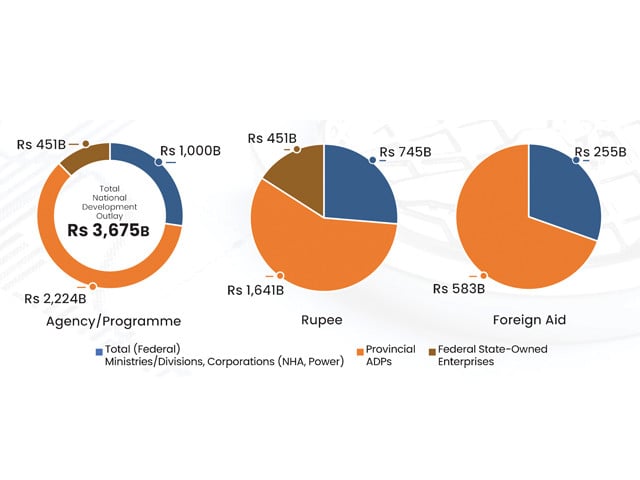
The National Development Programme for the financial year 2026-27 has approved a total budget of Rs3.675 trillion, which includes Rs1 trillion for the federal PSDP, Rs2.224 trillion designated for various provincial development programmes, and Rs451 billion earmarked for investments by state-owned enterprises (SOEs).
"The PSDP is the key instrument through which the government utilises both domestic and foreign resources for social and economic development," he added.
He also gave an explanation for the reduction, saying this distribution reflects the new division of responsibilities following the 18th Constitutional Amendment, under which the responsibility for the social sectors has largely shifted to the provinces, while the federation focuses specifically on projects of national strategic importance.
However, economists see it differently. Pakistan spends so much on debt, defence and routine government operations that development projects end up bearing the brunt of fiscal adjustment every year, even though they are crucial for economic growth and social welfare.
"Government expenditures can be categorised into four Ds: Debt, Defence, day-to-day running of the government, and Development (including the PSDP). The first three are largely non-discretionary and cannot be compromised, although they can be rationalised," said Dr Abid Qaiyum Suleri, Executive Director of the Sustainable Development Policy Institute (SDPI). "Resultantly the fourth D (and PSDP) gets axed every year."
The federal government will begin the fiscal year with a deficit of around Rs7 trillion, he added.
The federal government has allocated over 60% of its federal development programme budget to critical core sectors, specifically prioritising transport and communication, water resources and energy, Aurangzeb said. The remaining chunk of developmental funds will be systematically distributed across other high-priority areas, including information technology (IT), science and technology, agriculture, health and education. All funded initiatives have been strategically aligned with the "Uraan Pakistan" initiative and the 5Es-based national economic transformation plan, which serves as the state's blueprint to steer the economy towards sustainable growth and long-term stabilisation, he said.
The development of highways, railways and ports is at the top of our priorities, he emphasised. In the federal development programme 2026-27, Rs365 billion has been allocated for the improvement of transport infrastructure. At the top of this list is an amount of Rs100 billion to dualise Balochistan's highly important N-25 highway, the Pakistan Expressway, which connects Karachi to Chaman. Similarly, an investment of Rs30 billion will be made to complete the North-South motorway network, specifically the M-6 (Sukkur-Hyderabad motorway), while work on the Karachi-Rohri section of ML-1 will commence next fiscal year through new financing from the Asian Development Bank (ADB), for which Rs25 billion has been allocated. Furthermore, Rs2 billion has been set aside for the Thar Coal Connectivity Project, he said, adding that this is the project that will connect local energy reserves with the national transport system.
In addition to this, more than Rs93 billion has been allocated for the infrastructure of Gwadar Port and transport projects across all four provinces, so that fast means of transport can be made available throughout the country.
In FY2025-26, priority was given to near-completion projects, foreign-funded schemes and initiatives considered critical for national development. Major projects included the Dasu and Diamer-Bhasha hydropower projects, Mohmand Dam, Karachi's K-IV water project and information technology parks in Karachi and Islamabad.
The programme also included reconstruction of houses and schools damaged by floods, development of rail connectivity for Thar coal, establishment of a cancer hospital in Islamabad and national programmes aimed at combating hepatitis C and diabetes.
Several strategic new initiatives were launched under the previous PSDP. These included the Pakistan Manned Space Mission, the Pakistan Lunar Exploration Rover project and expansion of the Safe City Islamabad initiative. The government also announced plans for multiple Daanish Schools, a Centre of Excellence for Autism in Islamabad and scholarship programmes for students from friendly countries.
Infrastructure and industrial development remained central themes. Projects such as the widening of the N-5 highway, development of Karachi Industrial Park, Gwadar's Eastbay Expressway Phase-II and the Mashkhel-Panjgoor road were included among the government's flagship schemes.
Despite these ambitious plans, the PSDP represented only 5.8% of the total federal budget and around 0.6% of gross domestic product.
"Fiscal tightening, indirect taxation and reduced development spending disproportionately affected lower and middle-income groups," said Dr Jazib Mumtaz of IBA Public Finance. "Social welfare has deteriorated over the years as inflation has eroded the purchasing power of households."












This material may not be published, broadcast, rewritten, redistributed or derived from. Unless otherwise stated, all content is copyrighted © 2026 The Express Tribune.

1727268465-0/Untitled-design-(42)1727268465-0-208x130.webp "independence 2 0")

COMMENTS
Comments are moderated and generally will be posted if they are on-topic and not abusive.
For more information, please see our Comments FAQ