New districts leave residents struggling with outdated documents
Updated 1 hour ago

Dismisses govt’s growth narrative, saying economic gains have not reached ordinary people
1733924372-0/Untitled-design-(88)1733924372-0-640x480.webp "express file")
The Pakistan Tehreek-i-Insaf (PTI) on Friday rejected the federal budget for fiscal year 2026-27, describing it as “a refined exercise in elite self-preservation” that offered little relief to ordinary citizens.
Finance Minister Muhammad Aurangzeb earlier unveiled the Rs18.8 trillion budget for FY2026-27, announcing total federal expenditure of Rs18,771 billion and setting an economic growth target of 4pc, while describing the budget as anchored in “stabilisation, reform and growth”.
In a statement, PTI Central Information Secretary Sheikh Waqas Akram criticised the budget document, calling it “a refined exercise in elite self-preservation”, presented with “the sincerity of a merchant extolling yesterday’s unsold stock”.
PRESS RELEASE
— PTI (@PTIofficial) June 12, 2026
Islamabad
12 June 2026
PTI Rejects PML-N’s Budget 2026-27: Elite Relief, Statistical Creativity, and Crumbs for the Common Man
Sheikh Waqas Akram, Secretary Information of Pakistan Tehreek-e-Insaf, has categorically rejected the federal budget for 2026-27…
Akram said the government was presenting a 3.7pc growth rate as evidence of economic recovery while comparing its performance with that of the PTI government during the Covid-19 pandemic.
“The previous administration, despite a global pandemic that paralysed economies worldwide, recorded growth approaching 6 percent in its final year while strengthening the current account and remittances,” he said.
He argued that the current government was portraying a more modest economic performance as a major achievement while relying heavily on remittances, external borrowing and factors that, according to him, had little direct impact on people living and working in the economy.
Akram claimed poverty had increased significantly, pushing millions of people below the poverty line.
Read: Budget 2026-27: FinMin projects 4% growth as govt unveils fiscal, tax and reform agenda
“The poorest sections of society are left to manage as best they can, their circumstances worsened by conditions this budget claims to have mastered,” he said, adding that the government had acknowledged the impact of higher oil prices and flood-related losses on households while highlighting targeted subsidies introduced in response.
The PTI leader said the salaried class remained under pressure despite the relief measures announced in the budget.
“The salaried class, already the most heavily taxed segment, finds meeting basic household obligations an exercise in sustained improvisation,” he said.
He maintained that reductions for higher-income groups and the abolition or reduction of super tax for selected businesses primarily benefited those better positioned to withstand economic pressures.
According to Akram, adjustments to construction-related withholding taxes favoured developers rather than addressing the housing needs of the broader population. At the same time, relief for ordinary employees would be quickly eroded by inflation projected at 8.2pc.
He further said that over the past three to four budgets, the government had imposed a range of new taxes, reduced tax rates, withdrawn zero-rating under the Fifth Schedule and eliminated several exemptions.
Also Read: PM Shehbaz says ‘time of prosperity has begun’, terms FY27 budget one of 'relief’
“Beyond a few minor measures, the budget offers nothing substantive for the common citizen or small businesses,” he said.
Akram also criticised measures affecting small businesses and traders, including the introduction of a new fixed tax regime, the expansion of withholding tax on unregistered purchases, and enhanced production monitoring through digital invoicing.
He alleged that the government was increasingly relying on large-scale, faceless audits and stricter enforcement measures.
“This approach does not aim to broaden the tax base but relies on harassment and coercion of already compliant taxpayers to extract more revenue while ignoring widespread tax evasion,” he said.
The PTI leader further alleged that the budget continued what he described as a pattern of “statistical flexibility and selective historical recollection”.
He claimed the government was attributing positive developments to its own policies while overlooking earlier achievements and criticised what he termed the presentation of regional tensions as a source of strategic advantage and defence export opportunities.
“The presentation of regional tensions as a source of strategic advantage and defence export opportunities, even amid conflict, shows indifference to the human and economic costs borne by ordinary citizens,” he said.
Gohar slams budget as 'disappointing'
Party Chairman Barrister Gohar Ali Khan earlier said that the upcoming federal budget would not bring any relief to the public, stressing that it would fail to improve the lives of ordinary citizens.
Speaking to the media, the PTI chairman said the government had “no performance over the past four years” and accused it of continued borrowing instead of reducing expenditures. He said the budget was expected to be “disappointing”, adding that “there will be no relief for the public” in the financial plan.
Barrister Gohar criticised what he described as rising “extravagance and mismanagement” in government spending, saying the economic situation had worsened over time. He added that the budget should have focused on bringing real change in people’s lives, but instead, according to him, it reflected poor priorities.
Barrister Gohra also said efforts were ongoing to arrange a meeting with party founder Imran Khan, but there had been “no positive response” so far.
He remarked that the public was suffering while the government was “asking for informal engagement”, adding that the party did not want “photo sessions” with the prime minister.
The government is set to unveil a massive Rs17.5 trillion (approximately $61 billion) consolidated budget for the fiscal year 2026-27 today to meet strict International Monetary Fund austerity conditions.
The high-stakes spending plan balances fiscal tightening and IMF structural directives while introducing relief measures for the poorest citizens and modest salary bumps for government workers. The budget comes as much of the population continues to feel the effects of the Iran-US war, with no indication that the conflict is easing.
The government will propose measures to raise revenue and cut spending while shielding the nation's poorest.
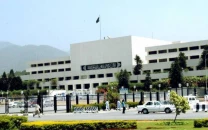
Under pressure to meet austerity conditions from the International Monetary Fund, Finance Minister Muhammad Aurangzeb will submit a delayed Rs17.5 trillion ($61-billion) spending plan for the fiscal year starting next month in the National Assembly.







This material may not be published, broadcast, rewritten, redistributed or derived from. Unless otherwise stated, all content is copyrighted © 2026 The Express Tribune.


COMMENTS
Comments are moderated and generally will be posted if they are on-topic and not abusive.
For more information, please see our Comments FAQ