Budget 2026-27: Federation will transfer Rs7.4tr to provinces, says finance minister
Opposition disrupts proceedings with loud chanting

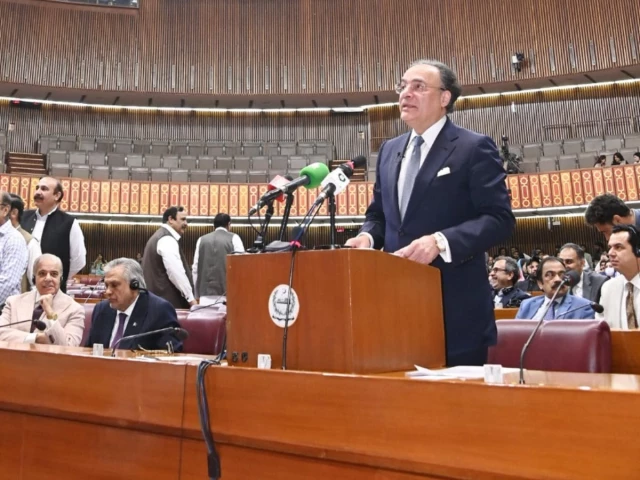
Finance Minister Muhammad Aurangzeb has said the provincial share under the National Finance Commission (NFC) Award would remain unchanged.
He said substantial allocations had been made for newly merged districts of Khyber-Pakhtunkhwa (K-P), Gilgit-Baltistan (G-B) and Azad Jammu and Kashmir (AJK), while presenting the Federal Budget for Fiscal Year 2026-27 amid opposition disruption on Friday.
Under PSDP, Rs13 billion allocated for governance, including digital governance Rs146 billion allocated for AJK in current expenditures Rs88 billion for G-B. For less developed areas, Rs144.9 billion earmarked and Rs95 billion allocated for the newly merged districts of K-P.
The finance minister said this budget is being presented at a time when Pakistan, in the eyes of its people and the world, has achieved the status of a country whose voice is heard and whose friendship is desired.
Turning to the economy, Aurangzeb said Pakistan's economic growth reached 3.7 per cent in FY2025-26 despite floods and regional conflict, while the size of the economy had reached $452 billion.
He said large-scale manufacturing productivity was recording its highest growth in four years, while per capita income had increased to $1,901.
The finance minister said foreign exchange reserves had risen from less than $4 billion three years ago to more than $17 billion, sufficient for approximately three months of imports.
Discussing inflation, Aurangzeb said it stood at 7 per cent and was expected to decline following the easing of Middle East tensions.
“Owing to Middle East tensions, inflation has increased, but with the resolution of the conflict, the inflation rate will come down,” he said.
He said the recent conflict involving Iran had pushed up international petrol and diesel prices, creating unexpected pressure on household budgets. However, he said the government had not passed on the full impact to consumers and instead provided a targeted petroleum subsidy of Rs128 billion during the recent oil crisis.
“Local prices of petrol and diesel did not fully reflect the intense severity of the international market,” he said.
Aurangzeb also said Pakistan had returned to the international bond market after four years, raising $750 million through Eurobonds.
He added that Pakistan had entered the Chinese capital market for the first time through a Panda Bond issue, where demand exceeded expectations.
The minister said 11 IPOs had been launched in the stock market during the year, while more than 250 companies had started business in Pakistan's Special Technology Zones.
“Pakistan's image has improved significantly and its voice is being heard internationally,” he said.
The finance minister said the government was delivering on its commitment to implement a long-delayed privatisation agenda, arguing that the private sector would be the main driver of Pakistan's future economic growth.
Aurangzeb recalled a pledge made during last year's budget address.
“During my budget speech in this very House last year, we made a promise to the nation that we would implement the privatisation agenda that has been delayed for decades,” he said.
The minister said the government had begun with the privatisation of First Women Bank and later completed the sale of Pakistan International Airlines (PIA).
“We started with the privatisation of First Women Bank, and then on December 23, 2025, the entire nation witnessed that through a transparent and live-televised auction in Islamabad, Pakistan International Airlines was handed over to the private sector for a total of Rs185 billion,” he said.
Aurangzeb described the transaction as a “successful and historic privatisation” carried out in line with PM Shehbaz's vision that the private sector is the guarantor of sustainable economic growth.
“Private sector is going to lead this country,” he told the House.
The finance minister said the government's privatisation programme would continue, announcing that power distribution companies (DISCOs), generation companies (GENCOs) and airports would also be privatised.
Highlighting economic reforms, Aurangzeb said the Federal Board of Revenue's tax collection had increased from Rs7.2 trillion to Rs13 trillion over the past three years and was expected to reach Rs13 trillion by the end of the current fiscal year.
Among other economic indicators, he said the policy rate had fallen from 22 per cent to 11.5 per cent, while the State Bank's foreign exchange reserves had exceeded $17 billion.
Aurangzeb said industrial growth stood at 6.1 per cent, while the services sector recorded growth of 4.1 per cent.
“The productive capacity of industries is continuously increasing,” he said, adding that “the world's large companies are investing in Pakistan.”
Discussing governance reforms, Aurangzeb said the Faceless Customs Assessment System had removed direct interaction between importers and tax officials to ensure transparency and improve revenue collection.
He added that 39,000 new companies had been registered with the Securities and Exchange Commission of Pakistan (SECP), reflecting growing business activity.
On financial inclusion, the finance minister said the government had introduced five schemes aimed at providing financing to small borrowers and vulnerable segments of society.
He highlighted the Rs7.1 billion Agri-Storage Financing Facility, under which storage facilities would be established across the country, enabling farmers to safely store grains and agricultural produce while obtaining bank financing against the stored stock.
Aurangzeb said the initiative had been launched under the special focus of prime minister and was intended to accelerate financial inclusion while creating opportunities for skilled and marginalised groups.
He further said that under the Zar Khezi project, loans worth Rs300 billion were being provided to 750,000 farmers.
The minister also highlighted progress under the government's Digital Pakistan agenda, saying large numbers of traders had started adopting digital systems.
“Significant progress has been made on the Digital Pakistan and financial inclusion agenda,” he said, adding that the reforms had resulted in an increase in banking users, rapid growth in digital transactions and a stronger foundation for a cashless economy.
According to Aurangzeb, the number of merchants integrated into the digital payments system rose to Rs1.67 million from 500,000 a year earlier.
He also told the House that a production monitoring system had been implemented in 27 cement factories and 75 sugar mills.
Turning to demographics and employment, the finance minister noted that 68 per cent of Pakistan's population was below the age of 30 and stressed the need to create opportunities for young people.
“Financing for youth is the most important programme,” he said, emphasising that employment generation remained a key priority of the government's economic strategy.
Aurangzeb said the government was focused on equipping young Pakistanis with the skills and opportunities needed to become active contributors to the economy.
“Our youth are filled with skill, determination and the spirit to achieve. It is the resolve of Prime Minister Shehbaz Sharif that every young Pakistani receives the skills, training and opportunities needed to become an active stakeholder in the national economy,” he said.
The minister said that under the Prime Minister's Youth Skills Development Programme, implemented through NAVTTC, around 515,000 young people had received modern and conventional technical training so far.
Citing an independent evaluation, he said 53 per cent of the trained participants had already secured employment.
Aurangzeb added that the programme placed special emphasis on the economic empowerment of women through IT-based training, enabling women to participate in the digital economy and freelancing sector from their homes.
FinMin said energy remained a lifeline for the economy and the government had introduced structural reforms to achieve self-reliance in the sector. “A net-zero accumulation of circular debt was achieved in the power sector, meaning no addition was made to this burden this year,” he said.
He added that the government was introducing a direct subsidy model aimed at improving targeting and efficiency in the power sector.
“We are introducing a direct subsidy model… there is no increase in circular debt this year,” he said.
Aurangzeb said a nationwide exercise would be carried out to identify, register and verify all subsidised consumers, enabling the launch of a Direct Subsidy Mechanism from January 2027.
“This is the same equitable model that we adopted through BISP,” he said.
He also said structural reforms at the National Transmission and Despatch Company (NTDC) were underway, including the unbundling of transmission, system operation and market operation functions.
The finance minister said Pakistan had renegotiated LNG agreements with Qatar and Italy, resulting in a reduction of 35 cargoes for 2026 and saving around $1.2 billion in foreign exchange.
He said uninterrupted gas supply had been ensured to fertiliser plants across the country.
“We did not let fertiliser production halt even for a single moment,” he said, adding that supply had been maintained to 10 fertiliser factories.
Aurangzeb said around 100 MMCFD of additional gas had been injected into the system since March 2024, while discoveries from 17 oil and gas reserves were yielding 108 MMCFD of gas and 16,000 barrels of additional oil.
He said offshore licensing had been revived after two decades, with 24 blocks allocated. He added that Pakistan's national oil company had entered the offshore sector in partnership with Türkiye.
The minister said the E&P sector was expected to attract around $1 billion in investment.
Aurangzeb said tax collection had doubled over the past three years, rising from Rs7.2 trillion in FY2022-23 to a projected Rs13 trillion by the end of the current fiscal year. He said Pakistan's debt-to-GDP ratio stood at 68.5 per cent, while debt maturity profiles had improved.
“Pakistan wants to reduce debt and the cost of debt,” he said.
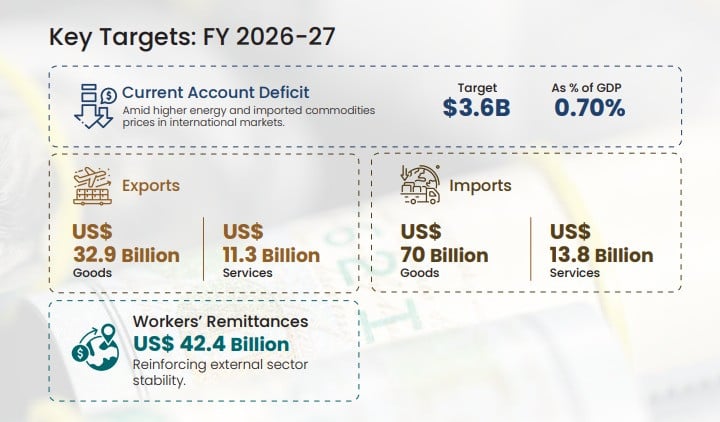
The finance minister presented key macroeconomic projections for FY2026-27. He said economic growth was expected to reach 4.0 per cent, while inflation was projected at 8.2 per cent.
He said the budget deficit was estimated at 3.6 per cent of GDP, with a primary surplus of 2 per cent.
Aurangzeb said Federal Board of Revenue (FBR) tax revenues were targeted at Rs15,264 billion, reflecting a 17.6 per cent increase over the previous year.
He added that the non-tax revenue target for 2026-27 had been set at Rs5,336 billion. The minister said boosting exports and productivity remained the government's top priority.
“The first priority of the budget is to increase productivity and exports, so our exporters can compete effectively in international markets,” he said.
He added that the government had reduced the cost of doing business to support export competitiveness.
“We have reduced the cost of doing business to promote exports,” he said.
Aurangzeb said the Export Development Surcharge on export income had been abolished, while the Export Finance Scheme mark-up rate had been reduced from 19 per cent to 4.5 per cent.
He said the only way forward was a strong private-sector-led growth model that generates jobs and investment.
The finance minister said 6,860 acres of Pakistan Steel Mills land would be activated as a Special Economic Zone to promote industrialisation, attract investment and create employment opportunities.
Aurangzeb said Rs71 billion had been allocated for the Prime Minister’s Apna Ghar housing scheme, under which low-cost housing loans are provided at a subsidised mark-up rate.
He also recommended extending tax exemptions for residents of former FATA and PATA regions. He said 12 million families would be covered under the Benazir Kafalat Programme. The finance minister said the Reko Diq project had achieved significant milestones during the year.
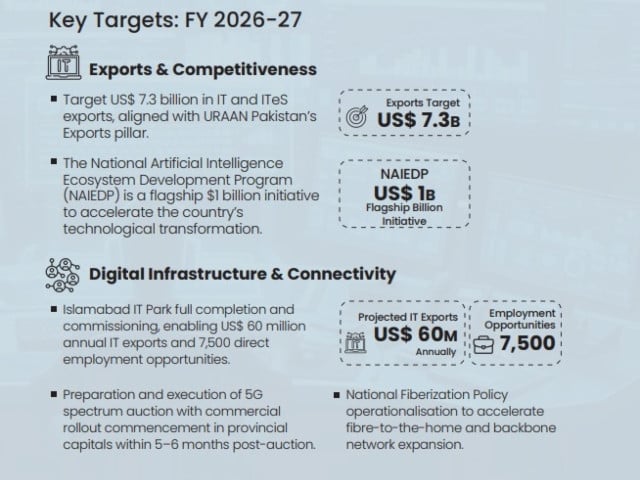
Aurangzeb said Pakistan's IT exports had increased by 20 per cent to $4.5 billion. He said 5G spectrum had been auctioned and would initially be launched in five cities.
He added that digital financial inclusion had expanded significantly, with 92 per cent of remittances now being received through bank accounts. Aurangzeb said the total federal expenditure for FY2026-27 was estimated at Rs18,771 billion.
He said current expenditure stood at Rs17.4 trillion, including Rs8,054 billion for mark-up payments and Rs2.680 trillion for grants.
He added that the fiscal framework reflected the government’s focus on stabilisation, reform and growth. He said Rs3,000 billion has been allocated for national defence.
Rs365 billion has been allocated for highways, railways and ports projects to improve connectivity. He said work on the Karachi–Rohri section of the ML-1 railway line will start next year. Rs116.2billion has been allocated for sustainable and affordable energy.
Rs1,071 billion has been allocated for civil administration expenditures. Rs1,169billion has been allocated for pension expenses.
Rs2,680billion has been allocated for grants. An additional Rs103 billion allocation was also mentioned under grants. Rs54 billion has been allocated for low-cost housing to support the construction of affordable homes.
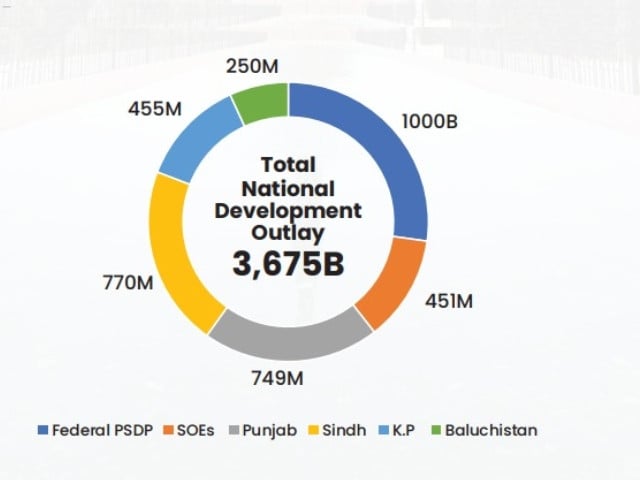
Rs6.6billion has been allocated for trade and industry support. He said Rs1trillion has been allocated for the Federal Development Programme.
He added that 1,000 textile stitching units are being expanded to boost exports and create employment opportunities. Rs88 billion has been allocated for the extension of the Export Refinance Scheme.
9.2 million children will benefit from the Benazir Taleemi Wazaif programme. Rs46 billion has been allocated for higher education, including scholarships for deserving students.
Under Daanish Schools, Rs22billion has been allocated to provide education to deserving and deprived students.
The finance minister said floods caused losses of Rs822billion this year.
He said Pakistan faces serious water challenges, including lack of storage capacity, declining reservoir efficiency, and climate-change-induced flood risks, requiring urgent investment in dams and reservoirs.
The finance minister said the area of taxation covers tax relief, tax rationalisation and broader FBR reforms.
He said a proposal has been made to reduce the tax rate for the salaried class from 23% to 20%, alongside broader relief measures for different income groups.
For salaried individuals earning between Rs2.2 million and Rs3.2 million annually, the tax rate has been reduced from 23% to 20%.
For those earning between Rs3.2million and Rs4.1million annually, the rate has been reduced from 30% to 25%, while for those earning between Rs4.1million and Rs5.6 million annually, the proposed tax rate has been reduced from 35% to 29%.
He said capital value tax on foreign assets is being removed, while the government is also considering abolishing the super tax on exporters. He added that export tax has been reduced from 2% to 1.25% under minimum tax arrangements.
He said a fixed tax regime is being introduced for small traders under Section 99B of the Income Tax Ordinance. Under this system, retailers will pay 1% tax on annual sales with a withholding tax adjustment facility, and a minimum tax payment of Rs25,000 will be mandatory at the time of filing returns. He added that shopkeepers with annual sales of up to Rs200 million will be eligible to opt for the fixed tax system.
He further said that all shopkeepers under this scheme will be issued a “green slate” for display at their shops, under which tax officials will not be allowed to enter shop premises. He also said the system will introduce a simple single-page tax return form, available in all major local languages in addition to Urdu.
He said the majority of small shopkeepers are still outside the tax net.
He further said that under the Federal Board of Revenue’s new operating model, three new pillars will be introduced, including the National Faceless Centre. The second pillar will involve the introduction of Artificial Intelligence in tax administration, while the third pillar will focus on third-party data integration and outreach, including property, vehicle and bank data.
He said the scope of the Third Schedule of the Sales Tax Act is also being expanded as part of reforms aimed at improving compliance and documentation.
He said Rs3,695billion has been allocated for the National Development Programme for the next fiscal year. He added that Rs365billion has been allocated for transport infrastructure, while Rs157.5billion has been set aside for the construction and improvement of highways.
The finance minister said last year’s floods caused losses worth Rs822billion to the economy. Proposal to reduce super tax rate from 10% to 8% on income exceeding Rs500million.
Aurangzeb said that Federal Excise Duty (FED) will be imposed on vehicles above 2,000cc to 3,000cc, while it will be increased for vehicles above 3,000cc. He said, “We introduced an auto policy, which resulted in an increase in the number of manufacturers and investment”.
The finance minister announced that tax relief will remain in place for e-bikes and e-rickshaws. He further said the government is removing customs duty on raw materials for more than 100 medicines for cancer and other critical ailments.
He also announced a 10% increase in the minimum wage. He said salaries of government employees will be increased by 7%, while pensions for retired employees will also be raised by 7%.
He added that industrial design and automation centres are being established in Karachi, Lahore and Sialkot. He said Rs46billion has been allocated for higher education.
A proposal has been made to reduce withholding tax on property sales for tax filers from 5.5% to 2.75%. Proposal also made to abolish the Capital Value Tax (CVT) on holding foreign assets.
Earlier, the finance minister stated that our defence industry has also become a source of earning valuable foreign exchange. This is proof that a strong defense is not only vital for our integrity but can also assist in the country's economic development.
He said Pakistan has responded forcefully to India's aggression. India was compelled to discuss peace. Our Operation Bunyanum Marsoos was a major success. Pakistan has achieved a massive diplomatic success in recent months and successfully brought the United States and Iran to the negotiating table to resolve regional conflict, he added.
The American and Iranian presidents have repeatedly praised the particularly important role of Prime Minister Shehbaz Sharif and COAS and CDF Field Marshal Syed Asim Munir. This is an unprecedented success which has enhanced our respect and stature in the comity of nations, and our efforts have been appreciated at every level and forum, have been appreciated, he said.
Aurangzeb said Pakistan-China relations remained “an important pillar of the economy”.
Concluding the budget speech, the finance minister expressed profound gratitude to the top civilian and military leadership for steering the state toward economic recovery. He commended PM Shehbaz for his personal dedication and guidance throughout the economic stabilisation journey.
Special appreciation was also extended to the military leadership, particularly CDF Munir, for ensuring an unassailable national defence.
Aurangzeb also thanked coalition partners for their unwavering support at critical junctures, acknowledged the constructive role of the opposition's criticism, and lauded the cooperative spirit of all provincial governments in meeting the country’s strategic goals.


1733924372-0/Untitled-design-(88)1733924372-0-208x130.webp)


COMMENTS
Comments are moderated and generally will be posted if they are on-topic and not abusive.
For more information, please see our Comments FAQ