Alphabet's SpaceX bet grows to $94b
Updated 4 hours ago

Solar energy fuels growth; agri-sector uses less electricity due to high costs
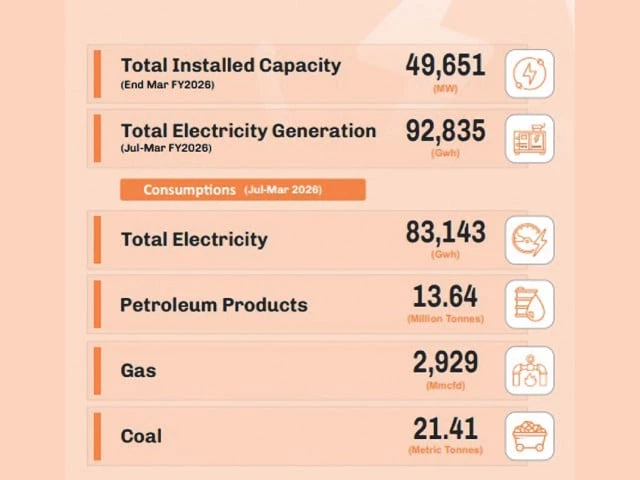
The installed electricity generation capacity of Pakistan has jumped up to 49,651 megawatts, reflecting an 8.5% increase primarily because of the addition of power production through solar net metering, according to the Pakistan Economic Survey 2025-26 released on Thursday.
The installed generation capacity stood lower at 45,782 MW in the corresponding period (July-March) of fiscal year 2024-25. A year earlier, the installed capacity was 45,888 MW.
Through solar net metering, an installed capacity of 7,319 MW was added during the first nine months of FY26. However, out of the commissioned 102 independent power plants (IPPs), 13 IPPs of a combined capacity of 5,105 MW were closed for various reasons.
Electricity consumption in the agriculture sector dropped significantly by 42.3%, from 4,566 gigawatt hours to 2,636 GWh, which reduced its share from 5.7% to 3.2%. "This sharp decline is likely due to changes in irrigation practices, rainfall patterns and possibly a switch to diesel-powered or solar alternatives in response to rising electricity costs," said the Economic Survey.
Out of the 13 closed IPPs, nine were residual fuel oil (RFO)-based plants of 2,877 MW, three were gas/re-gasified LNG-based plants of 601 MW and one was a multi-fuel-powered IPP of 1,638 MW. The percentage share of hydel, nuclear, renewable and thermal electricity was 23.4%, 7.1%, 20.3% and 49.2%, respectively.
The share of thermal power as the dominant source of electricity supply has declined over the past few years, highlighting increased reliance on indigenous sources. Out of the total electricity generation of 92,835 GWh, the share of hydel, nuclear and renewable energy came in at 53.1%. "This shift marks a positive development of the economy, as the energy mix transitions away from thermal generation towards more sustainable and environmentally friendly alternatives," said the survey.
During July-March FY26, the total electricity consumption in Pakistan stood at 83,143 GWh, compared to 80,811 GWh in the corresponding period of FY25, reflecting a 3.8% increase. The household sector continued to dominate electricity consumption, though its share declined to 47.5% (39,472 GWh), down from 49.6% (39,730 GWh) in the same period of FY25.
According to the report, this decrease indicates a relative structural shift to alternative energy sources due to tariff hikes, which have reduced affordability and incentivised conservation. In contrast, industrial consumption increased to 26,205 GWh, up from 21,083 GWh, taking its share from 26.3% to 31.5%.
Oil sector
During July-March FY26, the total consumption of petroleum products reached 13.64 million metric tons (MMT), registering a year-on-year increase of 3.5% compared to 13.17 MMT during the same period of FY25. The transport sector, which is the dominant consumer, recorded a 6.7% rise in consumption, from 10.55 MMT in July-March FY25 to 11.25 MMT (82.5% of total demand) in the same period of FY26.
The Economic Survey commented, "This growth is indicative of increased mobility, recovery in trade and logistics and higher fuel demand from road transport and commercial vehicles."
In contrast, the industrial sector saw a substantial decline of 42.6%, with consumption dropping from 754,600 metric tons (MT) to 433,500 MT (3.2% of total demand). This decline may be driven by improved fuel switching towards cheaper alternatives such as natural gas and renewables.
During July-March FY26, Pakistan imported 13.88 million metric tons (MMT) of petroleum products, up from 12.53 MMT in the same period of FY25, registering a 10.8% increase. The total import bill in value terms increased to $8.9 billion from $8.4 billion in July-March FY25. "This reflects a combination of higher import volumes as well as unstable international oil prices," it said.
The import of motor spirit (MS) edged higher by 2.3% to 4.07 MMT, though the import value declined by 2.4% to $2.96 billion, compared to $3.03 billion in the corresponding period of last year. This divergence points to a favourable shift in global prices in the first and second quarters of FY26 despite rising demand from the transport sector.
Gas sector
Natural gas is widely recognised as the cleanest burning fossil fuel. Its indigenous supply contributed about 29.3% in FY26 to the total primary energy supply mix of the country. Pakistan has an extensive gas network of over 13,729 km of transmission lines, 124,382 km of main lines and 30,661 km of services pipelines to cater to the needs of more than 10.9 million consumers across the country.
According to the survey, the government is pursuing policies to enhance indigenous gas production as well as gas imports to meet the increasing demand for energy in the country. At present, the capacity of two Floating Storage and Re-gasification Units (FSRUs) for re-gasified liquefied natural gas (RLNG) is 1,200 million cubic feet per day (mmcfd) and accordingly RLNG is being imported to mitigate the demand-supply shortfall.
The average natural gas consumption was about 2,929 mmcfd including 613 mmcfd of RLNG from July 2025 to March 2026. During the said period, the two gas utility companies (SNGPL and SSGCL) laid 729 km of main lines and 403 km of services lines, and connected 95 villages/towns to the gas network.
Meanwhile, 149,908 additional gas connections including 148,225 domestic, 1,578 commercial and 105 industrial were provided across the country. It is expected that gas will be supplied to approximately 708,245 new consumers during FY 2026-27.














This material may not be published, broadcast, rewritten, redistributed or derived from. Unless otherwise stated, all content is copyrighted © 2026 The Express Tribune.



1727268465-0/Untitled-design-(42)1727268465-0-208x130.webp "independence 2 0")



COMMENTS
Comments are moderated and generally will be posted if they are on-topic and not abusive.
For more information, please see our Comments FAQ