Gold rises Rs2,400 ahead of US inflation data
Updated 4 hours ago

Crop sector recovers from 1.01% contraction to 1.44% growth; livestock now 14.6% of GDP
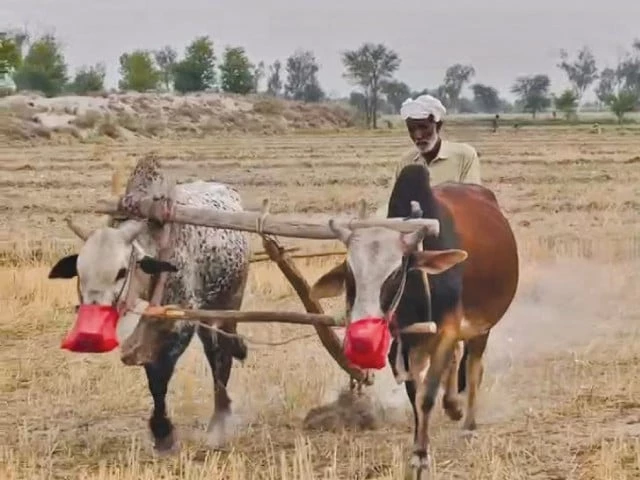
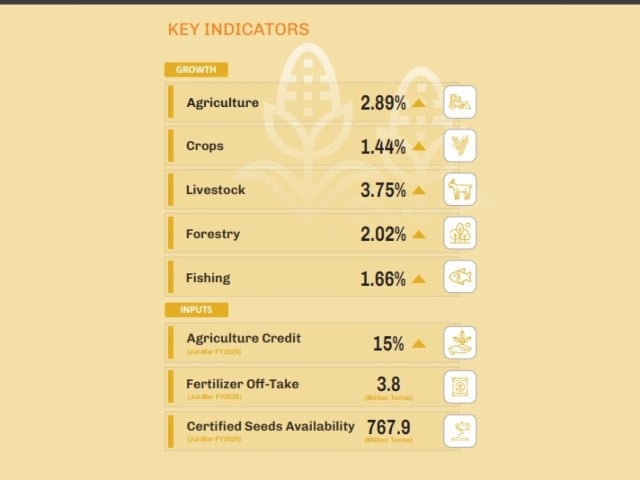
Pakistan’s agriculture sector has demonstrated notable resilience in 2025-26, recording growth of 2.89% compared with just 1.53% during the same period last year. The rebound is particularly significant given the devastating monsoon floods of 2025, which threatened to derail crop production across major growing regions.
According to the Economic Survey of Pakistan 2025-26, timely government interventions and support measures helped farmers weather the crisis, enabling the sector to outperform initial expectations.
Agriculture contributes 23.4% to national GDP and provides employment to 33.1% of the workforce. The sector's recovery also reflects a stronger policy environment, including the establishment of the National Agriculture and Food Security Council (NAFSC), which has given fresh direction to food security planning at the highest levels of government.
The crop sub-sector, which had contracted by 1.01% in 2024-25, recovered with growth of 1.44% this year. Among the five major crops, cotton, rice, sugarcane, maize and wheat, overall growth stood at 0.65%, a significant turnaround from the 13.19% contraction recorded last year. The recovery was led by strong performances in sugarcane, wheat and rice, which offset weaker cotton and maize output.
Also Read: Pakistan Economic Survey: Economy expands to $452b, GDP grows 3.7%
As per the survey, sugarcane delivered the most impressive performance, growing by 6.2% to reach 89.45 million tonnes from 84.24 million tonnes last year, driven by expanded cultivation area and a 3.7% improvement in yield. Wheat, Pakistan's staple food crop, also had a strong season, with production rising by 4.3% to 29.61 million tonnes from 28.40 million tonnes, supported by the Interim Wheat Policy 2025-26 and improved availability of certified seeds and fertilisers.
Rice production grew by 2.8%, rising from 9.72 to 9.99 million tonnes, driven by a 6.6% improvement in yield despite a decline in cultivated area.
Cotton and maize were the two weak spots. Cotton production dipped by 0.5% to 7.05 million bales as farmers shifted to more profitable alternatives, while maize output fell by 2.7% to 8.79 million tonnes due to flood-related effects on yields. The other crops category still managed growth of 2.43%, led by a 31.4% surge in pulses, a 12.6% rise in vegetables, and 2.8% growth in fruits.
On the livestock front, the sub-sector expanded by 3.75% in 2025-26, up from 2.95% the previous year, and now accounts for 62.4% of agriculture's total value addition and 14.6% of national GDP. Gross value addition in the sector grew from Rs6,004 billion to Rs6,229 billion. Remarkably, this was achieved despite a 4.5% decline in green fodder availability, with overall livestock output rising 3.46% due to improved animal husbandry practices and government support.
Read More: Poverty rises to 28.9% despite economic recovery
Milk production reached an estimated 74,689 thousand tonnes in 2025-26, up from 72,343 thousand tonnes the previous year. Total meat production also climbed to 6,314 thousand tonnes, with poultry meat recording the sharpest rise to 2,826 thousand tonnes.
Pakistan's poultry sector, which positions the country as the world's eleventh-largest poultry producer, has maintained an average annual growth rate of 8.1% over the past decade and now employs more than 1.5 million people.
The survey added that the government has signalled serious intent to transform livestock into an export engine. Meat exports have already grown from $196 million in 2015 to over $500 million in FY25.
The National Meat Sector Transformation and Export Council, constituted under the prime minister, has set a target to raise exports to nearly $700 million by 2028. Forestry and fishing also contributed positively, posting growth of 2.02% and 1.66% respectively.
On the inputs side, fertiliser nutrient offtake during July-March 2025-26 reached 3,795 thousand tonnes, up 11.4% from last year. Nitrogen offtake rose by 14.8% while potash use jumped by 26.2%, signalling growing farmer confidence. Phosphate offtake, however, dipped by 1.9% due to higher prices.










This material may not be published, broadcast, rewritten, redistributed or derived from. Unless otherwise stated, all content is copyrighted © 2026 The Express Tribune.








COMMENTS
Comments are moderated and generally will be posted if they are on-topic and not abusive.
For more information, please see our Comments FAQ