ECP director general martyred in K-P’s Tank after gun attack
Updated 4 hours ago

FM Araghchi thanks Dar for sharing the key aspects of the agreement
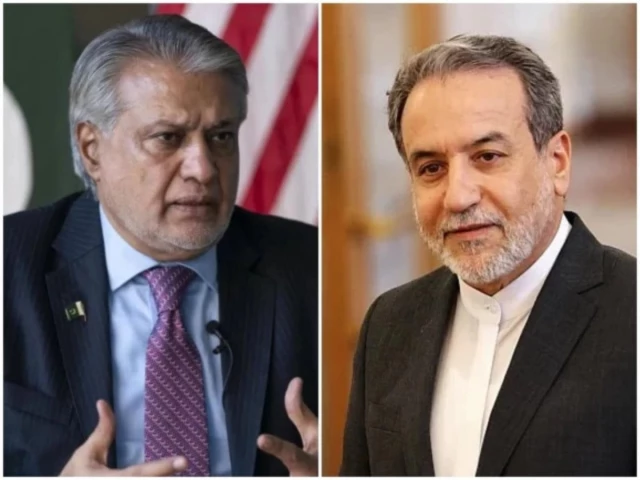
Deputy Prime Minister and Foreign Minister Ishaq Dar shared details of the key aspects of the recently signed Makkah defence agreement with his Iranian counterpart on Monday.
The Makkah Joint Defence Agreement was signed by Pakistan, Saudi Arabia and Turkiye on Friday, establishing a framework for collective security and defence cooperation under which an armed attack on any one of the three countries would be considered an attack on all. The pact was built on a Strategic Mutual Defence Agreement signed by Pakistan and Saudi Arabia in September 2025, which contained a similar mutual-defence commitment.
Iran has cautiously welcomed the agreement.
In a post on X today, the Foreign Office (FO) said FM Dar spoke with Iranian FM Abbas Araghchi.
"They exchanged views on regional and international developments, with particular focus on the evolving situation in the region and efforts to promote peace and stability," it said, adding that the former also "shared the contours" of the Makkah pact.
FM Dar underscored its "objectives of strengthening strategic cooperation and contributing to regional peace and security", with FM Araghchi thanking him for sharing the key aspects of the agreement.
"Both ministers agreed to remain in close contact on matters of mutual interest."
Deputy Prime Minister/Foreign Minister Senator Mohammad Ishaq Dar @MIshaqDar50 spoke today with Foreign Minister of Iran Abbas Araghchi @Araghchi.
— Ministry of Foreign Affairs - Pakistan (@ForeignOfficePk) August 10, 2026
They exchanged views on regional and international developments, with particular focus on the evolving situation in the region and… pic.twitter.com/UXm4e42PnV
Meanwhile, Iranian Foreign Ministry spokesman Esmaeil Baqaei said Araghchi and Parliament Speaker Mohammad Bagher Ghalibaf were invited by Pakistan to visit Islamabad for talks.
He said the two would visit "at an appropriate time". He did not provide further details as to when the visit would take place while talking to Iran's state-run Press TV.
"Reciprocal visits and exchanges are a natural part of the growing ties between the two neighbouring countries," Baqaei added.
Earlier, the FO said Kuwaiti FM Sheikh Jarrah Jaber Al-Ahmad Al-Sabah felicitated Dar over the signing of the Makkah agreement.
According to the FO, Sheikh Jarrah spoke with Dar late on Sunday night and congratulated him on the signing of the agreement. “The two also exchanged views on the regional situation, including Occupied East Jerusalem,” the FO said.
Deputy Prime Minister/Foreign Minister Senator Mohammad Ishaq Dar @MIshaqDar50 spoke late last night with Kuwaiti Foreign Minister Sheikh Jarrah Jaber Al-Ahmad Al-Sabah.
— Ministry of Foreign Affairs - Pakistan (@ForeignOfficePk) August 10, 2026
FM Jarrah felicitated the DPM/FM on the recent signing of the Makkah Joint Defence Agreement between… pic.twitter.com/CNCidV43nJ
The two foreign ministers also discussed Pakistan-Kuwait bilateral relations and matters of mutual interest. The discussion included a follow-up to Sheikh Jarrah’s recent visit to Pakistan and ways to further enhance cooperation and investment in key sectors.
“The two sides agreed to remain closely engaged,” the FO said.
During the conversation, Dar and Sheikh Jarrah also discussed the regional situation, with Occupied East Jerusalem among the issues under discussion. The FO said the two sides reviewed “matters of mutual interest” and agreed to maintain close engagement, particularly on bilateral cooperation and investment.
Dar said on Sunday that the agreement’s “sole purpose” was to strengthen ongoing efforts towards “peace, stability and prosperity” in the wider region.
He described the Makkah accord as a reflection of the “depth of the brotherly relations” between the leaderships and peoples of the three countries. Dar stressed that the accord did not “abrogate or replace” any existing bilateral or multilateral agreements between the three countries, or their agreements with other countries or organisations.
DPM Dar speaks to Saudi foreign minister
Separately, FM Dar spoke with Saudi FM Prince Faisal bin Farhan. The two ministers discussed “matters of mutual interest, including multilateral cooperation and regional developments”.
Deputy Prime Minister/Foreign Minister Senator Mohammad Ishaq Dar @MIshaqDar50 today spoke with the Foreign Minister of Saudi Arabia, Prince Faisal bin Farhan @FaisalbinFarhan.
— Ministry of Foreign Affairs - Pakistan (@ForeignOfficePk) August 10, 2026
They discussed matters of mutual interest, including multilateral cooperation and regional… pic.twitter.com/YjNPobj7MP
They also “underscored the importance of continued close coordination and cooperation”, both bilaterally and at multilateral forums, it said.
DPM Dar speaks to African leaders
Meanwhile, DPM Dar, in a phone call late last night, briefed the president of the Democratic Republic of the Congo, Félix-Antoine Tshisekedi Tshilombo, and former Guinea-Bissau president General Umaro Sissoco Embaló on the recently signed Makkah Joint Defence Agreement between Pakistan, Saudi Arabia and Türkiye.
Deputy Prime Minister/Foreign Minister Senator Mohammad Ishaq Dar @MIshaqDar50 spoke late last night jointly with President of the Democratic Republic of the Congo Félix-Antoine Tshisekedi Tshilombo and General Umaro Sissoco Embaló, former President of Guinea-Bissau.
— Ministry of Foreign Affairs - Pakistan (@ForeignOfficePk) August 10, 2026
DPM/FM… pic.twitter.com/T6mc3XteyL
According to a FO post on X, Dar shared with them “the contours” of the agreement and its significance for “strengthening strategic cooperation” and contributing to “regional peace, stability and security”.
Dar and President Tshisekedi also exchanged views on Pakistan-DRC relations and agreed on the importance of “further strengthening bilateral cooperation”, including through high-level exchanges. Dar also conveyed his “best wishes” to President Tshisekedi and the people of the DRC.
Significance of the Makkah Joint Defence Agreement
The Makkah Joint Defence Agreement was the latest step in longstanding military and strategic cooperation between Pakistan, Saudi Arabia and Türkiye. Signed in Makkah, the pact established a framework for collective deterrence and stipulated that an armed attack on any one of the three countries would be considered an attack on all three, while providing for wider cooperation across defence.
The agreement followed nearly a year of negotiations and came amid heightened instability across the Middle East. Türkiye and Pakistan had sought closer regional security cooperation, while Saudi Arabia had faced growing security concerns as conflicts spread across the region, threatening its territory, energy infrastructure and ambitious economic development plans.
Read More: Pakistan, Saudi Arabia, Turkiye sign joint defence pact in Makkah
For Pakistan and Saudi Arabia, the trilateral pact built on their Strategic Mutual Defence Agreement signed in September 2025. That agreement stated that “any aggression against either country shall be considered an aggression against both” and committed the two sides to strengthening defence cooperation and joint deterrence.
The three countries already had extensive military links. Pakistan had provided training and technical assistance to Saudi forces for decades, while Islamabad and Ankara had maintained close defence ties through military training, naval cooperation and defence equipment. In 2023, Saudi Arabia agreed to purchase Turkish drones in what Ankara described as its largest defence export contract.
Pakistan had also expanded its military and security cooperation with the kingdom, deploying about 8,000 troops, fighter jets, drones and an air-defence system to Saudi Arabia, according to Reuters. Pakistan deploys troops to Saudi air base under defence pact Islamabad had also been pursuing wider security and economic ties in the Gulf, including negotiations with Kuwait on an expanded cooperation pact linked to energy and investment. Pakistan-Kuwait agree to boost cooperation across key sectors
The signing in Makkah, Islam’s holiest city, added symbolic weight to an agreement that brought together three countries with significant military and strategic capabilities. It also came as Pakistan sought to avoid becoming directly involved in the Iran conflict, instead pursuing diplomatic efforts to mediate, while strengthening its broader regional security partnerships.









This material may not be published, broadcast, rewritten, redistributed or derived from. Unless otherwise stated, all content is copyrighted © 2026 The Express Tribune.



1727268465-0/Untitled-design-(42)1727268465-0-208x130.webp "the poor man s burden")


COMMENTS
Comments are moderated and generally will be posted if they are on-topic and not abusive.
For more information, please see our Comments FAQ