Gold rises Rs2,400 ahead of US inflation data
Updated 3 hours ago

Per capita income up 9% to $1,901; remittances to cross $41b as fiscal deficit falls to 0.7%
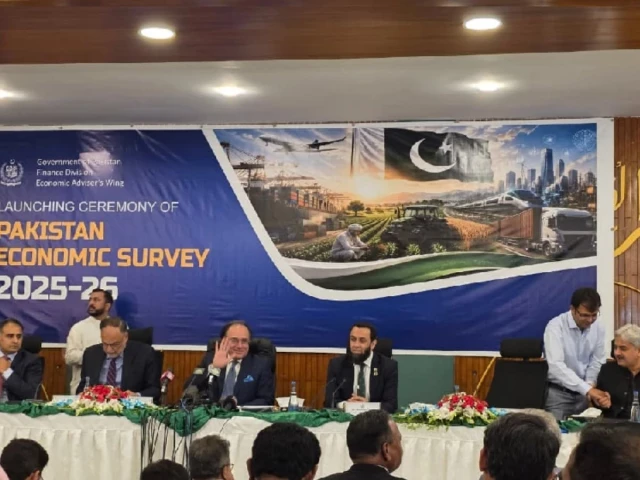
Finance Minister Muhammad Aurangzeb on Thursday unveiled Pakistan Economic Survey 2025-26, where he presented the main features of the annual report.
He said the economic survey “is not only an economic document, but it also tells a story about the past of one year, in terms of resilience, the discipline maintained and the renewed confidence”.
“When we entered this fiscal year in July, the first thing we faced was trade uncertainty, which was on account of tariff discussions on how to deal with duties around the world. We reached a point by the end of July where we could get into a competitive position in respect of our exports, especially to the US,” he said.
Right after that, he mentioned, Pakistan faced floods in August and September, which led to rescue and relief efforts for the rehabilitation of people and the reconstruction of infrastructure. The story did not end here, as in March, a regional conflict broke out.
Aurangzeb pointed out that out of these three exogenous factors, only the tariff uncertainty prevailed at the time of presentation of the previous economic survey. “The other factors were not there in the picture.”
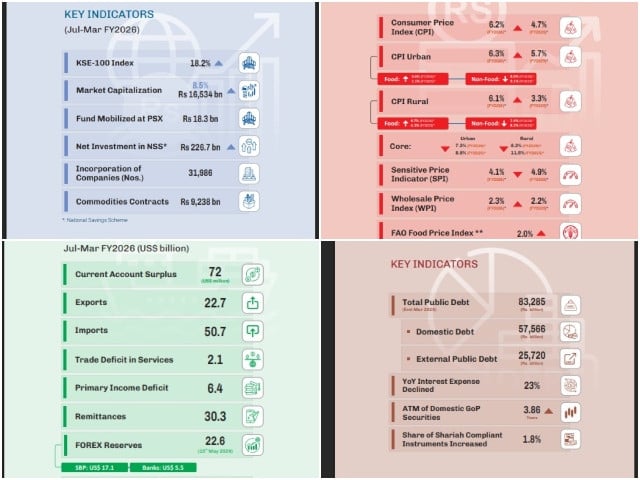
The fiscal deficit stood at 0.7% of GDP, while the primary balance remained in surplus. Federal Board of Revenue (FBR) revenues increased by 10.1%, and the current account posted a surplus of $72 million. The tax base has doubled in a few years from Rs7 trillion to Rs13 trillion. FBR revenues saw a 46% increase in June 2026, and tax revenue grew 40% over the past two years. Private sector credit stood at $11.57 billion.
Inflation has come as a result of the second-order impact of the international oil surge, but overall energy has been managed well. “In April, the oil import bill rose by $1 billion, but in May Pakistan managed to restrict the increase to $500 million,” Aurangzeb said. Pakistan’s total installed electricity capacity is 49,651 MW, comprising hydel (23.4%), thermal (49.2%), nuclear (7.1%) and renewables (20.3%).
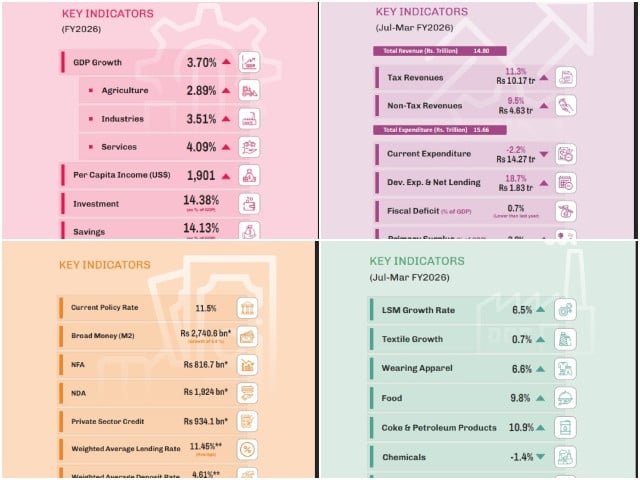
However, he added, these challenges put to the test the resilience of Pakistan, which dealt well with them and continued on the path from stabilisation to growth. In that regard, he highlighted that the country’s GDP growth remained at 3.7% in fiscal year 2025-26.
“We have made a broad-based recovery despite the conflict that has hurt the region as well as the entire world. Owing to this, the global growth fell to 3.1% in 2026,” he elaborated.
In spite of the global and domestic challenges, Pakistan registered a four-year high growth rate of 3.7% in FY26. Recalling the journey from where the current government started off, he said that in FY 2022-23, Pakistan’s growth rate was negative 0.2%, in FY24 the growth reached 2.6%, and in FY25 it touched 3.2%.
Earlier, the finance ministry, planning ministry and State Bank of Pakistan were of the unanimous view that economic growth in FY26 would exceed 4%, however, the Middle East conflict constrained economic expansion. Still, he said, Pakistan reached the biggest economic size in its history at Rs126.9 trillion, or $452.1 billion. Similarly, per capita income rose to $1,901 compared to last year’s level of $1,751.
Talking about different sectors, Aurangzeb cited that the agriculture sector’s growth rose from 1.53% last year to 2.89% in the current year, though floods damaged large swathes of farmland.
In the crops sub-sector, the growth was 1.44% compared to a contraction in the previous year. “The livestock sector continues to grow from strength to strength. Though we focus mainly on crops, the livestock sector is very important as dairy and livestock comprise 60% of the agricultural GDP.”
As part of industry and manufacturing, the large-scale manufacturing (LSM) grew 6.1% in FY26 – the highest in the last four years. The manufacturing sector saw broad-based growth, as out of 22 sectors, 16 showed a positive trajectory.
These included food, textiles, wearing apparel, petroleum products, non-metallic minerals, automobiles, beverages and electrical equipment. “It’s not one single sector, which is leading or contributing to the 6.1% growth in large-scale manufacturing. This is broad-based,” the finance minister remarked.
مینوفیکچرنگ کے 22 میں سے 16 شعبوں میں مثبت شرح نمو رہی، وزیر خزانہ محمد اورنگزیب#manufacturing #IndustrialGrowth #production #FinanceMinister pic.twitter.com/pGtFnkuMRC
— APP (@appcsocialmedia) June 11, 2026
On the other side, too, there was a notable year-on-year growth. Cement demand increased 10%, fertiliser consumption rose 17%, the petroleum sector 5%, automobiles 31% and mobile phones 9%. “This again translates into higher demand in various other sectors.”
Turning to services, which have been a strong anchor for a long time with a 58% share in GDP, Aurangzeb said that it expanded 4.9%, which is once again the highest in the past four years. Information and communication services grew 7.52%, where the digital economy was playing a critical role.
Highlighting the efforts being made to achieve fiscal consolidation, he mentioned that the fiscal deficit contracted to 0.7% of GDP compared to 2.6% last year, and the primary surplus increased.
Tax collection by the Federal Board of Revenue went up by 10.1%, and markup payments decreased 23%, which created additional room in the fiscal space. Additionally, Pakistan’s inflation rate has shrunk over the past two years.
Also Read: Poverty rises to 28.9% despite economic recovery
On the external side, he said the structural deficit had been the real issue for Pakistan for the longest time. “On the fiscal side, we have shown a surplus and brought down the deficit.”
Pakistan’s current account remained in surplus at $72 million in July-March FY26, supported by swelling workers’ remittances. In May 2026, the remittances touched a record high of $4.25 billion.
“Remittances are and will remain a very important component of our external balancing position as we move forward. Therefore, we should remain grateful to the expatriate Pakistanis settled abroad and sending remittances back home.”
Apart from remittances, Pakistan has another instrument called the Roshan Digital Account (RDA), aimed at encouraging investment-led inflows. Average monthly RDA inflows were estimated at $180 million to $190 million by March 2026. In April, they shot up to $322 million, and in May, they are expected to cross $300 million.
اقتصادی سروے۔۔۔2025-26
— APP (@appcsocialmedia) June 11, 2026
روشن ڈیجیٹل اکاؤنٹس کے ذریعے سرمایہ کاری کا حجم 12.7 ارب ڈالر تک پہنچ گیا۔#EconomicSurvey #Budget2026 pic.twitter.com/7uVPvcNPJ4
The minister emphasised that Pakistan must increase exports and cited the planning minister’s remarks about “export emergency”.
Exports were declining because of two major factors, of which one sector that was leading the decline was food, where rice exports fell by $1.1 billion, and sugar exports dropped by $403 million. Overall, there was a reduction of $1.5 billion in food-sector exports.
In terms of export growth in July-May FY26, the textile sector took the lead, where woven garments’ shipments rose 5%, home textiles increased 3% and knitted garments 3%.
“When we make value addition and increase productivity, notwithstanding energy, taxation and other challenges, exports grow. Industry has to review their business models and its productivity discussions,” he argued.
Read More: Power capacity jumps 8.5% to 49,651MW
“We can’t go after 40 to 50-year-old discussions. We are going to adopt AI-led productivity models, which is very important.”
The finance minister pointed out that in the upcoming FIFA World Cup, Pakistani footballs were going to be used. In July-May FY26, the export of sports goods surged 18%. Similarly, IT exports have crossed $3.8 billion and will reach $4.5 billion by the end of the current fiscal year.
Of these, the exports made by freelancers, comprising young men and women, are touching $900 million and are going to cross $1 billion.








This material may not be published, broadcast, rewritten, redistributed or derived from. Unless otherwise stated, all content is copyrighted © 2026 The Express Tribune.








COMMENTS (3)
Comments are moderated and generally will be posted if they are on-topic and not abusive.
For more information, please see our Comments FAQ