From roar to whimper: opposition protest fizzles
Updated 1 hour ago

Buyers protest unusually high prices; traders defend valuation system
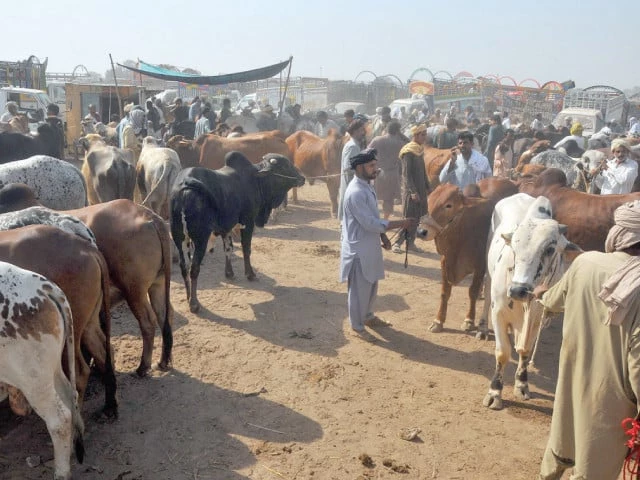
As Eidul Azha approaches, prices of sacrificial animals in cattle markets have once again become a focal point of debate, as buyers complain of unusually high rates while traders argue that they are not receiving fair returns for their livestock.
Unlike most commodities, Pakistan has no official pricing formula or regulatory mechanism for determining the cost of sacrificial animals. Experts note that prices are generally set based on multiple factors, including age, weight, breed, health, physical appearance, and prevailing market demand.
At cattle markets, ordinary goats and sheep are being sold in the range of Rs90,000 to Rs125,000, while premium breeds are priced between Rs200,000 and Rs400,000.
Similarly, medium-sized bulls and calves are available from Rs300,000 to Rs700,000, whereas high-breed and heavier animals are being offered between Rs800,000 and Rs1.5 million. Camel prices range from Rs500,000 to as high as Rs2 million.
Livestock traders maintain that animal pricing cannot be based on a single benchmark, as several variables influence valuation. Abdul Rehman, a trader who brought goats from Bahawalpur for sale, said prices are determined after assessing breed, weight, health, size, appearance, and market demand.
"Animals of superior breeds and attractive appearance usually attract higher demand, which naturally increases their prices," he said.
Another trader, Mian Shafiq, said rising costs of fodder, medicines, transportation, and general animal care also directly impact prices. He added that animals in higher demand fetch better prices, while those with lower demand are sold at comparatively reduced rates.
Rana Mubashir Hassan, a breeding farm owner, said producing high-quality animals requires substantial investment, which is reflected in their higher market value. He added that farms continuously bear expenses on feed, healthcare, and vaccination.
On the other hand, buyers have described prevailing prices as excessive. A citizen, Aftab Ahmed, said traders are demanding prices "touching the sky". He added that while sellers set prices based on breed and weight, buyers usually bid according to their financial capacity.
"When traders do not hesitate in demanding very high prices, buyers also do not hesitate in offering much lower amounts," he remarked.
A spokesperson for the Punjab Cattle Market Management and Development Company, Sheikh Asad Zafar, said there is no official formula or standard mechanism for fixing the prices of sacrificial animals.
According to him, traders independently determine prices based on breed, weight, health, and appearance, and the company does not intervene in the pricing process.
He added that action is taken whenever complaints of fraud or deception are received from either buyers or sellers. The spokesperson advised citizens to purchase animals only from registered cattle markets and designated enclosures set up by the company, and to avoid buying from roadside sellers.
He further clarified that sacrificial animals are not officially tagged or numbered through any formal system.
Meanwhile, competition between livestock traders and buyers has intensified across markets, with a visible increase in the supply of both small and large sacrificial animals, though buyer turnout remains relatively subdued.
Despite higher supply, the number of buyers has not increased proportionately, creating a competitive environment over pricing and sales between traders and purchasers.








This material may not be published, broadcast, rewritten, redistributed or derived from. Unless otherwise stated, all content is copyrighted © 2026 The Express Tribune.













COMMENTS
Comments are moderated and generally will be posted if they are on-topic and not abusive.
For more information, please see our Comments FAQ