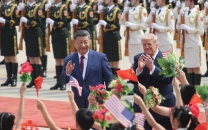
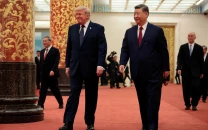
In pictures: Xi rolls out the red carpet for Trump's arrival
Updated 1 hour ago

Senior lawmaker says proposal submitted to parliament system for review and approval
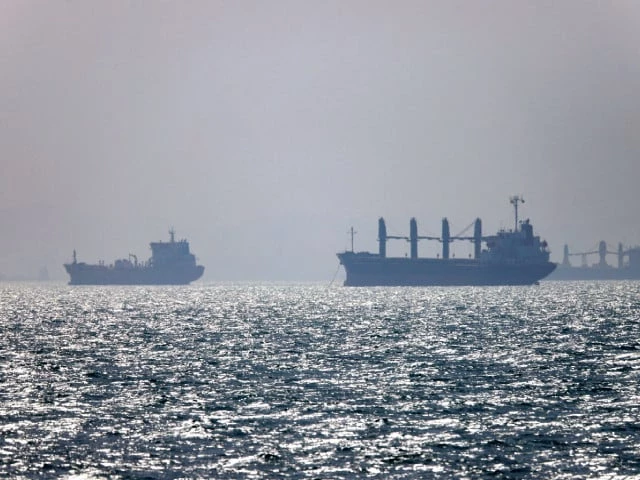
A strategic proposal on the “smart management” of the Strait of Hormuz has reached its final stage in Iran’s parliamentary National Security and Foreign Policy Commission and has been uploaded to parliament’s system for review and approval, the commission’s head said Wednesday.
Ebrahim Azizi said the proposal aims to use Iran’s geographic position in the strategic waterway as a “power-generating leverage.”
“The missile triad, the people and the Strait of Hormuz destroyed the product of 50 years of US efforts,” Azizi said in comments carried by the state broadcaster IRIB.
Read: Lavrov accuses US of seeking control over global energy, distracting from Palestine
He also praised public support during the recent conflict, saying the presence of people in streets and public squares “carried an important message.”
The remarks came after Azizi previously said on April 10 that the proposal could allow the Iranian government to cooperate with Oman and expand control over the Strait of Hormuz, which became a major issue during the recent war launched by the United States and Israel against Iran.
Speaking at the time to IRIB, Azizi said the framework would become binding only after parliamentary approval.
He said the proposal could allow negotiations with Oman on a treaty related to certain aspects of the broader framework, while stressing that Muscat would not play a role in determining the future of the waterway.
Azizi also said the proposal would place the Strait of Hormuz under what he described as the “comprehensive and full control” of Iran’s armed forces and security institutions if approved.
According to Azizi, the proposal includes provisions restricting vessels linked to countries considered hostile to Iran, including Israel, as well as military and intelligence-linked ships deemed harmful to Iranian national security.
He also said the proposal contains economic measures, including the possible use of Iran’s national currency, the rial, in related financial arrangements.
Regional tensions have escalated since the US and Israel launched strikes against Iran on Feb 28, triggering retaliation from Tehran against Israel as well as US allies in the Gulf, along with the closure of the Strait of Hormuz.
A ceasefire took effect on April 8 through Pakistani mediation, but talks in Islamabad failed to produce a lasting agreement. US President Donald Trump later extended the truce without a set deadline.
On Sunday, Iran sent Pakistan its response to a US proposal for ending the war, but Trump dismissed it as “totally unacceptable.”
US demands, rhetoric, lack of good faith obstacles to diplomacy: Iranian FM
Iranian Foreign Minister Abbas Araghchi said that the US' maximalist approach, provocative rhetoric, and lack of good faith and sincerity were the primary obstacles standing between the current state of conflict and any prospect of a definitive end to the war and a potential agreement, according to Mehr News Agency.
Araghchi made the remarks during a meeting with Andreas Motzfeldt Kravik, Deputy Foreign Minister of Norway, who travelled to Tehran for the talks.
The Norwegian Deputy Foreign Minister Andreas Kravik , who is paying an official visit to Tehran, has held talks with the Foreign Minister of the Islamic Republic of Iran @araghchi. pic.twitter.com/xcaScKhyVa
— IRNA News Agency ☫ (@IrnaEnglish) May 12, 2026
During the meeting, Araghchi confirmed that Iran, as a coastal state of the Strait of Hormuz, is currently in consultation to develop regulations governing arrangements for the strait based on international law. The statement formalises what senior Iranian officials have clearly signalled in recent weeks — that Tehran intends to establish a new legal order for the waterway.
Deputy Foreign Minister Andreas Kravik underscored the necessity of establishing durable peace and stability in the region and announced Norway's readiness to contribute in strengthening diplomacy, providing consultations on maritime safety, and supporting environmental protection efforts.
Iran rejects Kuwait's 'baseless claims' of IRGC infiltration
The Iranian foreign ministry condemned the Kuwaiti government’s detention of individuals who, according to the IRNA news agency, were performing their duties within the framework of a routine maritime patrol mission and had entered Kuwait’s territorial waters due to a navigation system malfunction.
According to the IRNA, the ministry announced that it expected Kuwaiti authorities to refrain from hasty comments and baseless claims while pursuing the existing issues through official channels.
Iran rejects Kuwait’s baseless claim regarding 4 Iranian citizenshttps://t.co/3TZGWzjJHq pic.twitter.com/u3V4x49tiQ
— IRNA News Agency ☫ (@IrnaEnglish) May 13, 2026
It also requested granting the Iranian embassy in Kuwait access to the detained Iranian nationals in accordance with international legal norms, as well as their immediate release.
Saudi Arabia condemns IRGC infiltration
Saudi Arabia's foreign ministry denounced what it termed "the infiltration carried out by an armed group from the Islamic Revolutionary Guard Corps of the Islamic Republic of Iran into Kuwait’s Bubiyan Island."
#Statement | The Foreign Ministry expresses the Kingdom of Saudi Arabia’s strongest condemnation and denunciation of the infiltration carried out by an armed group from the Islamic Revolutionary Guard Corps of the Islamic Republic of Iran into Kuwait’s Bubiyan Island, with the… pic.twitter.com/t2fVFd4LT6
— Foreign Ministry 🇸🇦 (@KSAmofaEN) May 12, 2026
"The Ministry stresses the Kingdom's categorical rejection of such hostilities that violate the sovereignty of the State of Kuwait."
Iran discusses Strait of Hormuz transit safety in talks with Azerbaijan
The top of diplomats of Iran and Azerbaijan held talks over the phone on Wednesday to discuss regional developments, as Tehran said it is seeking to develop arrangements aimed at strengthening and facilitating safe transit through the Strait of Hormuz.
A statement by the Iranian Foreign Ministry said Foreign Minister Abbas Araghchi discussed with his Azerbaijani counterpart Jeyhun Bayramov the latest developments related to diplomacy, regional issues and bilateral relations.
The discussions came a day after Araghchi said Tehran is holding consultations to develop executive arrangements aimed at strengthening and facilitating safe transit through the Strait of Hormuz in accordance with international law.
Also Read: US lawmaker says Washington lost 39 aircraft in Iran war, citing defense report
He made the remarks during a meeting in Tehran on Tuesday with Norway’s Deputy Foreign Minister Andreas Motzfeldt Kravik.
According to the ministry, Araghchi described what he called the United States’ “maximalist approach,” threatening rhetoric and “lack of good faith” as the main obstacles to a permanent end to the war and any potential agreement.
He also said the “main source” of the current situation in the Strait of Hormuz was the US and Israeli military attacks against Iran, followed by repeated ceasefire violations and the continued blockade of Iranian ports.
Italy to move minesweepers closer to Hormuz, rules out new military mission
Italy is preparing to move two minesweepers closer to the Strait of Hormuz as a precaution while ruling out any immediate request for a new military mission, Foreign Minister Antonio Tajani and Defence Minister Guido Crosetto told lawmakers on Wednesday.
Crosetto said the ships would be repositioned in stages — first to the eastern Mediterranean and then to the Red Sea — within existing missions already authorised by parliament.
“As a purely precautionary measure… we are arranging the minesweepers to be positioned relatively closer to the Strait,” Crosetto said.
The ministers sought to reassure parliament that Italy is not expanding its military role without oversight, even as tensions threaten a key global shipping route.
“We do not want to ask to authorise a new military mission in the Gulf,” Tajani said, adding that any eventual participation in an international coalition would come “only after the definitive cessation of hostilities.”
Crosetto stressed that any new operation would require strict conditions: “A new military mission envisages first a real truce, then a legal framework and finally the authorisation of Parliament,” he said, describing the situation as “fragile and precarious.”
The session focused on international efforts to restore freedom of navigation in the Strait of Hormuz. Italy, the ministers said, is acting within the prerogatives of existing foreign missions and sharing its plans “with the utmost transparency.”
Crosetto highlighted the scale of a potential multinational response, saying about 40 countries are considering contributing to securing the waterway, with 24 already signalling willingness to provide specialised capabilities.
Contributions under discussion include ships, support units and mine-neutralisation personnel from European and allied countries, alongside existing deployments already in the region.
Crosetto said parallel initiatives, including one promoted by the US, are developing alongside the broader effort. “It is a matter of separate initiatives at the moment, but they will necessarily have to exchange information and coordinate,” he said.
Chinese crude oil tanker seen sailing via Strait of Hormuz
A Chinese crude oil tanker transited the Strait of Hormuz on Wednesday, according to vessel-tracking data.
The tanker, identified as Yuan Hua Hu, was seen sailing past Iran’s Larak Island before continuing its voyage, according to MarineTraffic data cited in the report.
The vessel is reported to have a Chinese owner and crew.
The development comes as US President Donald Trump is visiting China from Wednesday to Friday.
Tehran's message to Beijing
Iran's Ambassador to China, Abdolreza Rahmani Fazli, outlined Tehran's diplomatic communication with Beijing in the wake of the US-Israel war on Iran.
According to Mehr, Fazli said China had worked to keep the path to dialogue open through multiple channels — including consultations with key regional actors, a joint peace initiative with Pakistan that helped lay the groundwork for the Islamabad talks, and a four-point proposal advanced by President Xi Jinping.
The ambassador stressed that the Comprehensive Strategic Partnership agreement between Iran and China carries significance well beyond its economic dimensions. "This document is not only about investment, oil, infrastructure, or trade," he said. "It is about how Iran defines its place in a changing global order."
He added that long-term cooperation with China creates a form of diplomatic strategic depth for Iran — one that allows Tehran to demonstrate concretely that it has real options, important partners, and alternative capacities in the face of US pressure.
Trump does not need China's help
Trump said on Tuesday he does not think he will need China's help to end the war with Iran, even as hopes for a lasting peace deal dwindled and Tehran tightened its grip over the Strait of Hormuz.
Ahead of a high-stakes summit in Beijing, Trump said he did not think he would need to enlist Xi Jinping to resolve the conflict, which has continued to block maritime traffic that normally provides one-fifth of the world's oil supply.
"I don't think we need any help with Iran. We'll win it one way or the other, peacefully or otherwise," he told reporters.
More than one month after a tenuous ceasefire took effect, the two sides have made no progress on an agreement to end hostilities.
Iran, meanwhile, has appeared to firm up its control over the Strait of Hormuz, cutting deals with Iraq and Pakistan to ship oil and liquefied natural gas from the region, according to sources with knowledge of the matter.
Other countries are exploring similar deals, sources said, in a move that could normalise Tehran's control of the waterway on a more permanent basis.
Read: Trump hails Pakistan's 'great mediation' role
The Trump administration said on Tuesday that senior US and Chinese officials had agreed last month that no country should be able to charge tolls on traffic through the region, in an effort to project consensus on the issue ahead of the summit.
China, which maintains ties with Iran and remains a major buyer of its oil, did not dispute that characterisation.
Trump is due to discuss the war with Xi during meetings scheduled for Thursday to Friday, and is widely expected to encourage China to convince Tehran to make a deal with Washington to end the conflict.
US demands include ending Iran's nuclear program and lifting its chokehold on the strait.
Iran has responded with demands of its own, including compensation for war damage, the lifting of the US blockade, and an end to the war on all fronts, including Lebanon, where US ally Israel is fighting Iran-backed Hezbollah militants. Trump dismissed those positions as "garbage" on Monday.
Price of war
As the costs of the war mount, Trump said on Tuesday that Americans’ financial struggles did not influence his thinking on the Iran war.
The Labour Department said earlier in the day that US consumer inflation continued to accelerate in April, with the annual rate posting its largest gain in three years. The data showed food prices surged, while rental costs and airfares also climbed.
Asked by a reporter to what extent Americans’ economic pain was motivating him to strike a deal, Trump said: “Not even a little bit.”
"The only thing that matters, when I’m talking about Iran, they can’t have a nuclear weapon," Trump said before leaving the White House for his trip to China. "I don’t think about Americans’ financial situation. I don’t think about anybody. I think about one thing: We cannot let Iran have a nuclear weapon. That’s all. That's the only thing that motivates me."
The remarks are likely to draw scrutiny from critics as cost-of-living concerns remain a top issue for voters ahead of the November midterm elections.
Brent crude oil futures extended gains, climbing to more than $107 a barrel, as the deadlock left the Strait of Hormuz largely closed.
US Central Command said the aircraft carrier Abraham Lincoln was in the Arabian Sea enforcing the US blockade, where it had redirected 65 commercial vessels and disabled four others.
The Pentagon put the cost of the war at $29 billion so far, an increase of $4 billion from an estimate provided late last month. An official told lawmakers the new cost included updated repair and replacement of equipment and operational costs.
Surveys show the war is unpopular with US voters, less than six months before nationwide elections that will determine whether Trump's Republican Party retains control of Congress.
Two out of three Americans, including one in three Republicans and almost all Democrats, think Trump has not clearly explained why the country has gone to war, according to a Reuters/Ipsos poll completed on Monday.
A Fars news agency report cited an Islamic Revolutionary Guard Corps official as saying Iran had expanded its definition of the Strait of Hormuz into a zone stretching from the coast of the city of Jask in the east to Siri Island in the west.
In Tehran, the Guards held drills "centred on preparation to confront the enemy", state TV reported.
Trump says stopping Iran's nuclear program outweighs Americans' economic pain
US President Donald Trump said on Tuesday that Americans’ financial struggles are not a factor in his decision-making as he seeks to negotiate an end to the Iran war, saying that preventing Tehran from acquiring a nuclear weapon is his top priority.
Asked by a reporter to what extent Americans’ financial situations were motivating him to strike a deal, Trump said: “Not even a little bit.”
"The only thing that matters, when I’m talking about Iran, they can’t have a nuclear weapon," Trump said before departing the White House for a trip to China. "I don’t think about Americans’ financial situation. I don’t think about anybody. I think about one thing: We cannot let Iran have a nuclear weapon. That’s all. That's the only thing that motivates me."
Trump's remarks are likely to draw scrutiny from critics who argue the administration should balance geopolitical objectives with the economic impact on Americans, particularly as cost-of-living concerns remain a top issue for voters ahead of the November midterm elections.
Asked to elaborate on the president's comments, White House Communications Director Steven Cheung said that Trump's "ultimate responsibility is the safety and security of Americans. Iran cannot have a nuclear weapon, and if action wasn’t taken, they’d have one, which threatens all Americans."
Trump is under growing pressure from fellow Republicans who fear economic pain caused by the war could spark a backlash against the party and cost it control of the House of Representatives and possibly the Senate in November.
Rising energy costs linked to the Iran conflict have pushed up gasoline prices and contributed to inflation. US consumer inflation in April posted its largest gain in three years, according to data released on Tuesday.




This material may not be published, broadcast, rewritten, redistributed or derived from. Unless otherwise stated, all content is copyrighted © 2026 The Express Tribune.











COMMENTS
Comments are moderated and generally will be posted if they are on-topic and not abusive.
For more information, please see our Comments FAQ