In pictures: Xi rolls out the red carpet for Trump's arrival
Updated 1 hour ago

'I don't think we need any help with Iran. We'll win it one way or the other, peacefully or otherwise,' Trump says
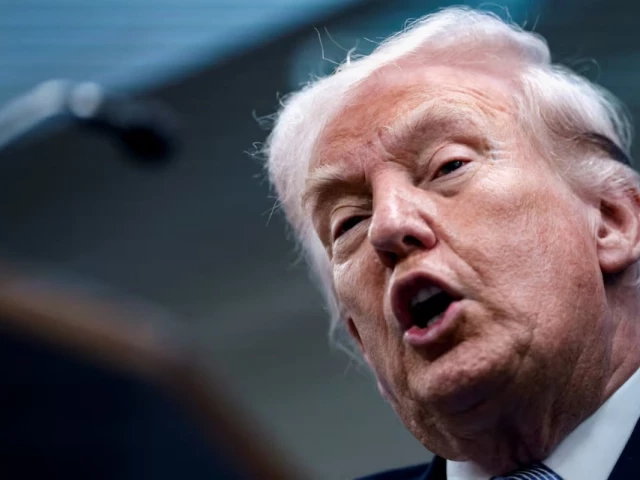
United States President Donald Trump said on Tuesday he will have a long talk with Chinese President Xi Jinping about the war in Iran during his upcoming trip to China, but added that he does not think he needs Xi's help.
"I don't think we need any help with Iran. We'll win it one way or the other, peacefully or otherwise," Trump told reporters when departing the White House for China.
The leaders of the world's two largest economies will hold their first face-to-face talks in more than six months as they try to stabilise ties strained by trade, the US and Israeli war with Iran and other areas of disagreement.
Trump is heading to China amid an unresolved Iran war, with diplomatic negotiations to end it at an impasse. Beijing maintains ties with Iran and remains a major consumer of its oil exports.
Trump has been leaning on China to use its influence to push Tehran to make a deal with Washington and end the conflict that began when the US and Israel launched strikes on Iran in late February.
The Republican president is scheduled to arrive in Beijing on Wednesday, ahead of talks set to take place Thursday and Friday. It will be his first trip to China since 2017.
Trump later told reporters: "We have a lot of things to discuss. I wouldn't say Iran is one of them, to be honest with you, because we have Iran very much under control."
US defence chief says Iran ceasefire remains 'in effect'
Earlier, US Defence Secretary Pete Hegseth said that a ceasefire between the US and Iran was active, even as lawmakers pressed him on whether a formal written agreement existed between the two sides.
Hegseth made the remarks alongside Joint Chiefs of Staff Chair General Dan Caine during testimony before a House Appropriations subcommittee reviewing the Trump administration’s proposed 2027 defence budget, and discussing developments in the conflict with Iran.
The sharpest exchange came when Representative Pete Aguilar questioned Hegseth about last month's testimony in which the Pentagon chief said the ceasefire effectively paused the 60-day clock under the War Powers Resolution.
“Who were the parties to the ceasefire?” Aguilar asked.
“Well, right now we are in that same ceasefire, as of right now,” Hegseth replied.
Aguilar interrupted, saying, “That wasn’t the question. Who are the parties to the ceasefire?”
“That would be the United States and the regime in Iran,” Hegseth responded.
The Democrat from the state of California then pressed for details on the agreement, asking whether the ceasefire had written terms or formal documentation.
“How many pages is the ceasefire? What deal points? How do we know that the ceasefire is active or not active without any documentation?” Aguilar asked.
“We know,” Hegseth said. “It’s evident, and the ceasefire is in effect.”
Aguilar continued questioning whether lawmakers were simply expected to trust the administration’s assessment without seeing a formal framework.
“You just trust that the president knows that the ceasefire is active or not inactive?” Aguilar asked.
“As you know, for the most part, a ceasefire means the fire is ceasing, and we know that has occurred while negotiations occur,” Hegseth replied.
The US and Israel launched strikes against Iran on February 28, triggering retaliation from Tehran against Israel as well as US allies in the Gulf, along with the closure of the Strait of Hormuz.
A ceasefire took effect on April 8 through Pakistani mediation, but talks in Islamabad failed to produce a lasting agreement. The truce was later extended by Trump without a set deadline.
Earlier in the hearing, Hegseth defended the administration’s broader military posture and the proposed $1.5 trillion defence budget, calling it “a fiscally responsible budget” and “a war-fighting budget”.
“We are rebuilding a military that the American people can be proud of,” Hegseth said. “One that instils nothing less than the unrelenting fear in our adversaries and confidence in our allies. We fight to win in every scenario.”
The defence secretary also argued that concerns about US weapons stockpiles had been exaggerated after committee chairman Ken Calvert raised questions about munitions spending and replenishment needs tied to the ongoing operation.
“The munitions issue has been foolishly and unhealthily overstated,” said Hegseth. “We know exactly what we have. We have plenty of what we need.”
Representative Betty McCollum later asked whether the Pentagon had contingency plans should the ceasefire collapse.
“We have a plan for all of that,” said Hegseth. “We have a plan to escalate if necessary. We have a plan to retrograde if necessary. We have a plan to shift assets.”
He declined to provide operational specifics publicly, citing the sensitivity of the mission and the administration’s objective “to ensure that Iran never has a nuclear bomb”.
US war in Iran has cost $29b so far, says Pentagon
A senior Pentagon official earlier said the war in Iran has cost $29 billion so far, an increase of $4b from an estimate provided late last month.
With just six months before the midterm elections in which US President Donald Trump's Republicans may face an uphill battle to keep their House majority, Democrats are riding high in public opinion polls as they attempt to link the war with cost-of-living issues.
On April 29, the Pentagon said the war at that point had cost $25b.
Jules Hurst, who is performing the duties of the comptroller, told lawmakers that the new cost included updated repair and replacement of equipment and operational costs.
"The joint staff team and the comptroller team are constantly looking at that estimate," Hurst said. He was speaking alongside Hegseth and General Caine.
Iran now defines Strait of Hormuz as far larger zone, IRGC officer says
Iran has expanded its definition of the Strait of Hormuz into a "vast operational area" far wider than before the Iran war, according to a senior officer in the Islamic Revolutionary Guard Corps (IRGC) Navy.
The strait is no longer viewed as a narrow stretch around a handful of islands but instead has been greatly enlarged in scope and military significance, said Mohammad Akbarzadeh, deputy political director of the IRGC Navy, the state-affiliated Fars news agency reported on Tuesday.
"In the past, the Strait of Hormuz was defined as a limited area around islands such as Hormuz and Hengam, but today this view has changed,” Akbarzadeh said.
About a fifth of the world's oil and liquefied natural gas supply normally passes through the strait, which is the gateway to the Gulf and main export route for countries such as Saudi Arabia, Iraq and Qatar.
Akbarzadeh said the strait is now defined as a strategic zone stretching from the city of Jask in the east to Siri Island in the west, describing it as “a vast operational area”.
The reported expansion is the second announced by Iran since the start of its conflict with the US and Israel.
On May 4, the IRGC Navy published a map showing a new zone of control extending along significant a stretch of the UAE's Gulf of Oman coastline.
That stretched from Iran's Mount Mobarak and the UAE's emirate of Fujairah in the east to Iran's Qeshm Island and the UAE emirate of Umm al Quwain in the west.
Tuesday's announcement appears to represent a widening of that area.
Fars and Tasnim, another Iranian news agency, reported on Tuesday that the strait’s width, which they said was previously estimated at 20 to 30 miles, had now increased to between 200 and 300 miles. The expanded zone forms a “complete crescent”, Tasnim said.
US says 65 commercial vessels redirected under naval blockade of Iran
The US military said on Tuesday that dozens of commercial vessels attempting to enter or leave Iranian ports have been redirected as Washington continues enforcing a naval blockade against Iran.
US Central Command (CENTCOM) said 65 commercial ships have been redirected and four disabled as part of the operation. “USS Abraham Lincoln (CVN 72) continues operations in the Arabian Sea, including enforcement of the US blockade against Iran,” CENTCOM said in a post on X.
USS Abraham Lincoln (CVN 72) continues operations in the Arabian Sea, including enforcement of the U.S. blockade against Iran. CENTCOM forces have redirected 65 commercial vessels and disabled 4. pic.twitter.com/5eV9g0CTLy
— U.S. Central Command (@CENTCOM) May 12, 2026
The US has maintained a naval blockade against Iran since April 13.
Last Friday, CENTCOM said the US had prevented 70 tankers from entering or leaving Iranian ports, which had a carrying capacity for more than 166 million barrels of Iranian oil worth over $13 billion.
Doha, Ankara support Pakistan’s mediation efforts to end US-Israeli war on Iran: Qatari PM
Qatari Prime Minister Sheikh Mohammed bin Abdulrahman Al Thani supported Pakistan’s mediation efforts in ending the US-Israeli war on Iran, in a press conference with Turkiye’s Foreign Minister Hakan Fidan, according to Al Jazeera.
Sheikh Mohammed said the two countries discussed the “dire circumstances” in the Middle East because of the US-Israel war on Iran, with the Strait of Hormuz crisis limiting “freedom of maritime movement”.
At a press conference in Doha, Qatar’s Prime Minister Sheikh Mohammed bin Abdulrahman bin Jassim Al Thani says the Strait of Hormuz has been “used as a weapon in this war” and Iran should not use to it pressure Gulf countries. pic.twitter.com/m1Dlov7hMz
— Al Jazeera Breaking News (@AJENews) May 12, 2026
Turkiye’s Foreign Minister Hakan Fidan reiterated Ankara’s strong support for Pakistan’s mediation efforts.
The Hormuz crisis has had a “dire” impact on the world, he said, stressing that the war needs to end for this reason, among others, according to Al Jazeera.
The waterway has been “used as a weapon in this war”, exacting harsh repercussions on Gulf states, specifically economic, Qatar’s prime minister added.
Fidan also condemned Israel’s “expansion policies” in Lebanon and Gaza, decrying the impact on civilian lives.
Qatar’s leader also condemned ongoing Israeli attacks on Lebanon and Gaza, saying Turkiye has emerged as a “leading partner” in these key regional issues.
Sheikh Mohammed said that Qatar would continue consulting Gulf states to restore regional peace, and that regional issues should be resolved with Iran via diplomacy.
Backdoor negotiations must continue to bring about the end of the US-Israel war on Iran, he said, according to Al Jazeera.
Iran could enrich uranium to weapons-grade
Iranian parliamentary spokesman Ebrahim Rezaei said on Tuesday that the country could enrich uranium up to 90% purity, a level considered weapons-grade, if Iran is attacked again.
"One of Iran's options in the event of another attack could be 90% enrichment. We will review it in the parliament," Rezaei, who is spokesperson for the parliamentary national security and foreign policy commission, posted on X.
یکی از گزینههای ایران در صورت حمله مجدد میتواند غنیسازی ۹۰ درصد باشد. در مجلس بررسی میکنیم.
— ابراهیم رضایی (@EbrahimRezaei14) May 12, 2026
Last June, Trump said Iran's nuclear facilities were "obliterated" by US and Israeli strikes during a 12-day war, severely limiting Iran's capacity to enrich uranium.
The fate of around 400kg of uranium enriched to 60% remains unclear.
US intelligence assessments suggest Tehran's nuclear programme will not be significantly impeded unless that highly enriched uranium (HEU) stockpile is removed or destroyed.
The nuclear issue has been a key point of contention in talks between the US and Iran to end the conflict that began in late February. Tehran wants nuclear topics discussed at a later stage, while Washington demands Iran should move its highly enriched uranium stockpile abroad and renounce domestic enrichment.
'No alternative' but to accept proposal
Speaker of the Iranian Parliament Mohammad Bagher Ghalibaf said that the US had no alternative but to "accept the rights of the Iranian people as laid out in the 14-point proposal." "The longer they drag their feet, the more American taxpayers will pay for it."
There is no alternative but to accept the rights of the Iranian people as laid out in the 14-point proposal.
— محمدباقر قالیباف | MB Ghalibaf (@mb_ghalibaf) May 11, 2026
Any other approach will be completely inconclusive; nothing but one failure after another.
The longer they drag their feet, the more American taxpayers will pay for it.
Earlier, Ghalibaf said that the Iranian armed forces were "ready to deliver a well-deserved response to any aggression."
نیروهای مسلح ما آمادهٔ پاسخگویی درسآموز به هر تجاوزی هستند؛ استراتژی اشتباه و تصمیمهای اشتباه، همیشه نتیجهٔ اشتباه خواهد داشت، همهٔ دنیا قبلاً این را فهمیدهاند.
— محمدباقر قالیباف | MB Ghalibaf (@mb_ghalibaf) May 11, 2026
ما برای تمام گزینهها آماده هستیم؛ شگفتزده خواهند شد.
"We are prepared for all options; they will be surprised."
Israel deployed Iron Dome batteries, personnel to UAE during war on Iran
The US ambassador to the UN Mike Waltz said Israel sent Iron Dome missile defence batteries and Israeli troops to the United Arab Emirates to help it defend against Iranian strikes, according to Al Jazeera.
Waltz first commented on Monday and was quoted by Israel Hayom newspaper as saying, “We saw the UAE make use of the Iron Dome provided to it by Israel.”
US Ambassador to Israel Mike Huckabee confirmed Waltz’s comments today at an event.
“I’d like to say a word of appreciation for United Arab Emirates, the first Abraham accord member,” Huckabee said at the Tel Aviv Conference. “Just look at the benefits. Israel just sent them Iron Dome batteries and personnel to help operate them.”
Huckabee added he’s “very optimistic” additional countries in the Middle East will soon join the Abraham Accords, the 2020 diplomatic recognition deal that also included Bahrain for formal relations with Israel, according to Al Jazeera.
UAE won’t resume full gas production until next year due to Iranian attacks
The United Arab Emirates’s main gas-processing complex, which was hit in Iranian attacks during the war, will not reach its full production capacity again until next year, Al Jazeera reported.
ADNOC Gas said the Habshan site, which is one of the world’s largest gas production facilities and supplies gas across the UAE, is now operating at 60%capacity and “the company is currently working towards achieving 80% restoration by the end of 2026 with full capacity restored in 2027”.
In a statement sharing its first-quarter results, the company reported $1.1bn in net income, a 15% decrease compared with the same quarter last year.
The drop was caused by “increased regional uncertainty and difficult market conditions” as the energy sector faces major disruption because Iran blockades the Strait of Hormuz, ADNOC said, as per Al Jazeera.
Israel warns citizens of ‘intimidation messages’ allegedly sent by Iran
Israel National Cyber Directorate said “intimidation messages” have been sent to citizens’ phones over the last few hours that are meant to “create panic and undermine the sense of security,” according to Al Jazeera.
“This is a familiar influence attempt in the digital space: threatening, dramatic or stressful messages sent directly to citizens and trying to make them act out of fear,” it wrote on Telegram, calling on Israelis not to open any suspect links or forward messages.
The statement comes after Israeli news outlets reported that many Israelis received a message, allegedly from Iranian authorities, threatening the return of missile and drone attacks.
Trump’s complaints on Iran war leaks prompt aggressive probe
Trump’s complaints about media leaks on the Iran war have triggered an aggressive investigation by the Justice Department, The Wall Street Journal reported on Monday, citing sources.
Trump privately complained to acting Attorney General Todd Blanche about media leaks following last month’s Iran war, prompting the Justice Department to aggressively pursue leak investigations.
Blanche pledged to seek subpoenas targeting reporters involved in sensitive national security stories, according to the report. In one meeting, Trump handed Blanche a stack of articles he viewed as threats to national security, marked with a sticky note reading “treason.”
Senior Justice Department and Pentagon officials have also discussed the investigations, the report said.
In particular, the report said, Trump has focused his ire on articles that provided details on how he arrived at his decision to launch the war, and what his advisers had told him as he deliberated.
“In all circumstances, the Department of Justice follows the facts and applies the law to identify those committing crimes against the United States,” a department spokeswoman said.
Peace deal hopes fade after Trump rejects 'garbage' Iran proposal
Hopes for a peace deal on Iran faded on Tuesday after Donald Trump said a ceasefire with Iran was "on life support" as Tehran rejected a US proposal to end the conflict and stuck to a list of demands the US president described as "garbage"
Iran has called for an end to the war on all fronts, including Lebanon, where US ally Israel is fighting Iran-backed Hezbollah militants. Tehran also emphasised its sovereignty over the Strait of Hormuz, demanded compensation for war damage, and an end to the US naval blockade, among other conditions.
Trump said Iran's response threatened the status of a ceasefire that began on April 7.
"I would call it the weakest right now, after reading that piece of garbage they sent us. I didn't even finish reading it," Trump, who has repeatedly threatened to end the ceasefire, told reporters.
The US had proposed an end to fighting before starting talks on more contentious issues, including Iran's nuclear programme.
Also read: Pakistan rejects report on Iranian aircraft at Nur Khan Airbase as 'misleading'
Brent crude oil futures extended gains in early Asian trade on Tuesday, climbing above $104.50 a barrel, as the deadlock left the Strait of Hormuz largely closed. Before the war began on February 28, the narrow waterway carried one-fifth of the world's oil and liquefied natural gas shipments, and has since become a central pressure point in the conflict.
Disruption caused by the near-closure of the strait has forced oil producers to cut exports, and OPEC oil output dropped further in April to the lowest in more than two decades, a Reuters survey showed on Monday.
The United States on Monday imposed new sanctions on individuals and companies it said were helping Iran ship oil to China, part of efforts to cut off funding for Tehran’s military and nuclear programs, while also warning banks about attempts to evade existing curbs.
Trump is expected to arrive in Beijing on Wednesday, where Iran is set to be among the topics discussed with Chinese President Xi Jinping.
Trickle of shipping through Hormuz
Traffic through the Strait of Hormuz is at a trickle compared with before the war. Shipping data on Kpler and LSEG showed that three tankers laden with crude exited the waterway last week, with trackers switched off to avoid an Iranian attack.
A second Qatari LNG tanker was attempting to transit the strait, the data showed, days after the first such cargo crossed under an arrangement involving Iran and Pakistan.
In the US, surveys show the war is unpopular with US voters who are paying more for fuel, less than six months before nationwide elections that will determine whether Trump's Republican Party retains control of Congress.
Two out of three Americans, including one in three Republicans and almost all Democrats, think Trump has not clearly explained why the country has gone to war, according to a Reuters/Ipsos poll completed on Monday.
Washington has also struggled to build international support, with NATO allies refusing to send ships to reopen the waterway without a full peace deal and an internationally mandated mission.
In separate statements on Monday, the State Department said US Secretary of State Marco Rubio held separate calls with his Australian and British counterparts to discuss "ongoing efforts to restore freedom of navigation in the Strait of Hormuz." It did not elaborate.
Hakan Fidan, the foreign minister of Turkey, which has been liaising closely with the US, Iran and mediator Pakistan since the start of the war, will hold talks in Qatar on Tuesday on the conflict and on ensuring navigational safety in the strait, a Turkish diplomatic source said.




This material may not be published, broadcast, rewritten, redistributed or derived from. Unless otherwise stated, all content is copyrighted © 2026 The Express Tribune.










COMMENTS (5)
Comments are moderated and generally will be posted if they are on-topic and not abusive.
For more information, please see our Comments FAQ