Pakistani documentary 'The Emergency Exit' wins Spirit of Doc Lab award in Kathmandu
Updated 1 hour ago

Thousands gather for 70th edition as protests over Israel's participation overshadow Europe's biggest music spectacl
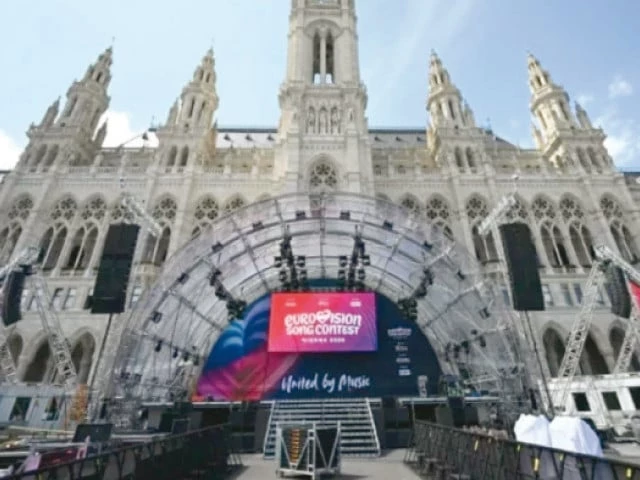
Thousands of music fans descended on Vienna as the 70th edition of the Eurovision Song Contest officially opened on Sunday, turning the Austrian capital into a sprawling festival venue while fresh controversy erupted over Israel's participation.
The world's most-watched music competition began with a colourful opening ceremony featuring a turquoise carpet parade for delegations from 35 participating countries, replacing Eurovision's traditional red-carpet tradition.
Fans packed the secured square outside Vienna's neo-Gothic city hall, where giant screens showcased memorable - and notorious - performances from the contest's seven-decade history ahead of the grand final on May 16.
Organisers expect Eurovision to attract more than 170 million television and online viewers worldwide, with billions of additional views generated across social media and streaming platforms.
Vienna has arranged concerts, fan zones and cultural events throughout the week as hotels, restaurants and public spaces filled with visitors from across Europe and beyond.
This year's competition, however, has again become entangled in political tensions surrounding Israel's military campaign in Gaza following the October 7, 2023 Hamas attack.
Spain, Ireland, Iceland, the Netherlands and Slovenia are among the countries boycotting the contest in protest against Israel's inclusion, while more than 1,000 musicians and groups have publicly supported calls for a boycott.
Among the artists backing the campaign are Peter Gabriel and Massive Attack. A pro-Palestinian demonstration was held in central Vienna on Saturday, while further protests both supporting and opposing Israel's participation are expected.
Several hundred police officers have been deployed daily across the city as Austrian authorities tighten security around Eurovision venues and fan areas. Officials said the security presence would remain in place until the conclusion of Saturday's final.
Germany's Culture Minister Wolfram Weimer criticised the boycott movement, saying calls to exclude Israel caused him to "suffer". He added that he had defended Israel's participation "at the highest political levels".
The European Broadcasting Union, which organises Eurovision, has meanwhile attempted to prevent controversy surrounding voting campaigns. Eurovision director Martin Green confirmed that Israel's broadcaster KAN received a warning after publishing videos encouraging viewers to vote repeatedly for the Israeli entry.
Green said direct appeals urging audiences to vote "10 times for Israel" violated both Eurovision rules and the spirit of the competition. Organisers have also updated voting regulations following concerns over unusually high public voting figures linked to organised campaigns during last year's contest.
Despite the political storm, bookmakers have installed Finland as the clear favourite to win this year's title. The Finnish entry pairs singer Pete Parkkonen with violinist Linda Lampenius in one of the contest's most closely watched performances. Eurovision organisers have reportedly granted a rare exception allowing Lampenius to perform live violin on stage rather than using pre-recorded instrumentation.
Austria automatically qualifies for the final after last year's victory by local artist JJ, although this year's Austrian entrant, Cosmo, is not considered among the leading contenders.
Germany, France, Italy and Britain also receive automatic places in the final because of their major financial contributions to the European Broadcasting Union.









This material may not be published, broadcast, rewritten, redistributed or derived from. Unless otherwise stated, all content is copyrighted © 2026 The Express Tribune.
COMMENTS
Comments are moderated and generally will be posted if they are on-topic and not abusive.
For more information, please see our Comments FAQ