India’s prized Alphonso mango crop ruined by weather
Updated 1 hour ago

Halt comes after reported attacks on Chinese tanker, French vessels & Iran's new transit rules for strategic waterway
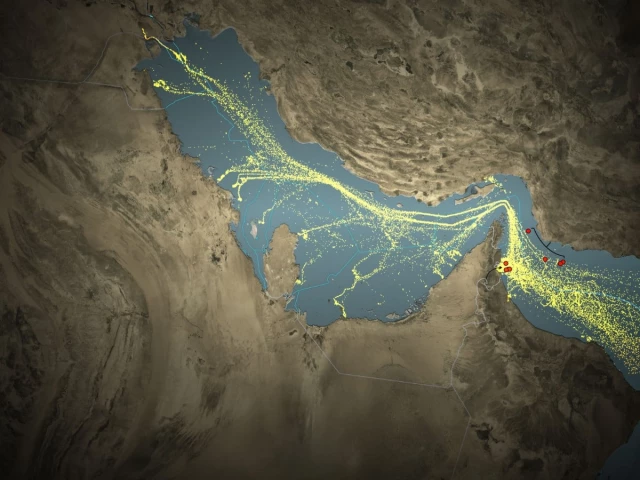
No major commercial ships passed through the Strait of Hormuz in the last 24 hours, amid rising security risks and tighter Iranian controls over one of the world’s most critical maritime chokepoints, according to ship tracking data compiled by Anadolu on Thursday.
The halt in vessel movements through the strait marks a further escalation in disruptions to global shipping since the US-Israeli war with Iran began on February 28.
Commercial traffic through the waterway has sharply declined in recent weeks, with many operators rerouting ships or avoiding the Gulf due to security concerns, signal jamming and uncertainty over passage conditions.
Read: Trump’s reversal on reopening Strait of Hormuz came after backlash from ally: NBC report
The latest stoppage came after Beijing-based news outlet Caixin reported that a Chinese-owned large oil tanker was attacked in the Strait of Hormuz on Monday, in the first such incident involving a Chinese vessel since the war began.
The incident reportedly occurred off the United Arab Emirates’ Al Jeer port and caused a fire on the ship’s deck.
Chinese Foreign Ministry spokesperson Lin Jian said Beijing would continue working for de-escalation in the Strait of Hormuz and make utmost efforts to protect the safety and security of Chinese ships and crew.
“We hope relevant parties will act prudently, avoid further escalation, resolve disputes through dialogue, and restore peace and tranquillity in the Strait soon,” Lin said Wednesday.
The waterway has also seen rare and risky transits by Western-linked vessels.
The French-owned CMA CGM Saigon reappeared off Oman’s coast late Wednesday after disappearing from tracking systems in the Persian Gulf, suggesting that the container ship crossed the strait with its Automatic Identification System switched off amid intensified signal jamming in the area.
Read more: US forces disable Iranian-flagged unladen oil tanker amid blockade: CENTCOM
The vessel was last seen on Tuesday off Ras Al Khaimah in the UAE before resurfacing in the Arabian Sea, signalling Colombo, Sri Lanka, as its destination. The passage made the CMA CGM Saigon one of the few Western Europe-linked vessels to transit the strait unharmed since the outbreak of the war.
On Tuesday, the CMA CGM San Antonio, another vessel owned by the French shipping company, was attacked while transiting the strait, injuring crew members and damaging the ship.
Iran’s Islamic Revolutionary Guard Corps Navy said Wednesday that ships were complying with new transit regulations set by Tehran in the Strait of Hormuz.
In a post on X, the IRGC Navy said the cooperation of vessels was contributing to regional maritime security and that “safe and stable passage” would be ensured under new protocols.
On Tuesday, the IRGC Navy urged vessels to use only designated routes when transiting the strait, warning that deviations would be considered unsafe and could prompt “decisive action.”
“All vessels intending to pass through the strait must use a corridor previously announced by Iran, and any deviation would face firm action,” it said, describing the designated route as the “only safe passage” through the strategic waterway.
The Strait of Hormuz is a key artery for global energy trade, linking the Persian Gulf with the Gulf of Oman and the Arabian Sea. Its disruption has raised concerns over oil, LNG and refined fuel flows at a time when energy markets are already strained by the conflict.








This material may not be published, broadcast, rewritten, redistributed or derived from. Unless otherwise stated, all content is copyrighted © 2026 The Express Tribune.











COMMENTS
Comments are moderated and generally will be posted if they are on-topic and not abusive.
For more information, please see our Comments FAQ