Panda bond opens cheaper yuan funding
Updated 17 hours ago

KSE-100 index sheds 3,267 points as ME tensions, energy woes mountQ
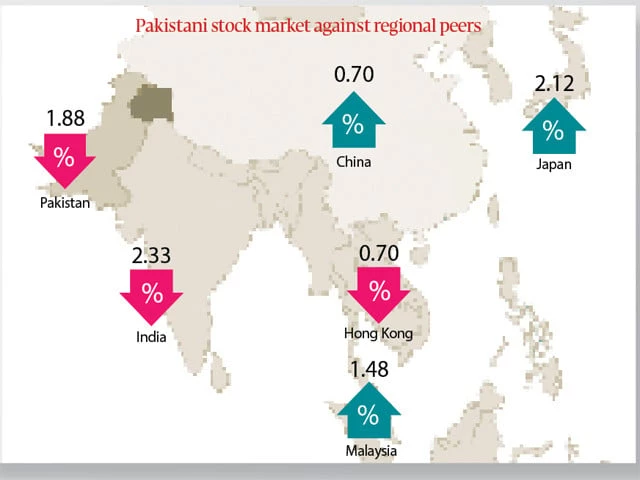
The Pakistan Stock Exchange (PSX) succumbed to a wave of selling pressure during the outgoing week as the benchmark KSE-100 index plunged by over 3,200 points, or 2%, settling at 170,672.
The market was rattled by a toxic mix of heightened geopolitical uncertainty, domestic energy crunch, and reports of stringent new IMF conditions.
On a day-on-day basis, the PSX commenced the week with another "negative Monday," where the KSE-100 declined by 1,742 points (-1%) to close at 172,197. On Tuesday, the market witnessed a mixed session, gaining 959 points (+0.56%) to close at 173,156.
PSX recorded a lacklustre session on Wednesday, when the index dipped by 1,577 points (-0.91%) to end trading at 171,579. The bourse came under selling pressure on Thursday as it dived 2,406 points (-1.40%) to close at 169,173 by losing the key psychological level of 170k.
However, stocks staged a strong recovery on Friday as the benchmark index rebounded sharply from early losses, rising around 1,500 points to settle above 170,670.
Arif Habib Limited (AHL) noted that the KSE-100 index ended lower during the outgoing week amid delay in the second round of US-Iran negotiations despite a ceasefire extension by the US. Heightened geopolitical uncertainty, coupled with rising oil prices following tensions and disruptions around the Strait of Hormuz, weighed on global equities and dampened investor sentiment. As a result, the index settled at 170,672, marking a 2% week-on-week (WoW) (or 3,267-point) decline.
During the week, the World Bank reclassified Pakistan from its South Asia grouping to Menaap region, which includes the Middle East, North Africa, Afghanistan, and Pakistan. The change will take effect from fiscal year 2026.
Pakistan has received the final $1 billion tranche of Saudi Arabia's $3 billion support package, while also repaying $3.45 billion to the UAE, meeting its maturing deposit obligations on schedule.
Gas production dropped by 3.1% WoW to 2,962 million cubic feet per day (mmcfd) in the second week of Apr'26, primarily due to lower output from Uch field and no production from Shewa. Oil production fell 1.1% to 66,838 barrels per day, driven by reduced output from Makori East and Kunnar Pasakhi Deep.
Pakistan raised an additional $250 million from international investors by exercising the green shoe option, taking the total size of its latest Eurobond issuance to $750 million.
During Mar'26, the repatriation of profits and dividends from Pakistan declined by 35.1% year-on-year (YoY), +110.3% month-on-month (MoM), to $102.4 million. In 9MFY26, the repatriation edged higher by 3.4% to $1,778 million, AHL said.
Syed Danyal Hussain of JS Global noted that the KSE-100 lost momentum during the week, decreasing 2% (3,267 points) at 170,672, as persistent geopolitical uncertainty surrounding US-Iran ceasefire negotiations kept investor sentiment subdued. Brent crude once again crossed the $100/barrel mark on continued closure of the Strait of Hormuz.
Meanwhile, discussions between Pakistan's government and the IMF were ongoing, with reports indicating the introduction of 11 additional conditions under the programme. On the fiscal side, the government has committed to a tighter stance in FY27, targeting a primary surplus of Rs2.8 trillion alongside tax revenues of Rs15.56 trillion.
Separately, Pakistan was facing a power shortfall exceeding 11,000 megawatts due to zero supply of re-gasified liquefied natural gas (RLNG). Therefore, the government has issued an urgent tender for LNG cargoes under amended procurement rules.
In other developments, the government repaid $1 billion to the UAE, bringing total repayment to $3.4 billion while securing fresh inflows of $1 billion from Saudi Arabia, bringing total support from the kingdom to $3 billion, in addition to the rollover of its existing $5 billion deposit. Furthermore, the government successfully raised $750 million from international capital markets, marking its re-entry after a four-year hiatus. Lastly, the State Bank reserves rose by $18 million and stood at $15.1 billion, Hussain said.







This material may not be published, broadcast, rewritten, redistributed or derived from. Unless otherwise stated, all content is copyrighted © 2026 The Express Tribune.







COMMENTS
Comments are moderated and generally will be posted if they are on-topic and not abusive.
For more information, please see our Comments FAQ