Gold up Rs4,100 on global tensions
Updated 7 hours ago

AI, cybersecurity key to sustaining growth; 5G, satellite net solutions urged
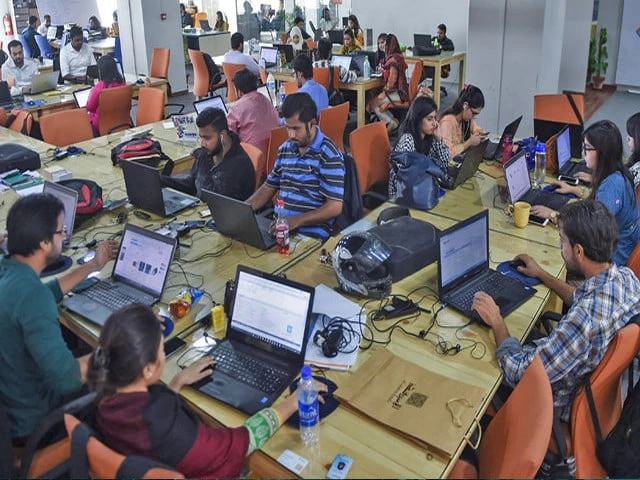
Pakistani freelancers, despite an unconducive environment stemming from a lack of interest in human resource development by those at the helm, are increasing their contribution to the global freelancing market, bringing in over $850 million in foreign exchange by the end of the third quarter of the current financial year, despite challenges such as internet disruptions and electricity load-shedding.
According to the State Bank of Pakistan (SBP), freelancers of computer and IT services fetched $856 million by the end of the third quarter of FY2025-26, compared with $567 million reported in the same period last year, showing a handsome 50% growth or $289 million record upsurge.
Overall, Pakistan's information technology (IT) exports surged to $413 million in March 2026, registering a 21% year-on-year increase and a 13% rise compared with February, according to Topline Securities Limited. While this appears to show healthy growth, the number does not align with the country's true potential.
On a net basis, IT exports, calculated after adjusting for imports, stood at $360 million during the month, reflecting a 16% annual increase. Cumulatively, IT exports reached $3.39 billion during the first nine months (July-March) of FY2025-26, marking 20% year-on-year growth, Topline Research data showed.
Despite the government's export target of $5 billion for FY26, analysts expect the sector to expand by 18-20% during the year, taking total exports to about $4.5 billion, compared with $3.8 billion recorded in FY25, according to Topline Securities. Under the government's 'Uraan Pakistan' economic plan, IT exports are projected to reach $10 billion by FY2028-29, implying a compound annual growth rate (CAGR) of approximately 27% - a goal that seems unattainable at the current pace.
Nevertheless, analysts attribute the sector's continued growth to supportive policy measures, relative exchange rate stability and sustained global demand for digital and IT-enabled services.
Pakistan Freelancers Association (PAFLA) Chairman Ibrahim Amin said that hundreds of thousands of individuals trained by public sector initiatives and non-governmental organisations are entering the freelancing market each month, boosting the country's foreign exchange earnings. He said the role of institutions such as the Ministry of IT and Telecommunication, the Pakistan Software Export Board and the Special Investment Facilitation Council is crucial in developing a supportive ecosystem for freelancers.
Amin urged the government and internet service providers to ensure uninterrupted and high-speed internet services across Pakistan to support the digitally-connected economy, including freelancers and gig economy workers nationwide. He suggested that the government introduce satellite-based internet solutions as an alternative, ensuring reliable connectivity and minimising disruptions caused by submarine cable faults. He expressed optimism that the rollout of 5G technology will significantly improve internet speeds in the near future, enhancing the productivity of freelancers, content creators and other online professionals across the country.
According to the Asian Development Bank, Pakistan is home to more than 2.37 million freelancers, ranking among the top countries globally in terms of freelance workforce size.
Dr Noman Said, a freelancers coach, said the freelancers' contribution to the economy is visible despite multiple challenges and infrastructure issues. The freelancing community could play a pivotal role in aiding economic stability and reducing unemployment, he said. He stated that freelancers should upskill themselves with emerging technologies and in-demand fields, including AI and cybersecurity, to remain competitive and valuable at the global level.
Said mentioned that more than 60% of Pakistan's population consists of youth, who will be the country's assets if the government and private sector invest in their capacity building based on a concrete plan or roadmap. He further said the government should further facilitate freelancers to reduce payment and regulatory issues and encourage them to form small or medium-sized firms through business-friendly policies, which will help them progress in a growing direction.












This material may not be published, broadcast, rewritten, redistributed or derived from. Unless otherwise stated, all content is copyrighted © 2026 The Express Tribune.







COMMENTS
Comments are moderated and generally will be posted if they are on-topic and not abusive.
For more information, please see our Comments FAQ