Dar warns UNSC over Middle East tensions
Updated 2 hours ago

CDF Munir likely to visit to Washington, DC, after trip to Tehran, Pakistan government sources say
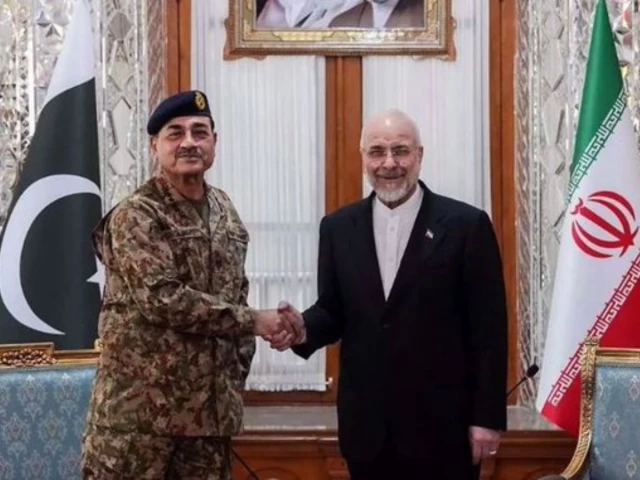
Chief of Defence Forces (CDF) and Chief of the Army Staff Field Marshal Asim Munir met with Iranian Parliament Speaker Mohammad Bagher Ghalibaf in Tehran on Thursday, PressTV reported on X.
Pakistani army chief meets Iranian Parliament speaker in Tehran https://t.co/kssgb72Qs7
— Press TV 🔻 (@PressTV) April 16, 2026
The discussions were linked to ongoing negotiations with the US, state-run IRIB reported. The consultations included planning for a possible new round of talks between Iran and the US, as well as “to convey messages from Washington”, the report said.
Tehran “would decide on the next phase of negotiations” with the US following the meetings with the Pakistani delegation, the report said.
Iranian media said he also held a meeting with Khatam Al-Anbiya Central Headquarters Commander Major General Ali Abdollahi.
As per IRNA, he "presented a report on the measures he has taken within the framework of ending the war as well as his talks in Tehran, and stressed the continuation of these efforts".
Pakistani army commander in a meeting with the commander of the Khatam al-Anbiya Central Headquarters presented a report on the measures he has taken within the framework of ending the war as well as his talks in Tehran, and stressed the continuation of these efforts. pic.twitter.com/e9S6vG8ZHl
— IRNA News Agency ☫ (@IrnaEnglish) April 16, 2026
CDF Munir stressed the need to continue mediation efforts, while the Iranian commander expressed appreciation for what he described as Pakistan’s “supportive” stance during the conflict.
Abdollahi said the outbreak of hostilities stemmed from a “miscalculation” by adversaries regarding Iran’s public support and the capabilities of its armed forces.
He also highlighted domestic backing for Iran’s military, saying the equipment used during the war was domestically produced and that the armed forces remain prepared for “comprehensive defence” in case of further escalation.
Officials accompanying CDF Munir also held separate talks with Iranian counterparts to discuss regional developments and bilateral cooperation.
Iran’s Interior Minister Eskandar Momeni met with Mohsin Naqvi to discuss ways to strengthen cooperation, particularly in areas related to internal affairs and the responsibilities of their ministries.
Meanwhile, two government sources told Anadolu that Pakistan was working for a "breakthrough" on Iran's nuclear programme issue in "days to come" with CDF Munir holding talks with the Iranian leadership on the issue, which remains the key bottleneck in the way of a negotiated settlement with the United States.
Islamabad “is working on bringing a maximum understanding" between the US and Iran, with a focus on Tehran's nuclear issue, before a possible new round of talks in the capital, said the sources, stressing anonymity for discussing “sensitive details” of the ongoing mediation process.
Sources also said Iran has agreed to a third-party monitoring of its nuclear programme by four nations jointly with the International Atomic Energy Agency (IAEA).
"Tehran in principle agrees to Islamabad's proposal” of third-party monitoring on its nuclear programme, they said, adding that Iran has no objection to the inclusion of the IAEA in the four-nation monitoring framework.
Iran has conveyed its agreement to CDF Munir, while Washington has yet to react to the proposal, the sources noted.
No names were provided for potential members of the four-nation team.
The US has long demanded “strict and comprehensive” monitoring to ensure that Iran does not build a nuclear weapon.
Reports have emerged from Tehran that gaps between the US and Iranian demands have been “reduced,” while the nuclear issue remains the main issue.
Washington's priority, however, “still is the suspension of Iran's uranium enrichment programme for at least 20 years in exchange for sanctions relief”, the Pakistani sources added.
Iran is said to have over 400 kilogrammes of enriched uranium, and Tehran has proposed that it can suspend nuclear activity for up to five years, according to The New York Times.
They also said that CDF Munir may visit Washington, DC, “in a day or two” to meet with US President Donald Trump to discuss various issues related to Islamabad's proposal. There has been no official confirmation or announcement regarding a possible US visit by CDF Munir.
Technical teams of the US and Iran “are constantly exchanging messages” to reach the "maximum understanding” before another round of talks, the Pakistani sources told Anadolu, adding: “Both sides want the next round of talks to be a ‘deal-signing’ ceremony.”
Expressing optimism about the prospects of a four-nation third-party team, the sources added: “There could be a different framework — a mix of four-nations formula and Washington's demands; it could also be a 10-year moratorium on Iran instead of five years.”
The situation, they added, “would be clear” after CDF Munir's possible US visit.
CDF Munir arrived in Tehran on Wednesday as part of the ongoing Mideast peace negotiation efforts. He was part of a delegation that also included Interior Minister Mohsin Naqvi. Iranian Foreign Minister Abbas Araghchi received the delegation, Inter Services Public Relations ISPR said in a statement.
چیف آف ڈیفنس اسٹاف فیلڈ مارشل سید عاصم منیر تہران پہنچ گئے۔ وزیر داخلہ محسن نقوی بھی آرمی چیف کے ہمراہ۔ دورہ تہران ثالثی کی پاکستانی کوششوں کا حصہ ہے۔ pic.twitter.com/drQnysbgd8
— PTV News (@PTVNewsOfficial) April 15, 2026
Araghchi said he was "delighted" to welcome the field marshal on his visit. "Expressed gratitude for Pakistan's gracious hosting of the dialogue, emphasising that it reflects our deep and great bilateral relationship. Our commitment to promoting peace and stability in the region remains strong — and shared".
Delighted to welcome Field Marshal Munir to Iran.
— Seyed Abbas Araghchi (@araghchi) April 15, 2026
Expressed gratitude for Pakistan's gracious hosting of dialogue, emphasizing that it reflects our deep and great bilateral relationship. Our commitment to promoting peace and stability in the region remains strong—and shared. pic.twitter.com/e74lm6hL8r
The delegation later held a meeting with FM Araghchi and other Iranian officials.
📹 دیدار عاصم منیر فرمانده ارتش پاکستان با عراقچی pic.twitter.com/e7EVWL2gLY
— خبرگزاری تسنیم (@Tasnimnews_Fa) April 15, 2026
Iran had earlier said it continued to exchange messages with Washington through Pakistani mediators.
“Message exchanges continue” regarding negotiations with the US, Foreign Ministry spokesperson Esmaeil Baghaei said in a news briefing cited by the state news agency IRNA.
“Since Sunday, when the Iranian delegation returned to Tehran, multiple messages have been exchanged through the Pakistani intermediary,” he stated, adding, “Our positions have been conveyed and heard.”
On the nuclear file, the spokesperson said discussions over uranium enrichment are not new. “There is room for discussion on the type and level of enrichment,” he said. “The Islamic Republic of Iran must be able to continue enrichment based on its national needs,” he added.
FM Spokesperson Esmaeil Baghaei: Message exchange between #Iran and the US continues via Pakistan mediation. Iran’s positions are clear and consistently conveyed. Tehran is likely to host a Pakistani delegation soon. #Diplomacy@IRIMFA_SPOX https://t.co/fAnhGDsAFf
— Government of the Islamic Republic of Iran (@Iran_GOV) April 15, 2026
The US and Iran held rare direct talks in Pakistan last weekend aimed at ending their conflict, but the talks ended early Sunday without any agreement.
On April 11, US and Iranian delegations arrived in Pakistan for conclusive talks following a two-week immediate ceasefire "everywhere, including Lebanon", announced by PM Shehbaz, who later invited delegations from both countries to Islamabad.
Read More: No date finalised for second round of US-Iran talks: FO
Both sides were unable to reach an agreement to end their war despite marathon negotiations lasting around 21 hours in Islamabad over the weekend. The prolonged talks, aimed at halting hostilities that have killed thousands and driven global oil prices higher over the past six weeks, ended with both sides blaming each other for the impasse.
The US and Israel launched a joint offensive on Iran on February 28, killing thousands of people in Iran, including then-supreme leader Ayatollah Ali Khamenei and leaving tens of thousands injured, with civilian areas, including residential buildings and religious sites, among those hit.
The conflict also expanded geographically. Iran retaliated with drone and missile strikes targeting Israel as well as Jordan, Iraq, and Gulf countries hosting US military assets. It also restricted the movement of ships through the Strait of Hormuz.





This material may not be published, broadcast, rewritten, redistributed or derived from. Unless otherwise stated, all content is copyrighted © 2026 The Express Tribune.












COMMENTS (1)
Comments are moderated and generally will be posted if they are on-topic and not abusive.
For more information, please see our Comments FAQ