Ranveer's 'Don 3' exit sparks Bollywood power clash
Updated 11 hours ago

Actor reflects on identity, representation and global presence; Pakistan's leaders discuss future across key sectors
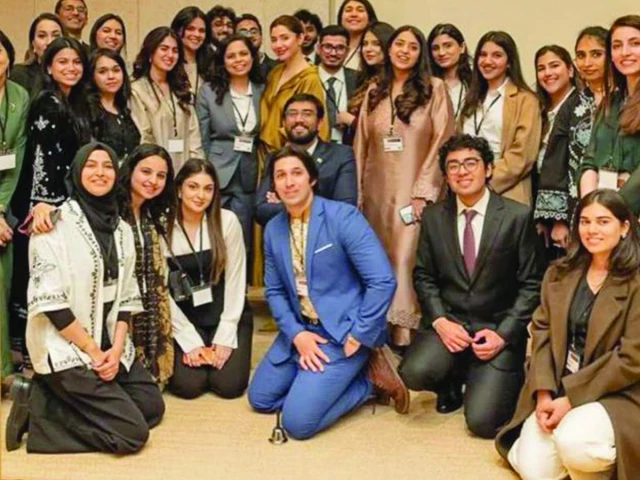
Pakistani actor and model Mahira Khan has described her participation at the Pakistan Conference held at Harvard University as a deeply emotional and memorable experience, saying the moment will remain "etched in memory forever".
Reflecting on her appearance after the event, where she represented Pakistan, the actor said there are moments people imagine as dreams, while others arrive unexpectedly in ways that feel even more meaningful.
She said her Harvard invitation belonged to that rare category, where aspiration and reality converge in an unforgettable setting. Khan said she felt honoured to address the Pakistan Conference at Harvard.
She stressed that she was not only representing herself but also carrying the identity of Pakistan before an international audience of students, academics and professionals. She also expressed gratitude for the reception she received from students.
"Their warmth and energy made the experience even more special despite the cold weather in Cambridge, she said. She added that the interaction with attendees turned the occasion into a meaningful exchange of stories, ideas and perspectives.
Hosted by the Pakistan Student Association at the university's Graduate School of Education, the Pakistan Conference brought together some of Pakistan's most prominent figures from entertainment, politics, business and academia.
The event focused on discussing Pakistan's evolving challenges, opportunities and global positioning. Among the speakers was designer Hassan Sheheryar Yasin, who held two sessions and spoke about representing Pakistan abroad.
He said he was carrying "not just our craft, but our potential, our resilience, and the voices that shape the US and Pakistan." Yasin described his discussions as extending beyond fashion and textiles, focusing instead on entrepreneurship, education, and women's empowerment.
He emphasised the belief that Pakistan's progress lies in its people and their ability to shape change across sectors. He also thanked Harvard students, saying their openness contributed to making the conference a meaningful exchange rather than a formal dialogue.
Joining him on a cultural panel were musician Faisal Kapadia and New York-based designer Faraz Zaidi, with media personality Momina Mustehsan moderating the discussion. The session highlighted Pakistan's cultural diversity and creative industries.
The conference concluded with Mahira Khan delivering the keynote address, which participants described as a highlight of the event. In a post shared on social media, she said the experience felt like a dream and expressed gratitude to everyone involved in making it memorable.
Beyond entertainment figures, the conference also hosted senior political, economic and legal voices. Former foreign minister Hina Rabbani Khar, former national security adviser Moeed Yusuf, and Ambassador Rizwan Saeed Sheikh addressed diplomacy and geopolitical developments affecting Pakistan.
Economic discussions featured former State Bank governor Reza Baqir alongside CEOs and economists, focusing on financial resilience and policy direction. Meanwhile, Justice Mansoor Ali Shah discussed judicial reform and the importance of rule of law in institutional stability.
Personal narratives added a human dimension to the event. Authors Zafar Masud and Shahbaz Taseer shared stories of survival and resilience, drawing attention to lived experiences of adversity. Taseer recounted his abduction in 2011 and subsequent rescue in 2016, while Masud reflected on surviving the 2020 PIA plane crash.
Separately, Aamir Ibrahim highlighted Pakistan's digital transformation during a panel discussion titled "Pakistan's Digital Transformation: Opportunity, Scale & What It Takes." He said the country had moved from expanding access to focusing on measurable impact in its digital ecosystem.
Ibrahim noted Pakistan's large mobile and internet user base, describing mobile technology as a cross-sector enabler. However, he stressed that the next phase must focus on inclusion, affordability and meaningful usage to ensure technology reduces, rather than widens, inequality.
He also underlined the importance of data sovereignty and artificial intelligence readiness, warning that global competition in AI would determine future economic strength. He called for sustained investment in infrastructure, human capital and policy alignment.
The conference concluded that Pakistan's future growth depends on execution at scale, requiring coordinated efforts across innovation, policy and investment to convert potential into long-term economic performance.













This material may not be published, broadcast, rewritten, redistributed or derived from. Unless otherwise stated, all content is copyrighted © 2026 The Express Tribune.







COMMENTS (1)
Comments are moderated and generally will be posted if they are on-topic and not abusive.
For more information, please see our Comments FAQ