Iranian FM Spokesperson condemns US threats against Oman
Updated 2 hours ago

Thanks Pakistan, for facilitating the dialogue process
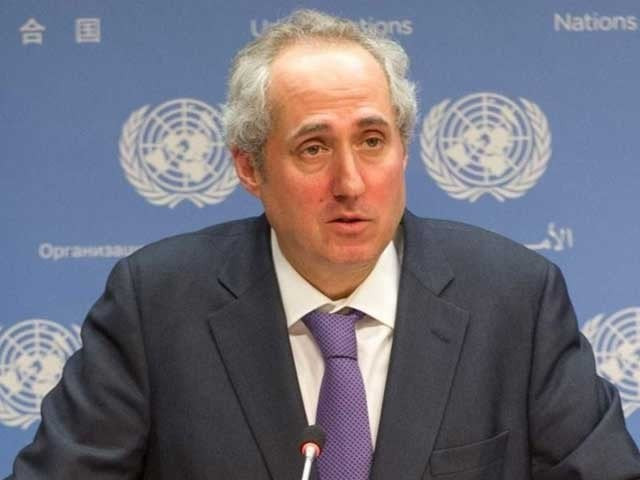
Spokesperson for the United Nations Secretary-General Stéphane Dujarric on Monday called on the United States and Iran to continue engaging constructively to reach an agreement, saying there was no military solution to the ongoing conflict in the Middle East.
In a statement, Dujarric said, “After weeks of destruction and distress, it is clear that there is no military solution to the current conflict in the Middle East.”
While no agreement was reached in Islamabad between the US and Iran, discussions themselves underscored the seriousness of their engagement. @antonioguterres calls on the talks to continue constructively for an agreement to be reached.
— UN Spokesperson (@UN_Spokesperson) April 13, 2026
Full statement: https://t.co/aQ3JCZqV1U
Referring to recent talks held in Islamabad that failed to yield any outcome, he said that although no agreement was reached between the US and Iran, the discussions underscored the seriousness of engagement and marked a positive step towards renewed dialogue.
Read: Trump says Iran reached out 'this morning', wants a deal
“Given the deeply rooted differences, an agreement cannot be reached overnight,” he said, adding that UN Secretary-General António Guterres had also called for continued constructive engagement.
He also thanked Pakistan for facilitating the dialogue process and urged continued efforts by mediators, while calling on Saudi Arabia, Egypt, Türkiye, and the broader international community to support such efforts.
The spokesperson also called for upholding the ceasefire, urging all parties to respect it. “The ceasefire must absolutely be preserved. All violations must cease,” he said.
Sharing the UN chief’s message, he said Guterres stressed that all parties must respect freedom of navigation, including in the Strait of Hormuz, in line with international law.
“We need to remember that some 20,000 seafarers have been caught up in this conflict and are currently stranded on ships, facing increasing hardships daily,” he said.
He added that disruptions to maritime trade through the Strait of Hormuz had already affected global economic stability, increasing fragility across sectors, and could further worsen food insecurity for vulnerable populations worldwide.
Read More: Trump warns of 'eliminating' Iranian ships as US naval blockade on Strait of Hormuz begins
The US and Iran failed to reach an agreement to end their war despite marathon talks that concluded on Sunday in Islamabad, jeopardising a fragile ceasefire. Each side blamed the other for the failure of the 21-hour negotiations to end fighting that has killed thousands and sent global oil prices soaring since it began over six weeks ago.
US Vice President JD Vance left Pakistan after announcing that intensive discussions with Iran had failed to reach an agreement, while appreciating Pakistan’s efforts.
“We had been at it for 21 hours and had held several substantive discussions with the Iranians. That was the good news. The bad news was that we had not reached an agreement, and I think that was bad news for Iran much more than it was for the United States of America,” he said while addressing a press conference in Islamabad.
On the other hand, Iran accused the United States of derailing talks in Islamabad after the two sides had come close to reaching an agreement. “We had engaged with the US in good faith to end the war,” Iranian Foreign Minister Abbas Araghchi said in a statement.
Following the failed talks, US President Donald Trump had thanked Pakistan for hosting talks between Washington and Tehran in Islamabad, while announcing that the US Navy would begin blockading the Strait of Hormuz after negotiations failed to produce a breakthrough.
Also Read: Dar meets Chinese ambassador to discuss developments following 'Islamabad Talks'
The US and Israel launched a joint offensive on Iran on February 28, killing thousands of people in Iran, including then-Supreme Leader Ayatollah Ali Khamenei and leaving tens of thousands injured, with civilian areas, including residential buildings and religious sites, among those hit.
The conflict also expanded geographically. Iran retaliated with drone and missile strikes targeting Israel as well as Jordan, Iraq, and Gulf countries hosting US military assets. It also restricted the movement of ships through the Strait of Hormuz.
To ease tensions, Pakistan had also hosted a quadrilateral foreign ministers' meeting in Islamabad, with representatives from Turkiye, Saudi Arabia, and Egypt. The meeting grabbed the world's attention and was widely appreciated for Pakistan's efforts.
Pakistan and China also jointly proposed a five-point initiative aimed at restoring peace and stability in the Gulf and the broader Middle East.











This material may not be published, broadcast, rewritten, redistributed or derived from. Unless otherwise stated, all content is copyrighted © 2026 The Express Tribune.






COMMENTS
Comments are moderated and generally will be posted if they are on-topic and not abusive.
For more information, please see our Comments FAQ