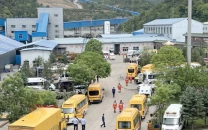
Ukrainian strike on college in Russian-occupied town kills 18
Updated 3 hours ago

Iran’s military says Gulf and Oman ports must be shared equally or closed to all users.
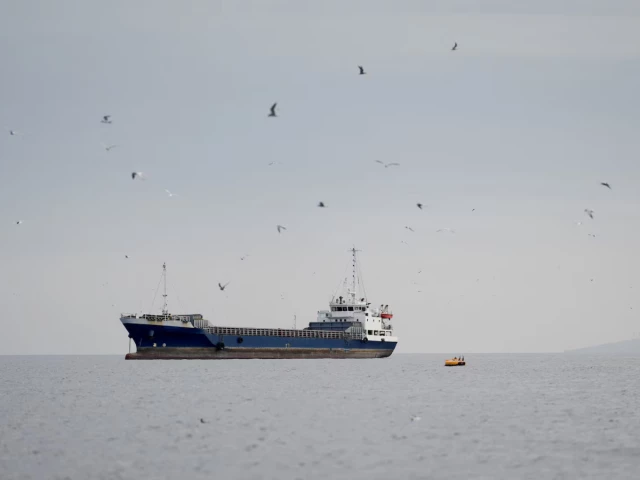
The United States Naval blockade begins in the Strait of Hormuz after the deadline of 7 pm (10 am ET). A blockade was imposed on all the ships entering or leaving Iranian ports.
After the deadline, Trump warned on the Truth Social platform about the blockade.
" If any of these ships come anywhere close to our blockade, they will be immediately eliminated," he wrote.
"Iran’s Navy is laying at the bottom of the sea, completely obliterated - 158 ships. What we have not hit are their small number of, what they call, “fast attack ships,” because we did not consider them much of a threat. Warning: If any of these ships come anywhere close to our blocked, they will be immediately eliminated, using the same system of kill that we use against the drug dealers on boats at Sea. It is quick and brutal. P.S. 98.2% of Drugs coming into the US by ocean or sea have stopped!" he said.
The Deal
On Monday, he said that he had been contacted by the right and appropriate people in Iran, and they want to work out a deal.
"We've been called this morning by the right people, the appropriate people, and they want to work a deal," said Trump during a news conference.
However, he reiterated that the United States would not agree to any deal unless Iran abandoned its pursuit of nuclear weapons.
President Trump on negotiations with Iran: "We've been called this morning by the right people, the appropriate people, and they want to work a deal." pic.twitter.com/wFGhnXi2hE
— TPUSA Rapid Response (@TPUSARapidRep) April 13, 2026
Trump said the "blockade" of ships transiting the Strait of Hormuz to and from Iranian ports had begun.
"Right now there's no fighting. Right now we have a blockade," he added.
He said Iran is doing "absolutely no business."
"And we're going to keep it that way very easily," he said.
Meanwhile, the unified command of the Iranian armed forces said the ports in the Arabian Gulf and the Sea of Oman are “either for everyone or for no one”, state broadcaster IRIB reported, according to Al Jazeera.
“The Armed Forces of the Islamic Republic of Iran consider defending the legal rights of our country a natural and legal duty, and accordingly, exercising the sovereignty of the Islamic Republic of Iran in the territorial waters of our country is the natural right of the Iranian nation,” IRIB cited Iran’s forces as stating.
Al Jazeera reported that the forces' statement read “Enemy-affiliated vessels” will have the right to pass through the Strait of Hormuz, while other vessels will be allowed passage, subject to regulations by Tehran.
“The criminal US’s imposition of restrictions on the movement of vessels in international waters is an illegal act and amounts to piracy.” If the security of the ports is threatened, no port in the region “will be safe”, the forces added, as per Al Jazeera.
Earlier, US President Donald Trump said he and his advisers were considering resuming limited military strikes on Iran, according to a Wall Street Journal report.
BREAKING: US President Donald Trump and his advisers are considering resuming limited military strikes on Iran, alongside the US blockade of the Strait of Hormuz, to break a stalemate in peace talks, Wall Street Journal reports. pic.twitter.com/EnrgFtEbOd
— Al Jazeera Breaking News (@AJENews) April 12, 2026
The Islamabad Talks 2026, which ran from Saturday into early Sunday, were the first direct US-Iranian meeting in more than a decade and the highest-level discussions since Iran's 1979 Islamic Revolution.
The negotiations came days after a ceasefire began on Tuesday, aimed at ending six weeks of fighting that has killed thousands of people across the Gulf, throttled vital supplies of energy and sparked fears of a wider regional conflict.
The US Central Command said that the US blockade, starting at 10am ET on Monday (7pm PKT), would be "enforced impartially against vessels of all nations entering or departing Iranian ports and coastal areas, including all Iranian ports on the Arabian Gulf and Gulf of Oman."
— U.S. Central Command (@CENTCOM) April 12, 2026
Vessels transiting the Strait of Hormuz to and from non-Iranian ports will not be impeded, the US military said. Additional information would be provided to commercial mariners through a formal notice before the start of the blockade, it said.
Trump said on Sunday that US forces would also intercept every vessel in international waters that had paid a toll to Iran.
"No one who pays an illegal toll will have safe passage on the high seas," Trump wrote on social media, adding: "Any Iranian who fires at us, or at peaceful vessels, will be BLOWN TO HELL!"
He added that the US Navy will begin destroying mines that the Iranians had dropped in the Strait of Hormuz, a choke point for about 20% of global energy supplies.
Also Read: Trump orders naval blockade of Hormuz
While shipping data showed three supertankers fully laden with oil passed through the Strait on Saturday, tankers were steering clear of the waterway on Monday, ahead of the US blockade.
Benchmark crude oil prices surged more than 7% to top $100 per barrel in Monday morning trade in Asia, while the dollar jumped and US stock futures fell following the blockade announcement.
"Trump wants a quick fix," said Dana Stroul, a former senior Pentagon official during the Biden administration now at The Washington Institute for Near East Policy. "The reality is, this mission is difficult to execute alone and likely unsustainable over the medium to long-term."
Hormuz situation points to need for international coalition, EU
The European Union's foreign policy chief Kaja Kallas has been speaking in a meeting of the United Nations' Security Council in New York.
She said the situation in the Strait of Hormuz is a clear point in favour of a "strong international coalition on maritime security."
She did not specify what such a coalition would do specifically, but added the European Union rejected any arrangement that would limit "the free and safe passage through the straits in accordance with the international law."
Waterways should not be bargaining chip, Qatar tells Iran
Qatar’s Foreign Minister Sheikh Mohammed bin Abdulrahman al-Thani has held a call with Iran’s Foreign Minister Abbas Araqchi, Qatar’s Foreign Ministry said in a post on X.
The ministry said the pair discussed ceasefire efforts, maritime security and freedom of navigation.
Qatar's foreign minister stressed the need to keep waterways open, saying they should not be used as a pressure tactic or bargaining chip.
He added that all parties needed to respond to current mediation efforts to end the war, the ministry added.
Iran says 'zero lessons learned'
After Trump's initial remarks on Sunday, Iran's Islamic Revolutionary Guards warned that military vessels approaching the strait will be considered a ceasefire breach and dealt with harshly and decisively, underlining the risk of a dangerous escalation.
A US official said Iran rejected Washington's call for an end to all uranium enrichment, the dismantling of all major enrichment facilities and the transfer of highly enriched uranium.
Iran also refused US demands that Iran cease funding for Hamas, Hezbollah and the Houthis, as well as fully open the Strait of Hormuz, the official added.
Iranian media said there was agreement on several issues, but the Strait and Iran's nuclear program were the main sticking points.
Iranian Foreign Minister Abbas Araghchi said Iran had "encountered maximalism, shifting goalposts, and blockade" when just inches away from an "Islamabad MoU."
"Zero lessons learned," he added. "Good will begets good will. Enmity begets enmity."
In intensive talks at highest level in 47 years, Iran engaged with U.S in good faith to end war.
— Seyed Abbas Araghchi (@araghchi) April 12, 2026
But when just inches away from "Islamabad MoU", we encountered maximalism, shifting goalposts, and blockade.
Zero lessons earned
Good will begets good will.
Enmity begets enmity.
Even if the ceasefire holds, many analysts expect it will take some time before energy flows through the Gulf return to normal, which will mean higher fuel prices and stronger inflation for the global economy.
Trump told Fox News' "Sunday Briefing" programme that oil and gasoline prices may remain high through November's midterm elections, a rare acknowledgement of the potential political fallout from the war.
Iran's Ghalibaf posted a map of Washington-area gasoline prices on social media with the comment: "Enjoy the current pump figures. With the so-called 'blockade'. Soon you'll be nostalgic for $4–$5 gas."
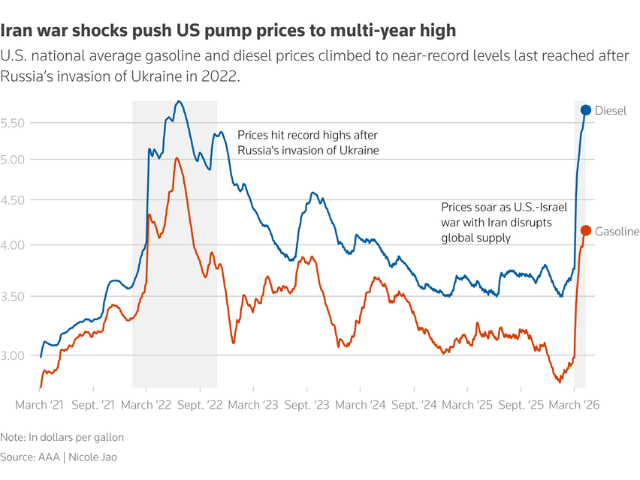
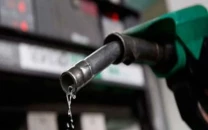
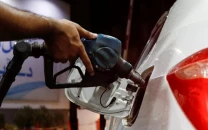
US fuel prices have surged sharply since the start of Iran war. PHOTO: REUTERS
More negotiations
Trump said he believed Iran would continue to negotiate and called the Islamabad discussions "very friendly."
"I do believe they're going to come to the table on this, because nobody can be so stupid as to say, ‘We want nuclear weapons,’ and they have no cards," he said.
But several hours later, the US president said he did not care whether a "desperate" Iran returned to the negotiating table.
"If they don't come back, I'm fine," Trump told journalists on Sunday night after he returned to the Washington area from an overnight stay in Florida.
Ghalibaf blamed the US for not winning Tehran's trust, despite his team offering "forward-looking initiatives," Iran's President Masoud Pezeshkian, who discussed the talks in a call with Russian President Vladimir Putin, said Tehran wanted "a balanced and fair agreement."
"If the United States returns to the framework of international law, reaching an agreement is not far off," he told Putin, Iranian state media reported.




This material may not be published, broadcast, rewritten, redistributed or derived from. Unless otherwise stated, all content is copyrighted © 2026 The Express Tribune.







COMMENTS
Comments are moderated and generally will be posted if they are on-topic and not abusive.
For more information, please see our Comments FAQ